
The most powerful AI tools in networking are transforming how businesses manage modern infrastructure in 2026. Enterprise networks now handle cloud computing, remote teams, edge devices, and massive data traffic every second. Because of this growing complexity, companies rely heavily on AI network automation and AI-powered network management to improve performance and reduce downtime. Advanced platforms now provide AI-assisted root cause analysis, predictive monitoring, and intelligent traffic optimization in real time.
Tools powered by network telemetry analytics and enterprise network automation also help engineers automate repetitive tasks and strengthen cybersecurity. As networks continue expanding rapidly, AI-driven solutions are becoming essential for faster operations, smarter troubleshooting, and highly scalable infrastructure management across modern digital environments.
| Key AI Networking Benefit | Business Impact |
| Faster troubleshooting | Reduced downtime |
| Predictive analytics | Prevents outages |
| AI security monitoring | Improves compliance |
| Automation workflows | Saves engineering time |
| Smart traffic optimization | Better application performance |
What Are AI-Powered Network Automation Tools?
AI networking platforms combine machine learning, automation engines, telemetry analytics, and predictive intelligence into one operational layer. These platforms observe network behavior continuously. Then they identify unusual traffic patterns, failed devices, or security anomalies before users even notice disruptions. This process powers modern AI-driven NetOps environments where engineers manage thousands of devices efficiently. Technologies like intent-based networking, network telemetry analytics, and AI-assisted root cause analysis now form the backbone of enterprise networking.
Unlike older monitoring tools, modern systems actively recommend solutions. Some tools even execute automated fixes without human input. Platforms such as Cisco AI Canvas, Forward AI networking, and Selector AI platform create intelligent workflows that simplify operations across multi-cloud infrastructure.
Businesses increasingly rely on multi-vendor network automation because modern environments contain Cisco, Juniper, Arista, VMware, and cloud-native platforms simultaneously. AI removes the friction between these disconnected systems.
“The future network will diagnose and heal itself before users notice problems.” — Enterprise Infrastructure Research Group
| Traditional Networking | AI Networking |
| Manual troubleshooting | Automated remediation |
| Static monitoring | Predictive analytics |
| Reactive operations | Proactive optimization |
| Limited visibility | Full-stack observability |
| Human-only workflows | AI-assisted operations |
Why Network Engineers Need AI Tools in 2026
Network environments now resemble sprawling digital cities. Remote work, SaaS applications, cloud migration, IoT devices, and edge computing increased operational complexity dramatically. Engineers often manage hybrid infrastructure spanning multiple clouds and data centers simultaneously. Because of that pressure, AI network troubleshooting tools have become operational necessities rather than luxury add-ons. AI platforms reduce repetitive work while improving accuracy during critical incidents.
The cybersecurity landscape also changed rapidly. Attackers now use automation and AI to launch advanced threats. Consequently, engineers need systems capable of identifying abnormal behavior instantly.
Solutions like Arista AVA, CloudVision AI operations, and SD-WAN AI management continuously inspect traffic patterns and user behavior. Modern enterprises also rely heavily on enterprise network automation and cloud network orchestration to maintain uptime while scaling infrastructure quickly.
| Major Challenge in 2026 | AI-Based Solution |
| Hybrid cloud complexity | Intelligent orchestration |
| Security threats | AI anomaly detection |
| Staffing shortages | Conversational AI assistants |
| Slow troubleshooting | Predictive diagnostics |
| Manual configuration errors | Automated remediation |
Key Features to Look for in AI Network Automation Tools
The strongest networking platforms combine visibility, automation, security, and intelligent recommendations into a single operational framework. A powerful network observability platform should provide real-time telemetry, anomaly detection, topology mapping, and traffic analytics. Engineers also need intelligent alert reduction because thousands of notifications can overwhelm operational teams during incidents. AI platforms filter noise intelligently and prioritize critical events.
Modern enterprises also demand compatibility across diverse environments. Platforms supporting multi-vendor network automation help businesses avoid vendor lock-in while improving operational flexibility. Tools like Itential FlowAI, NAPALM network automation, and Netmiko Python automation excel in cross-platform deployments.
Strong AI networking tools should also support network configuration automation, security validation, compliance reporting, and conversational interfaces that simplify engineering tasks for junior administrators.
| Essential Feature | Why It Matters |
| Predictive analytics | Prevents outages |
| AI automation | Reduces manual work |
| Security visibility | Stops threats early |
| Natural language queries | Easier operations |
| Cross-platform support | Better scalability |
Top 10 AI Network Automation Tools (Tier-Wise Ranking)
The best AI networking tools combine operational intelligence with automation depth. Some specialize in observability while others focus heavily on AI co-pilot capabilities. In 2026, enterprises prioritize platforms capable of reducing operational costs while improving uptime. Vendors also compete heavily in AI-driven automation because businesses demand faster deployment cycles.
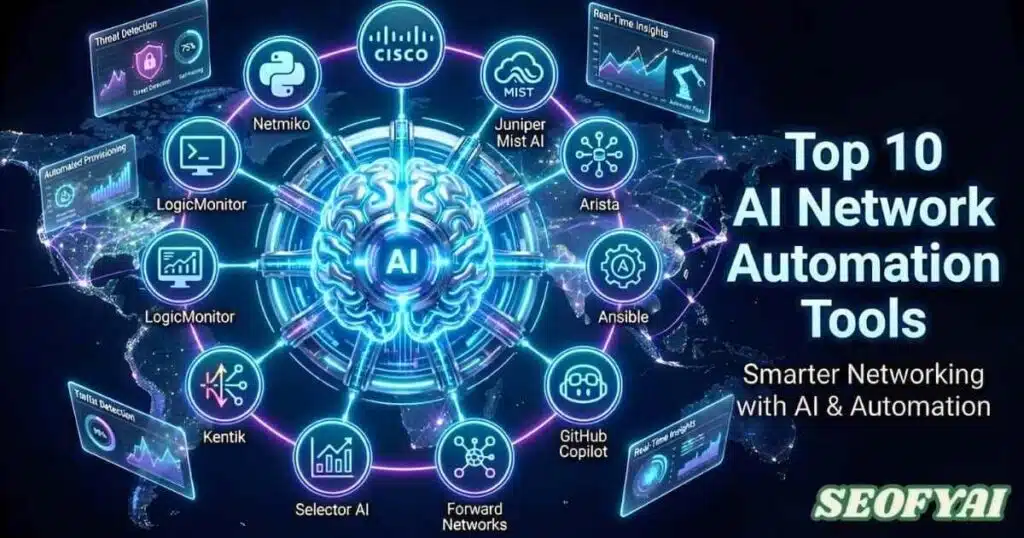
Several tools stand out due to scalability, intelligent automation, and ecosystem maturity. Products like GitHub Copilot for Ansible, Ansible Lightspeed, and Claude Code network automation help engineers accelerate scripting and infrastructure provisioning workflows.
Meanwhile, observability-focused platforms such as IP Fabric network assurance and Kentik AI Advisor provide deep infrastructure insights across cloud and on-premise environments.
| Tier | Tool | Primary Strength |
| S | Cisco AI Assistant | AI co-pilot networking |
| S | Juniper Marvis AI | Wireless AI operations |
| S | IBM Watson AIOps | Predictive enterprise operations |
| A | Palo Alto AIOps | Security intelligence |
| A | SolarWinds AI Ops | Network observability |
| A | NetBrain | Dynamic automation |
| B | Selector AI platform | Event correlation |
| B | Forward AI networking | Digital twin validation |
| B | Itential FlowAI | Workflow orchestration |
| B | Arista AVA | AI operations analytics |
Tier S: AI-Native Network Co-Pilots (Best Overall)
The highest-tier AI networking tools function almost like senior engineers working beside operational teams. Cisco AI Assistant stands at the front because it combines automation, telemetry analysis, troubleshooting intelligence, and conversational workflows into one environment. Engineers can describe issues using plain English while the system generates actionable recommendations instantly.
Combined with Cisco CML MCP server, engineers can simulate infrastructure safely before deployment.Another industry leader is Juniper Marvis AI. This platform transformed wireless networking through predictive automation and proactive troubleshooting. It constantly analyzes user experience metrics to identify hidden performance issues.
Enterprises using AI-powered network management platforms like Marvis often reduce support tickets significantly. These systems also improve operational consistency across large campuses and branch offices.
| Tier S Tool | Best Use Case |
| Cisco AI Assistant | Enterprise automation |
| Juniper Marvis AI | Wireless networking |
| IBM Watson AIOps | Hybrid infrastructure |
Tier A: Category Leaders and Enterprise Solutions
Tier A solutions dominate specific networking categories. They may not offer fully autonomous operations like Tier S tools yet they remain critical inside enterprise infrastructure. CloudVision AI operations from Arista provides exceptional visibility and analytics for cloud-scale environments.
Similarly, Palo Alto Networks AIOps excels in AI-driven cybersecurity and firewall optimization.Platforms such as NetBrain and SolarWinds AI Ops simplify operational workflows dramatically. Engineers use them for topology visualization, automated diagnostics, and AI network validation.
Businesses managing large infrastructures also benefit from network digital twin technology offered by platforms like Forward AI networking. Digital twins allow teams to test policies safely before applying changes to production environments.
| Tier A Tool | Main Capability |
| Palo Alto AIOps | Security automation |
| SolarWinds AI Ops | Root cause analytics |
| NetBrain | Automated troubleshooting |
| CloudVision AI operations | Cloud-scale observability |
Tier B: Specialized and Emerging AI Tools
Emerging AI networking tools continue reshaping operations rapidly. Many smaller vendors innovate faster because they focus heavily on niche operational problems. Selector AI platform specializes in intelligent event correlation and noise reduction.
This dramatically improves incident management during large outages where thousands of alerts overwhelm engineering teams.Automation-focused tools like ContainerLab automation, NAPALM network automation, and pyATS testing framework help engineers create repeatable workflows quickly.
These solutions also support modern DevNetOps strategies where infrastructure behaves like software. Teams increasingly combine these platforms with AI-powered network labs for testing automation scripts safely before deployment into production networks.
| Emerging Tool | Specialization |
| Selector AI platform | Event intelligence |
| Itential FlowAI | Workflow automation |
| ContainerLab automation | Lab simulation |
| pyATS testing framework | Automated testing |
How AI Network Tools Work Together (The Complete Toolchain)
Modern networking no longer relies on one standalone platform. Instead, enterprises build connected ecosystems combining observability, automation, AI analytics, and security monitoring. A typical workflow begins with AI network monitoring tools detecting anomalies across infrastructure. Then observability systems perform AI-assisted root cause analysis while orchestration engines apply remediation automatically.
For example, an enterprise may combine Kentik AI Advisor for observability, Ansible Lightspeed for automation, and Forward AI networking for policy validation. Together these tools create a highly resilient operational pipeline.
This interconnected architecture defines the future of agentic AI networking where intelligent systems collaborate autonomously across operational domains.
Detection → Analysis → Validation → Automation → Compliance
| AI Workflow Stage | Tool Example |
| Monitoring | Kentik AI Advisor |
| Automation | Ansible Lightspeed |
| Validation | Forward AI networking |
| Simulation | Cisco CML MCP server |
| Orchestration | Itential FlowAI |
Choosing the Right AI Network Tool for Your Needs
Choosing the correct platform depends heavily on organizational size, operational maturity, and infrastructure complexity. Small businesses usually prefer simplified systems with lower deployment costs. Enterprises managing thousands of devices require advanced observability, automation, and compliance features. Organizations heavily invested in Cisco ecosystems naturally benefit from Cisco AI Assistant while cloud-native businesses may prefer CloudVision AI operations.
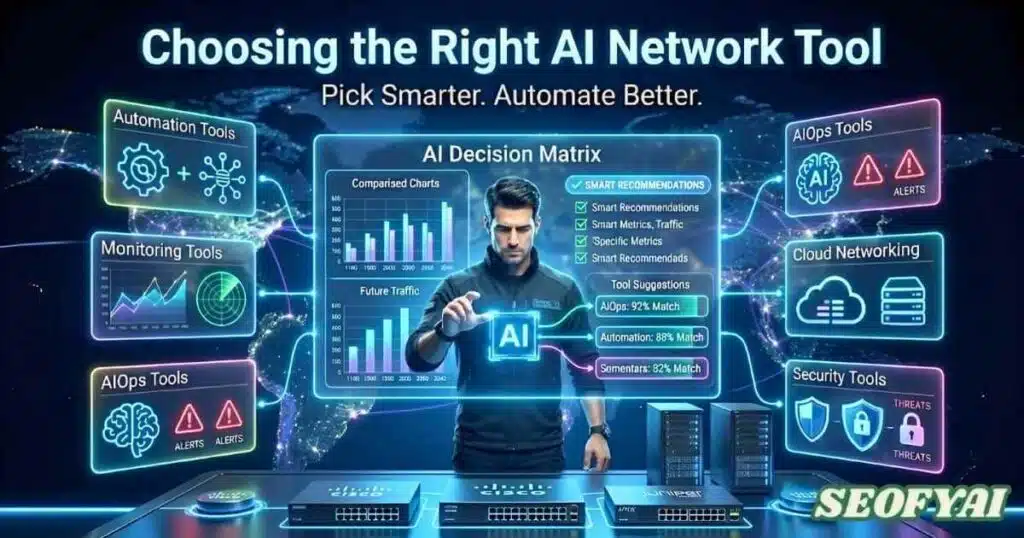
Operational goals also matter enormously. Teams focused on automation may prioritize Netmiko Python automation or GitHub Copilot for Ansible.
Meanwhile, organizations prioritizing compliance and validation often adopt IP Fabric network assurance and network digital twin technologies. Businesses should also evaluate vendor integration support carefully because disconnected tools create operational silos quickly.
| Business Need | Recommended Solution |
| Automation scripting | GitHub Copilot for Ansible |
| Wireless AI management | Juniper Marvis AI |
| Security-focused operations | Palo Alto AIOps |
| Validation and assurance | IP Fabric network assurance |
Future of AI in Network Engineering (2026 and Beyond)
The future of networking revolves around autonomous operations. Engineers increasingly supervise intelligent systems instead of performing repetitive manual tasks. AI models already generate configurations, optimize traffic paths, and validate compliance automatically.
Over time, conversational network operations will become standard across enterprise environments. Engineers will interact with infrastructure almost like speaking with a human assistant.Another major trend involves AI infrastructure management powered by predictive intelligence and digital twins.
Enterprises now explore agentic AI networking where AI systems coordinate across observability, security, automation, and orchestration platforms independently. This evolution will reshape how businesses build resilient infrastructure for cloud computing, AI workloads, and edge networking over the next decade.
“Networks are evolving from managed systems into intelligent autonomous ecosystems.”
| Future AI Trend | Expected Impact |
| Autonomous remediation | Faster recovery |
| Conversational AI operations | Simplified management |
| Digital twins | Safer deployments |
| AI-driven observability | Better reliability |
| Intelligent orchestration | Reduced operational costs |
Conclusion
The most powerful AI tools in networking are changing how modern enterprises build, secure, and manage digital infrastructure. Businesses no longer depend only on manual troubleshooting because today’s networks require speed, automation, visibility, and predictive intelligence. As hybrid cloud environments continue expanding, the most powerful AI tools in networking help engineers reduce downtime, improve performance, and simplify large-scale operations with far greater accuracy.
Platforms powered by AI network automation, AI-powered network management, and AI-driven NetOps now handle tasks that once consumed entire engineering teams. Solutions like Cisco AI Assistant, Juniper Marvis AI, and Selector AI platform continue leading the industry because they combine observability, automation, security, and analytics into one intelligent ecosystem.
The most powerful AI tools in networking also improve operational efficiency through AI-assisted root cause analysis, network configuration automation, and real-time telemetry insights.
Frequently Asked Questions (FAQ)
Which AI tool is best for networking?
Juniper Mist AI and Cisco AI Assistant rank among the Top 10 most powerful AI tools in networking because they provide smart automation, predictive troubleshooting, and advanced network visibility for enterprises.
Which is the most powerful AI tool currently?
Many experts on Most powerful ai tools in networking reddit consider Cisco AI Assistant and NetPilot among the Best AI tools for network engineers due to their intelligent automation and AI-driven operations.
Which AI is best for network configuration?
For automated configuration and deployment, Juniper Mist AI, NetPilot, and Cisco AI Assistant are leading choices. Many engineers also test Networking AI tools free before large-scale deployment.
Who are the big 4 in AI?
The Big 4 in AI are usually Google, Microsoft, Amazon, and Meta because they lead global AI research, cloud infrastructure, and enterprise automation technologies.
Who are the big 7 in AI?
The Big 7 AI companies include Google, Microsoft, Amazon, Meta, NVIDIA, OpenAI, and Apple. Their innovations power many Best AI for networking questions and enterprise AI platforms worldwide.

Abdul Manan is a professional SEO content creator and AI-SEO strategist at seofyai.com. He specializes in helping businesses rank higher on Google through AI-powered, data-driven content optimization. Connect on LinkedIn or visit seofyai.com for expert SEO tips.