

Grok SEO Prompts For Beginners can make SEO research easier when you give the AI clear instructions and useful context. Instead of asking vague questions, you can provide a target keyword, audience, niche, country, search intent, and preferred output format. This approach helps you discover keyword ideas, organize content topics, improve on-page elements, and plan practical SEO workflows.
However, AI suggestions still need human judgment and verification. The goal isn’t to let Grok make every SEO decision. It’s to use well-written prompts as a research assistant while real search results, reliable data, and editorial expertise guide the final decision.
What is Grok AI and Why It’s Perfect for SEO Beginners
Search engines evolve rapidly. However, many beginners struggle with complex SEO tools. That’s where Grok AI becomes valuable. Developed by xAI, this AI system helps users create smart content strategies without advanced technical knowledge. Unlike traditional SEO software, Grok understands context, search intent, and semantic relationships naturally.
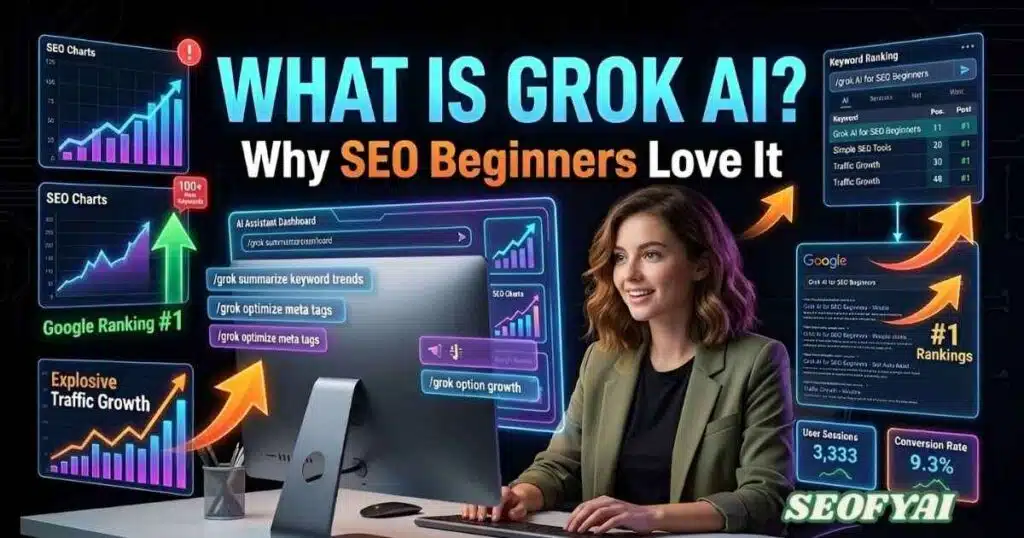
What Is Grok and How Can Beginners Use It for SEO?
Grok is an AI assistant that can support research, analysis, writing, and information-organizing tasks. For SEO beginners, its usefulness depends largely on the quality of the instructions you provide. You can ask it to analyze a topic, organize keyword ideas, identify content gaps, suggest headings, review existing copy, or create an SEO-focused workflow.
However, Grok shouldn’t become the final authority for SEO decisions. AI can produce plausible information that still needs verification. Use it to accelerate research and organize ideas, then confirm important claims with search results, reliable datasets, official documentation, and human editorial judgment.
How to Write Effective Grok SEO Prompts
A strong SEO prompt gives Grok enough information to understand the task. Include the role, website context, target audience, keyword, objective, output format, and any restrictions. For example, asking for “keywords about coffee” produces a broad response. Adding the target country, audience, website type, and search intent creates a much more focused research task.
A useful formula is Role + Context + Task + Data + Output + Restrictions. You can also tell Grok what not to do. For example, request that it avoid invented search volumes, clearly label assumptions, separate informational and commercial intent, and flag claims that require verification. These small instructions often make the final response more practical.
Grok SEO Prompts For Beginners for Keyword Research
Keyword research becomes more useful when you organize keywords by purpose rather than collecting the largest possible list. Grok SEO Prompts For Beginners can help discover seed terms, long-tail variations, related questions, commercial phrases, and different search-intent groups. Give Grok your niche, target audience, location, and primary topic before requesting keyword ideas.
Don’t treat AI-generated search volume or keyword difficulty as verified data. Instead, ask Grok to classify and organize potential keywords while using an appropriate SEO platform to validate demand and competition. This creates a cleaner workflow where AI handles organization and human research confirms the commercial opportunity.
Keyword Discovery Prompts
Start with broad seed terms before moving toward specific queries. Ask Grok to generate related topics based on customer problems, products, services, questions, comparisons, and buying situations. This approach often uncovers useful angles that a simple seed-keyword list misses.
Long-Tail Keyword Prompts
Long-tail queries usually contain more context than broad phrases. Ask Grok to create variations around specific problems, audiences, locations, use cases, and product attributes. Then group those terms by similar intent so multiple near-identical keywords don’t become separate articles unnecessarily.
Search Intent Prompts
Search intent tells you what the user is trying to accomplish. Ask Grok to classify queries as informational, commercial, transactional, or navigational and explain the reasoning briefly. Compare those classifications with the current SERP because search results provide stronger evidence of how a query behaves.
Keyword Clustering Prompts
Keyword clustering helps combine closely related queries into logical content groups. Ask Grok to cluster terms according to shared intent and topic relevance rather than simply matching similar words. This can help you decide when one comprehensive page should target several related queries.
How Grok Ranking Actually Works
Grok doesn’t rank pages the way traditional search engines do; it reads meaning, context, and trust signals through large language model search systems. It scans structured data and authority signals to gauge intent, so ranking factors for Grok favor clarity and accuracy over keyword density. Content that feeds AI recommendation systems well earns a spot in the answer; content that doesn’t simply disappears from the conversation entirely.
Key Features to Look for in a Grok Rank Tracker
The best Grok rank tracker should surface citation frequency, prompt-level visibility, and share-of-voice data side by side, not buried across three different dashboards. Look for content optimization for LLMs built into the platform itself, since structured content for AI is what determines whether Grok pulls your page into a response or skips it for a competitor with cleaner formatting.
A tool that tracks these signals in real time gives you the fastest path to fixing gaps before a competitor claims the citation first.
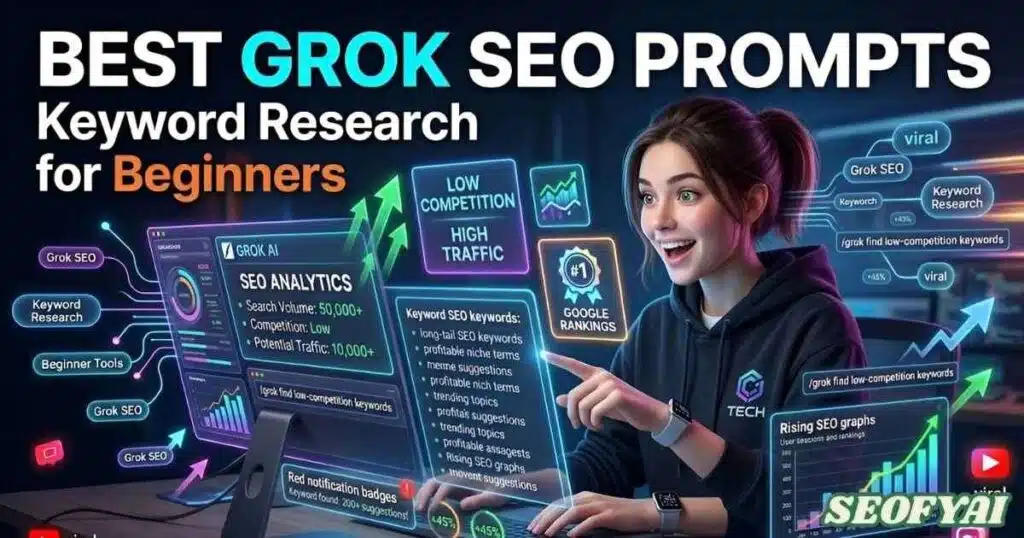
Many SEO professionals now combine prompts for keyword research, AI for research, and Data Analysis techniques to identify ranking gaps quickly. Grok can also organize keywords into topical clusters. This strategy improves internal linking structure and strengthens semantic SEO signals across an entire website.
Grok SEO Prompts For Beginners for Content Creation
Content prompts should focus on solving reader problems rather than producing maximum word count. Ask Grok to create content briefs, topic clusters, article outlines, FAQs, examples, comparison points, and missing-subtopic suggestions. Include the audience’s knowledge level so the resulting structure matches the reader instead of sounding like generic AI copy.
Before drafting, give Grok the article’s purpose and the information that must remain accurate. After drafting, use another prompt to identify unsupported claims, repeated ideas, weak explanations, and unanswered questions. Human editing should then add original insight, practical experience, examples, and trustworthy evidence.
Content Brief Prompts
A strong brief should identify the target audience, primary topic, search intent, key questions, proposed structure, supporting entities, and information gaps. Ask Grok to explain why each major section belongs in the article. That reasoning helps prevent unnecessary headings that exist only to increase word count.
Blog Outline Prompts
Ask for an outline based on the user’s journey rather than competitor headings alone. A good structure should move logically from the main problem toward explanation, examples, practical steps, and supporting details. Avoid copying a competitor’s exact heading sequence because it adds little originality.
Content Refresh Prompts
Give Grok an existing article and ask it to identify outdated claims, weak sections, missing questions, duplicated ideas, and areas needing stronger evidence. Don’t ask it to rewrite everything automatically. Targeted updates usually preserve useful information while removing obsolete or low-value material.
Real-Life Example: Using Grok for an SEO Workflow
Consider a small gardening website targeting “indoor herb garden.” First, Grok can generate related questions and classify them by search intent. Next, it can group relevant topics around herb selection, lighting, watering, containers, and common problems. The writer can then build a content brief from the strongest topics.
After drafting, Grok can review the article for missing questions and internal-link opportunities. The writer should then compare the ideas with actual search results, verify factual claims, add original expertise, and edit the final copy. This workflow shows where AI helps most: research organization and analysis, not blind content production.
Grok SEO Prompts For Beginners for Link Building
Link-building prompts are most useful for prospect research, outreach preparation, digital PR ideas, and linkable asset planning. Ask Grok to identify relevant publication types, suggest useful resources worth promoting, or personalize outreach using information you provide. Never ask it to fabricate relationships, testimonials, statistics, or reasons for contacting a publication.
A useful prompt can turn an original study into several outreach angles for journalists or industry websites. Another can analyze the information you provide about a prospect and create a concise outreach draft. Every prospect and personalization detail should be checked before sending.
Grok SEO Prompts For Beginners for Local SEO
Local SEO prompts should include the actual service, location, customer type, and business context. Ask Grok to generate local content ideas, service-page structures, customer questions, review-response drafts, and location-specific topic clusters. Avoid producing dozens of near-identical location pages because changing only the city name rarely creates genuinely useful content.
For example, a plumbing company can use Grok to organize topics around emergency repairs, blocked drains, water pressure, maintenance, and local service questions. The business should then add real service details, operating information, customer concerns, and locally relevant expertise. That makes the content more useful than generic location-page templates.
Grok SEO Prompts For Beginners for E-commerce SEO
E-commerce prompts should reflect the buyer’s journey. Ask Grok to improve product titles, category descriptions, product FAQs, comparison content, commercial search-intent groups, and internal-link opportunities. Provide real product specifications and customer information so the output doesn’t fill missing details with assumptions.
For example, a product prompt can ask Grok to describe benefits only from supplied specifications. This reduces the risk of invented features or unsupported claims. Product information should always be checked against current manufacturer or merchant data before publication.
Grok Prompts for Content Repurposing
Content repurposing can turn one well-researched article into several useful formats. Give Grok a completed article and ask it to create a newsletter outline, social post, video script, FAQ section, or editorial-calendar idea. Tell it to preserve factual accuracy and avoid introducing information that doesn’t appear in the source material.
The goal isn’t to publish the same paragraph everywhere. Instead, extract different useful angles for different audiences and formats. One detailed tutorial might become a short checklist, a newsletter explanation, and a video outline without becoming repetitive.
| Technical SEO Area | Prompt Example |
| Schema Markup | “Generate FAQ schema for this article” |
| Site Speed | “Suggest ways to improve mobile speed” |
| Crawlability | “Check indexing issues for blog pages” |
Common SEO Mistakes Beginners Make With Grok
The biggest mistake is assuming confident AI output must be accurate. Grok can produce unsupported statistics, outdated information, incorrect technical advice, or citations that require verification. Other common mistakes include publishing raw AI drafts, stuffing keywords, creating thin pages at scale, and copying competitor structures too closely.
Add quality-control instructions to your prompts. Ask Grok to identify uncertainty, avoid invented data, distinguish facts from assumptions, and flag information requiring external verification. Then review the output yourself. Human editing adds judgment that an automated response cannot reliably provide.
Download Free Grok SEO Prompts Bundle (200+ Templates)
A structured prompt library saves time and improves workflow consistency. Beginners can use categorized templates for keyword research, content writing, local SEO, technical optimization, and link building campaigns. These systems reduce manual effort while improving output quality.
The best prompt collections also include examples of AI prompts, best prompts for AI chatbots, and advanced workflows for prompts for automation, prompts for developers, prompts for students, and prompts for customer support. This flexibility allows marketers to scale SEO operations efficiently across multiple industries.
Conclusion
Grok SEO Prompts For Beginners are most useful when they support a clear SEO workflow rather than replace research or editorial judgment. Use them to explore keywords, classify intent, build content briefs, improve pages, organize internal links, and generate practical content ideas. Then validate important information with trustworthy sources and real website data.
The strongest results come from specificity. Give Grok the right context, define the expected output, challenge weak assumptions, and edit every important result before publishing. With that approach, the prompts become practical SEO tools instead of another collection of generic AI commands.
Frequently Asked Questions
What are Grok SEO Prompts For Beginners?
Grok SEO prompts are structured instructions that help beginners use Grok for SEO-related research and content tasks.
Can beginners use Grok for SEO?
Yes. Beginners can use Grok to organize research, explore topics, review content, and create repeatable SEO workflows.
Can Grok help with keyword research?
Grok can generate keyword ideas, organize related terms, classify search intent, and identify common questions around a topic.
Can Grok replace SEO tools?
Grok can complement SEO tools but shouldn’t automatically replace platforms that provide specialized datasets
Should Grok’s SEO recommendations be fact-checked?
Yes. Verify important statistics, technical recommendations, citations, and current SEO claims before publishing or implementing them.

Abdul Manan is a professional SEO content creator and AI-SEO strategist at seofyai.com. He specializes in helping businesses rank higher on Google through AI-powered, data-driven content optimization. Connect on LinkedIn or visit seofyai.com for expert SEO tips.