

How to track brand mentions in Gemini AI has become one of the most important questions for marketers, SEO professionals, and business owners in 2026. As Google Gemini continues transforming search, brands can no longer rely only on traditional rankings to measure online success. Today, users increasingly depend on AI-generated responses to discover products, services, and trusted companies.
This shift makes AI visibility tracking essential for understanding how often your brand appears in AI recommendations. By monitoring mentions, citations, and sentiment across Generative AI search, businesses can strengthen their online presence, improve authority, and gain a competitive advantage in the rapidly evolving world of AI-powered search.
How to Track Brand Mentions in Gemini — And Why It Matters
Brand mentions in Gemini AI refer to how often Google’s AI-powered search engine recommends your business, products, or services inside its generated responses. When someone searches for the best CRM software, top marketing tools, or trusted service providers, Gemini doesn’t show ten blue links — it delivers a direct, conversational answer that names specific brands.
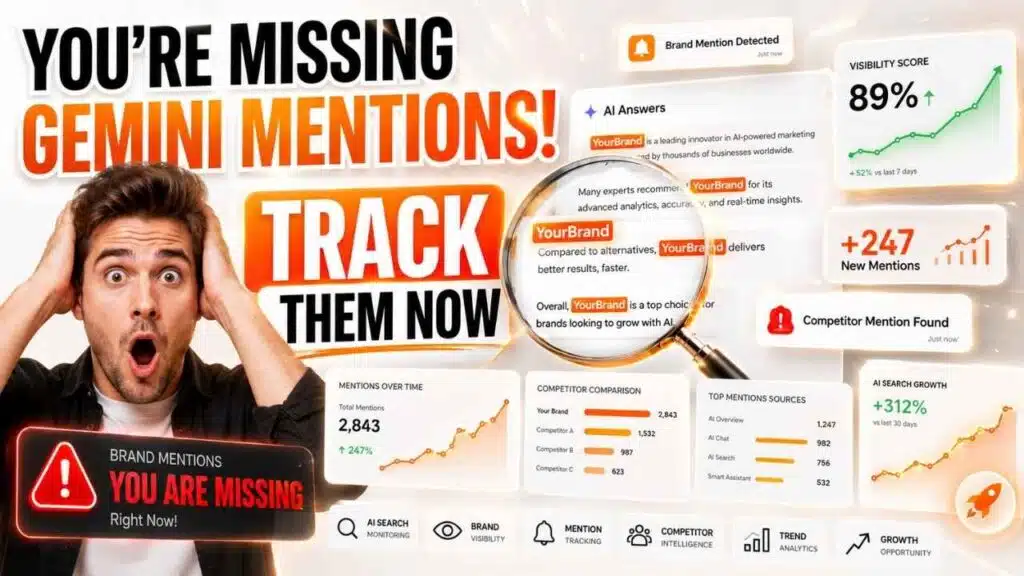
Understanding how to track brand mentions in Gemini starts with knowing how the system works. Gemini builds its responses by analyzing multiple signals:
- User intent — what the searcher actually needs
- Source credibility — how authoritative your content is
- Knowledge retrieval — what structured data Gemini can find about your brand
- Contextual relevance — how well your brand matches the query
This is fundamentally different from traditional SEO. You’re not competing for a position on page one — you’re competing to be named inside an AI-generated answer.
The stakes are high. Users increasingly trust AI recommendations during research and purchase decisions. If Gemini mentions your competitor but not you, that’s lost traffic, lost trust, and lost revenue — often without you even knowing it. Businesses that actively monitor their Gemini brand visibility gain a measurable edge in AI search optimization, digital brand presence, and long-term brand positioning in an AI-first search landscape.
Traditional Search vs Gemini Visibility
| Factor | Traditional Search | Gemini Visibility |
| Focus | Rankings | Mentions |
| User Experience | Link clicking | Direct answers |
| Measurement | Position tracking | AI visibility metrics |
| Traffic Source | Organic visits | AI-assisted discovery |
| Optimization | SEO | AI answer engine optimization (AEO) and Generative Engine Optimization (GEO) |
How Google Gemini Decides Which Brands to Mention
At its core, Gemini AI evaluates enormous amounts of information using advanced Large language models (LLMs). These models analyze patterns, relationships, authority signals, and relevance across the web. Gemini does not simply choose brands with the highest rankings. Instead, it looks for indicators that suggest expertise, reliability, and trustworthiness.
Strong Content authority, accurate information, positive brand signals, and widespread recognition often influence which organizations receive mentions. This process makes Entity recognition increasingly important because AI systems understand brands as entities connected to topics, industries, and user needs.
Another important factor involves source credibility. Gemini frequently favors content supported by Trustworthy sources, industry publications, research reports, expert commentary, and reputable websites. A brand consistently referenced across respected platforms develops stronger authority signals within the AI ecosystem.
This explains why many businesses invest heavily in public relations, expert content creation, and thought leadership initiatives. These activities contribute to stronger Brand authority signals, increased Search visibility, and improved performance within AI search engines.
Major Signals That Influence Gemini Brand Mentions
| Signal | Why It Matters |
| Content Quality | Helps establish expertise |
| Entity Recognition | Improves topic association |
| Brand Reputation | Increases trust |
| Citations Across Websites | Expands authority |
| User Relevance | Matches search intent |
| Industry Mentions | Strengthens credibility |
| Expert Content | Supports authority building |
Why Traditional Rank Trackers Miss Your Gemini Presence
Most SEO tools were designed during a different era of search. Their primary purpose was measuring rankings across search engine result pages. While rankings remain important, they fail to capture visibility within AI-generated conversations. A website might rank well for competitive keywords while remaining completely absent from Gemini responses.
This limitation creates significant blind spots for marketers attempting to understand modern search performance. Traditional tools often miss the broader reality of Conversational search and evolving user behaviors.
The rise of AI-generated content, AI-generated responses, and conversational interfaces means businesses need new measurement frameworks. Instead of focusing exclusively on positions, organizations must track how often their brand appears in AI conversations, recommendation lists, comparison queries, and purchasing discussions.
This new reality has accelerated demand for AI response tracking, AI content monitoring, and advanced LLM monitoring systems. Companies that ignore these developments risk losing visibility even while maintaining strong rankings.
“In the age of AI search, being mentioned may become as valuable as being ranked.”
Example Visibility Gap
| Scenario | Traditional SEO Result | Gemini Result |
| Brand A | Ranks #1 | Rarely Mentioned |
| Brand B | Ranks #7 | Frequently Mentioned |
| Brand C | Ranks #12 | Recommended by AI |
| Brand D | Not Ranking | Appears in Niche Responses |
The Real Impact of Gemini Brand Mentions on Your Traffic & SEO
Brand mentions inside Google Gemini influence far more than visibility alone. They shape trust, awareness, consideration, and purchase decisions throughout the AI-driven customer journey. When users repeatedly encounter a brand inside AI-generated recommendations, they often perceive that company as an authority within its field.
This phenomenon strengthens Brand perception and influences decision-making before users ever visit a website. As a result, AI mentions increasingly contribute to lead generation, customer acquisition, and long-term business growth.
The impact extends beyond direct traffic. Consistent mentions improve Online brand perception, increase awareness, and strengthen authority across multiple touchpoints. Brands frequently referenced by AI systems often experience stronger engagement rates, better conversion performance, and enhanced visibility across digital channels.
Furthermore, as AI search trends continue reshaping online discovery, businesses that invest in AI search citations, AI visibility metrics, and ongoing Brand reputation monitoring position themselves ahead of competitors who remain focused solely on conventional SEO measurements.
Case Study Example
A software company tracked its visibility across fifty industry-related Gemini prompts over six months. Although organic traffic remained relatively stable, the brand’s appearance rate within AI-generated recommendations increased from 12% to 48%. During the same period, branded search volume rose significantly.
Customer surveys revealed that many prospects first discovered the company through AI-generated recommendations rather than traditional search results. This example demonstrates how AI search rankings, AI citations, and AI narrative management increasingly influence modern marketing performance.
Key Benefits of Strong Gemini Visibility
| Benefit | Business Impact |
| More Brand Mentions | Increased awareness |
| Better Authority | Greater trust |
| Improved Discoverability | More opportunities |
| Higher Engagement | Better conversion rates |
| Stronger Reputation | Competitive advantage |
| Wider Reach | Enhanced market presence |
As the search landscape evolves, organizations must understand that visibility no longer depends exclusively on rankings. The combination of Artificial Intelligence, Generative AI, advanced Knowledge retrieval systems, and conversational experiences has created a new environment where mentions matter as much as positions.
Businesses that embrace AI visibility tracking, Brand mention analysis, and AI sentiment analysis will be better equipped to thrive in the rapidly expanding AI search ecosystem.
The Biggest Challenges in Tracking Gemini Brand Mentions
Tracking mentions inside Google Gemini sounds simple at first. However, the reality is much more complex. Unlike traditional search engines that display relatively stable rankings, Gemini AI generates dynamic responses that can change based on user context, search history, location, device type, and prompt wording. A brand may appear prominently for one user while remaining absent for another.
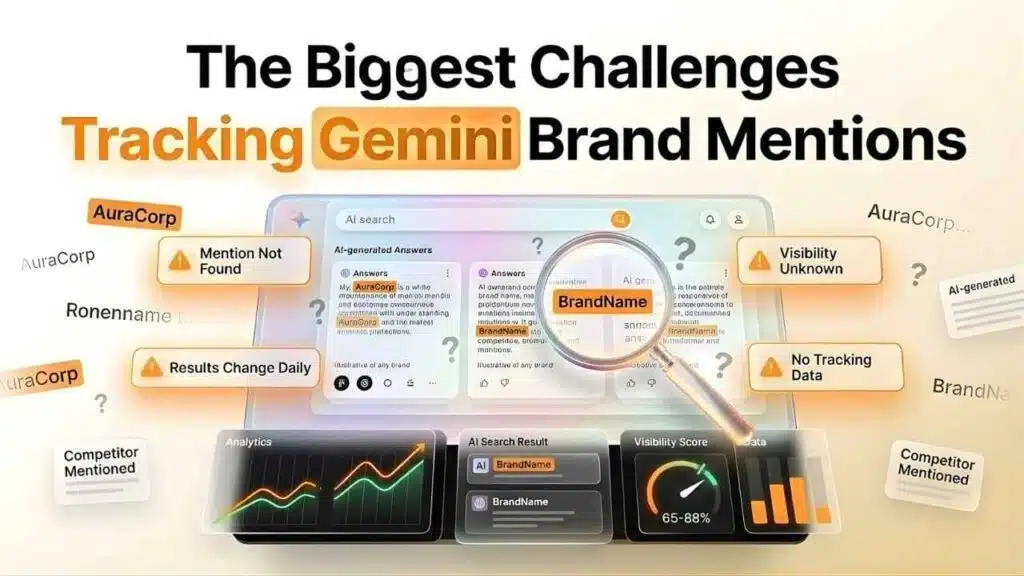
This variability makes AI brand monitoring significantly more challenging than conventional SEO tracking. Companies must account for numerous variables before drawing conclusions from their visibility data.
Another major obstacle comes from the rapid evolution of Generative AI search. Models continuously improve their understanding of language, entities, and relationships. A small change in query wording can generate an entirely different response. This makes Brand mention analysis far more difficult than tracking keyword rankings. Businesses must also consider changing citation sources, emerging competitors, and shifting user expectations.
Effective AI content monitoring requires continuous observation rather than occasional audits. Organizations that fail to monitor consistently often miss important changes in their Digital brand presence across the expanding AI search ecosystem.
Common Gemini Tracking Challenges
| Challenge | Impact on Tracking |
| Dynamic Responses | Results change frequently |
| Personalized Outputs | Different users see different answers |
| Location Variations | Mentions differ by region |
| Prompt Variations | Small wording changes affect results |
| Source Changes | Citations evolve over time |
| Competitor Movement | Visibility shifts quickly |
| Model Updates | AI behavior changes regularly |
The challenge becomes even greater when brands operate nationally or globally. Monitoring a single prompt is no longer enough. Modern businesses need systems capable of handling AI response tracking, AI sentiment analysis, competitor monitoring, and ongoing visibility measurement across multiple categories. This growing complexity explains why advanced tracking solutions are becoming essential components of modern marketing strategies.
Key Metrics to Measure Your Gemini Visibility
Success within Google Gemini requires more than counting mentions. Businesses need comprehensive measurement frameworks that capture the full picture of their AI presence. One of the most important metrics is mention frequency. This measures how often a brand appears across selected prompts.
Frequent appearances usually indicate stronger relevance and authority within specific topics. However, frequency alone does not tell the complete story. Organizations must also evaluate sentiment, context, citation quality, and competitor performance.
Another critical metric involves share of voice. Within the world of AI visibility tracking, share of voice measures how often a brand appears compared to competitors across similar prompts. This helps businesses understand their relative position inside the AI landscape.
Additional metrics such as AI visibility metrics, citation quality, response placement, and prompt coverage provide deeper insights into overall performance. Together, these indicators create a reliable framework for evaluating success in modern AI search engines.
Essential Gemini Visibility Metrics
| Metric | Purpose |
| Mention Frequency | Tracks brand appearances |
| Share of Voice | Compares competitors |
| Citation Sources | Identifies trusted references |
| Sentiment Score | Measures response tone |
| Prompt Coverage | Evaluates visibility breadth |
| Geographic Visibility | Tracks regional performance |
| Competitor Mentions | Benchmarks market position |
Measuring Sentiment in AI Responses
Businesses should also evaluate the tone of mentions through AI sentiment scoring. Positive references strengthen trust. Neutral references maintain awareness. Negative references may indicate reputation concerns.
When combined with Brand reputation monitoring, sentiment tracking provides valuable insight into how AI systems present a company to potential customers. This process supports stronger AI narrative management and helps organizations protect their online reputation.
How to Track Your Brand Mentions in Google Gemini (Step-by-Step)
Successful tracking begins with identifying the most important prompts within your industry. Companies should focus on informational, commercial, transactional, and local-intent searches that customers frequently use. These prompts form the foundation of a structured monitoring strategy.
Instead of relying on a few generic searches, businesses should create a diverse prompt library that reflects actual customer behavior. This approach aligns closely with User intent analysis and improves visibility measurement accuracy.
After establishing target prompts, businesses should conduct regular searches using consistent formats. Every response should be documented carefully. Record whether the brand appears, where it appears, how competitors are mentioned, and which sources Gemini references.
Over time, these observations reveal patterns that support better decision-making. Consistency remains essential because meaningful trends emerge only through long-term observation.
Step-by-Step Gemini Tracking Process
| Step | Action |
| 1 | Identify important keywords |
| 2 | Build a prompt library |
| 3 | Track competitors |
| 4 | Record Gemini responses |
| 5 | Monitor citations |
| 6 | Analyze trends |
| 7 | Measure sentiment |
| 8 | Create monthly reports |
Example Prompt Categories
| Prompt Type | Example |
| Informational | Best CRM software for startups |
| Commercial | Top marketing agencies in Chicago |
| Local | Best dentists near me |
| Comparison | HubSpot vs Salesforce |
| Industry Expert | Leading cybersecurity consultants |
As businesses gather more data, they can begin identifying opportunities for AI search optimization, stronger Content authority, and improved AI content discoverability. Over time, this structured approach transforms visibility tracking from guesswork into a reliable strategic process. Organizations that implement systematic monitoring often discover new opportunities to strengthen Brand positioning and improve performance within AI-powered search engines.
Location-Aware Gemini Tracking: Why It Changes Everything
Location plays a larger role in Gemini AI responses than many marketers realize. A search performed in New York may produce different recommendations than the same query performed in Dallas, Miami, or Los Angeles. Gemini often adapts responses based on regional preferences, local businesses, geographic relevance, and location-specific context. This behavior makes location-aware monitoring a critical component of modern AI visibility tracking strategies.
For local businesses, location-based tracking is especially important. Law firms, medical practices, restaurants, contractors, and service providers often experience dramatic visibility differences across regions. A business that dominates local AI recommendations in one city may have little visibility elsewhere.
Tracking regional performance helps organizations identify opportunities for growth and improve local authority signals. This process strengthens Search visibility while supporting more effective Generative search optimization efforts.
Impact of Location on Gemini Responses
| Factor | Effect |
| User Location | Changes recommendations |
| Local Businesses | Prioritized when relevant |
| Regional Trends | Influence responses |
| Nearby Services | Gain visibility |
| Geographic Relevance | Affects rankings and mentions |
Building a Geographic Tracking Framework
Organizations operating across multiple locations should develop region-specific monitoring systems. Each region should have its own prompt set, competitor benchmarks, and reporting process. This allows businesses to understand how AI-generated responses vary across markets. Combined with Competitive intelligence, geographic tracking reveals valuable insights that would otherwise remain hidden.
A national retailer, for example, may discover strong visibility in California but weak representation in Texas. These findings can guide content development, local partnerships, citation building, and authority-building efforts.
As Search behavior evolution continues reshaping discovery patterns, location-aware tracking becomes increasingly important for maintaining strong visibility within the expanding world of Artificial Intelligence and Generative AI search.
Top Tools for Google Gemini Brand Visibility Tracking
Tracking brand mentions in Google Gemini requires advanced tools that go beyond traditional SEO software. Businesses need platforms capable of AI response tracking, monitoring AI citations, analyzing sentiment, and observing competitor movements. Tools that specialize in AI visibility tracking help measure Brand authority signals, track AI content discoverability, and generate actionable insights about performance within Generative AI search.
Popular tools include AI-powered search engines that integrate LLM monitoring, enterprise-level AI brand monitoring, and software offering AI search trends analysis. Some platforms provide dashboards displaying AI visibility metrics, Brand perception, and Digital brand presence across multiple prompts. A carefully selected toolset ensures businesses maintain a complete understanding of their visibility, citation sources, and impact on the AI search ecosystem.
| Tool Type | Best For | Key Features |
| AI Visibility Platforms | AI mention tracking | Prompt monitoring, sentiment analysis, share of voice |
| Brand Monitoring Software | Reputation tracking | Citation discovery, AI narrative management, alert systems |
| Enterprise AI Platforms | Large brands | Multi-location tracking, AI-driven customer journey insights |
| SEO Platforms with AI Modules | SEO + AI insights | Keyword + Gemini visibility, AI answer engine optimization (AEO) reporting |
How to Build a Gemini Monitoring System for Your Brand
A robust Gemini monitoring system begins with clear objectives. Companies must define the types of mentions that matter most, from product references to service endorsements. Then, identify key prompts aligned with customer queries and industry trends. These prompts form the foundation for AI brand monitoring, AI content monitoring, and consistent AI response tracking.
Next, create a workflow that includes scheduled searches, documentation of results, sentiment scoring, and trend analysis. Reports should combine AI visibility metrics, competitor comparisons, and source analysis to guide actionable strategies.
Assigning team members to manage prompt updates, monitor citations, and measure Brand perception ensures the system operates efficiently. Over time, the system evolves, integrating AI search optimization strategies and strengthening Content authority across the AI search ecosystem.
| Step | Action |
| 1 | Define visibility goals |
| 2 | Identify key prompts and queries |
| 3 | Track competitors and sources |
| 4 | Collect AI-generated responses regularly |
| 5 | Analyze sentiment, frequency, and placement |
| 6 | Generate monthly reports |
| 7 | Adjust strategies based on insights |
| 8 | Integrate with overall SEO and marketing workflow |
How to Improve Your Brand’s Visibility in Gemini AI Results
Improving visibility requires a multi-pronged approach. Brands must build strong Entity recognition, consistent AI citations, and authoritative content optimized for AI-powered search engines. Publishing high-quality, trustworthy content improves AI content discoverability, while digital PR, guest contributions, and mentions on authoritative platforms reinforce Brand authority signals.
Additionally, local optimization, structured data, and prompt-targeted content improve AI search optimization. Tracking progress through AI sentiment scoring and monitoring AI search trends allows companies to adjust strategies in real time.
By investing in AI-driven customer journey insights, Generative search optimization, and AI answer engine optimization (AEO), brands can steadily increase their presence, strengthen Brand perception, and maintain relevance in an evolving AI search ecosystem.
| Strategy | Key Focus |
| Content Quality | Trustworthy, relevant, prompt-aligned |
| Citation Building | Increase mentions from authoritative sources |
| Local Optimization | Regional visibility for location-specific queries |
| Structured Data | Improve Knowledge retrieval by AI |
| Digital PR | Media coverage for AI narrative management |
| Continuous Monitoring | Adjust based on AI visibility metrics |
Future Trends in Gemini Brand Tracking for 2026 and Beyond
The future of AI search suggests an even greater emphasis on mentions rather than traditional rankings. Large language models (LLMs) will become smarter at understanding brand context, user intent, and content relevance.
AI will increasingly consider sentiment, trustworthiness, and Brand positioning. Companies will need to integrate AI search citations, AI content monitoring, and AI narrative management into every stage of digital marketing.
Additionally, location-aware tracking, competitive intelligence, and predictive AI-driven customer journey analysis will become standard. Businesses that invest in Generative Engine Optimization (GEO), continuous Brand reputation monitoring, and AI content discoverability strategies will dominate the AI search ecosystem.
Understanding the evolution of Search behavior evolution and leveraging AI tools to track Brand perception will separate leaders from laggards in the coming years.
Conclusion
Understanding how to track brand mentions in Gemini AI is now a critical part of modern digital marketing. As Google Gemini and other AI-powered search engines continue reshaping how users discover information, businesses must look beyond traditional rankings and focus on visibility within AI-generated responses. By implementing effective AI brand monitoring, tracking key AI visibility metrics, and improving your presence through Generative AI search optimization, you can gain valuable insights into how AI platforms perceive and recommend your brand.
Companies that consistently monitor, measure, and strengthen their AI visibility will be better positioned to increase authority, improve trust, and stay competitive in the rapidly evolving AI search landscape.
Frequently Asked Questions (FAQ)
How to track AI brand mentions?
Use tools like Brand24, Mention.com, or Google Alerts to monitor when AI platforms and web sources reference your brand.
How to track media mentions?
Set up Google Alerts with your brand name or use Meltwater, Brand24, or BuzzSumo for real-time media tracking.
How to get references from Gemini?
Publish authoritative, well-structured content that Gemini can cite — focus on E-E-A-T, schema markup, and being referenced on trusted sites.
Does Gemini track what you say?
Yes, Google may store your Gemini conversations to improve its AI unless you manually turn off activity tracking in your Google Account settings.
What to never ask Google Assistant?
Never share passwords, banking details, or personal sensitive information — Google Assistant conversations can be recorded and reviewed by human reviewers.

Abdul Manan is a professional SEO content creator and AI-SEO strategist at seofyai.com. He specializes in helping businesses rank higher on Google through AI-powered, data-driven content optimization. Connect on LinkedIn or visit seofyai.com for expert SEO tips.