
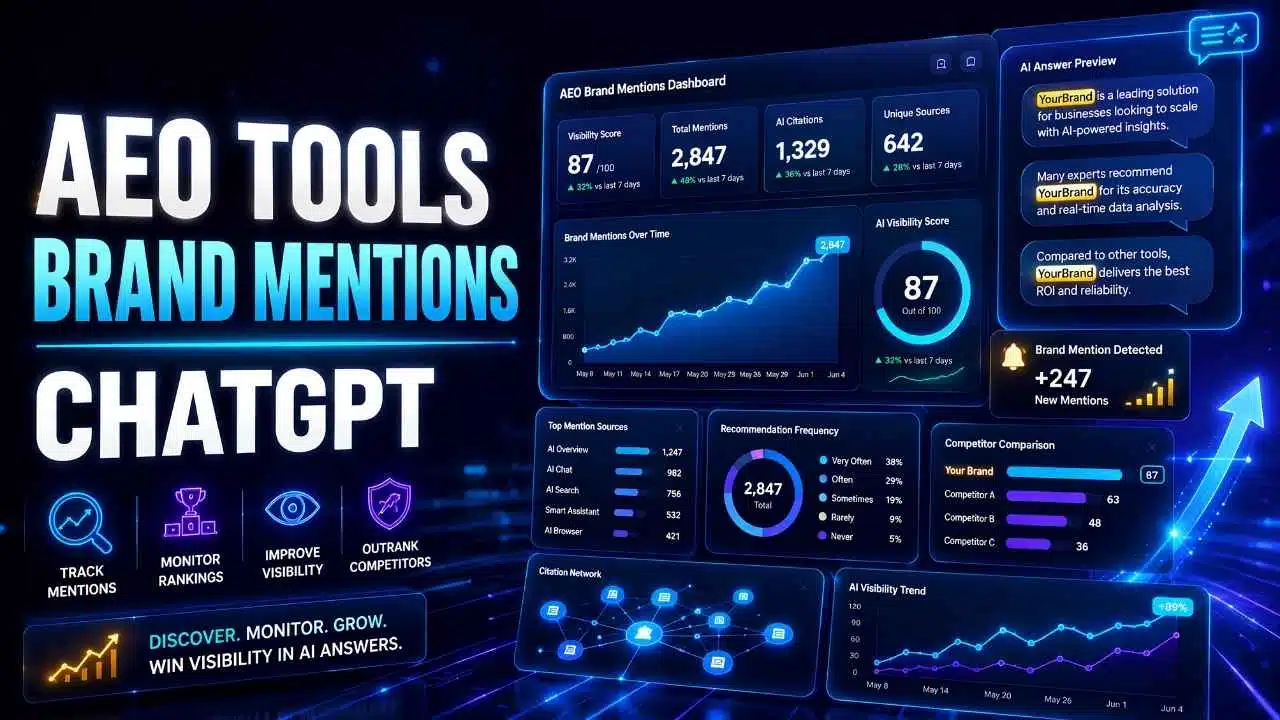
AEO tools brand mentions chatgpt answer a question traditional SEO tools cannot: when a buyer asks ChatGPT for a recommendation, does it name your brand, a competitor, or nobody at all? These platforms run your buyers’ real questions through ChatGPT on a schedule, recording mentioned and cited brands. For wider context, start with the ChatGPT brand mentions guide, then use this article to pick the right tracker.
What are AEO tools for ChatGPT brand mentions?
Answer Engine Optimization (AEO) is the work of making a brand easy for an AI system to understand, trust and recommend inside a generated answer. Traditional SEO competes for a position on a results page; AEO competes to be named inside the answer itself. Generative Engine Optimization (GEO) extends the idea across several AI platforms.
An AEO tool is a measurement tool, not a way to buy your way into answers. It tracks whether your brand appears, cited sources, and your share of mentions against competitors on the same prompts. Companies now monitor AI citation tracking and share of voice together, because appearing in 40 of 100 buying questions while your rival appears in 65 tells you exactly where the gap is.
Why can’t you track ChatGPT brand mentions by hand?
Manual checking fails on scale. The same question worded five ways can return five different shortlists, and answers shift with phrasing, location and model updates. A team checking ten prompts weekly misses the prompt families driving buying decisions: comparisons (“HubSpot vs Salesforce”), budget questions (“affordable CRM for a small team”) and local questions (“best dentist near me”). There is also a competitor blind spot: your brand can look healthy alone while a rival owns the prompts asked right before purchase.
How do AEO tools for brand mentions in ChatGPT actually work?
Most platforms follow four steps. First, build a prompt set from real buyer language — sales calls, support tickets, search queries. Second, run those prompts against ChatGPT on a schedule. Third, parse each answer for mentions, cited sources, position and sentiment. Fourth, trend results over weeks rather than reacting to one odd answer.
One correction to the old version: vendors do not all use “official APIs” — some use browser-like sessions, others API access — and no reputable tool can read private chat histories. They analyse public model outputs for prompts they run. Treat a single answer as noise and the cluster trend as the signal.
What features matter most when comparing AEO tools?
- Prompt coverage: enough prompts, grouped into clusters, for your category.
- Citation-level data: the exact pages cited, so you know what to fix.
- Share of voice: your mentions against named competitors on the same prompts.
- Sentiment: whether the model describes you positively or raises an objection.
- History and alerts: stored answers you can re-read, plus alerts on sharp drops.
- Exports: CSV or API access if the data must reach your reporting.
A nine-engine tool is wasted money if your team checks one dashboard monthly.
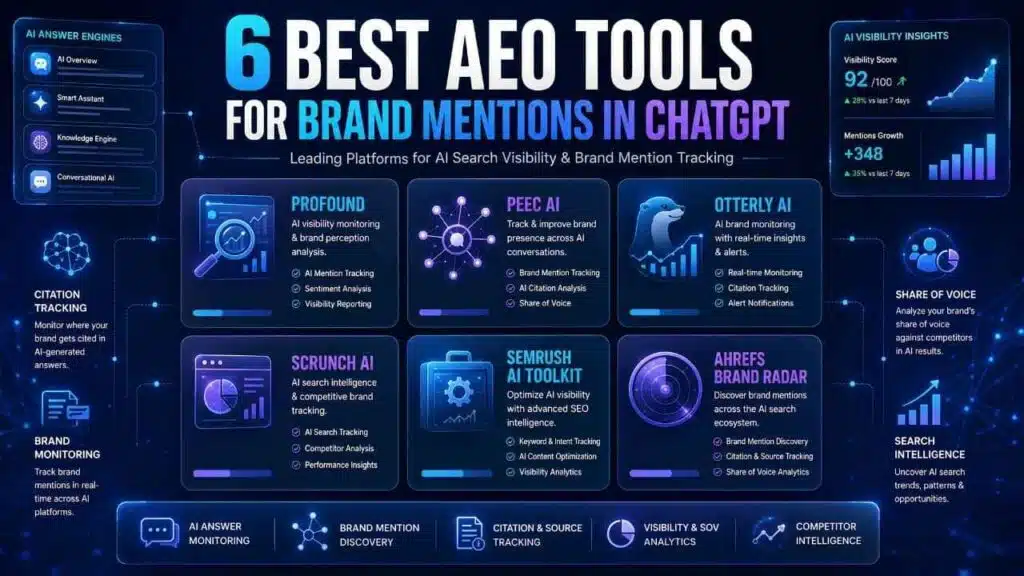
7 AEO tools brand mentions chatgpt, compared
The table below replaces the old version’s subjective “Excellent / Good” ratings, which had no methodology. Entry prices are from October 2026 roundups — confirm them with the vendor.
| Tool | Positioned for | Entry pricing reported, Oct 2026 | Watch out for |
|---|---|---|---|
| Profound | Enterprise | About $99/month, ChatGPT-only; enterprise custom | Multi-engine coverage needs a higher tier |
| Peec AI | Small teams, agencies | About $95/month, 50 prompts | Extra engines are paid add-ons |
| Goodie AI | Attribution and actions | Reported from about $295/month | Entry price varies across roundups |
| Scrunch AI | Agencies, mid-market | About $250–$300/month | Advanced features sit on higher tiers |
| Rankscale | Budget multi-engine | Credit-based, from about $20/month | Costs scale with usage |
| Otterly AI | Small teams on a budget | About $29/month, 15 prompts | Gemini and Claude are add-ons |
| Hall | Startups, simple reporting | No widely published entry price found | Ask for written pricing and a trial |
Profound
Profound is the enterprise reference point: deep citation analysis, share-of-voice tracking, prompt-volume data from real user conversations, and AI-crawler analytics. Roundups list Starter around $99 a month for ChatGPT-only tracking, though others describe brand plans as custom-priced — verify on its pricing page.
Peec AI
Peec AI, based in Berlin, tracks visibility, position, sentiment and share of voice daily, with source reports and gap analysis showing sources naming competitors but not you. Starter is about $95 a month (€89) for 50 prompts, three engines and unlimited users. It is monitoring-first: it will not write your content fixes.
Goodie AI
Goodie AI pairs monitoring with revenue attribution and optimisation actions, connecting AI visibility to outcomes rather than stopping at a dashboard. That suits brands with existing traffic. Entry pricing is reported around $295–$399 a month, so confirm allowances in a trial. Organisations new to Answer Engine Optimization often find its action lists easier to follow.
Scrunch AI
Scrunch AI is built for agencies and mid-market teams: multi-client reporting, citation tracking, AI crawler and agent-traffic analytics, and a platform for serving structured content to AI crawlers. Starter pricing is reported around $250–$300 a month. It was acquired by Sitecore in 2026.
Rankscale
Rankscale prices by credits, with entry plans reported from about $20 a month and Pro around $99 a month, covering a broad engine list (17 or more claimed). Costs are harder to forecast — model credit burn on your real prompt list in the trial.
Otterly AI
Otterly AI is the budget entry point: Lite around $29 a month for 15 prompts across ChatGPT, Google AI Overviews, Perplexity and Copilot, with a coverage-vs-prominence index. Gemini and Claude are add-ons. Fifteen prompts will not cover a category, but they set a baseline for deciding on deeper tracking.
Hall
Hall targets startups needing straightforward reporting on ChatGPT brand mentions and competitor performance without enterprise complexity. No widely published entry price was found for Hall in October 2026 roundups: request written pricing and a trial, and compare its allowance with Otterly AI and Rankscale.
How to turn ChatGPT mention data into more mentions
Data alone changes nothing. The loop is: measure, read cited sources, fix one gap, re-measure. Run a two-to-four-week baseline first. Find clusters where competitors appear and you do not, and open the cited pages — those are the format to beat. Strengthen your own pages with a direct answer, exact figures and comparison tables. Earn mentions where the model already looks: review sites and comparison articles dominating citations. Re-check a month later and keep only changes that moved the trend.
Common mistakes to avoid when tracking ChatGPT brand mentions
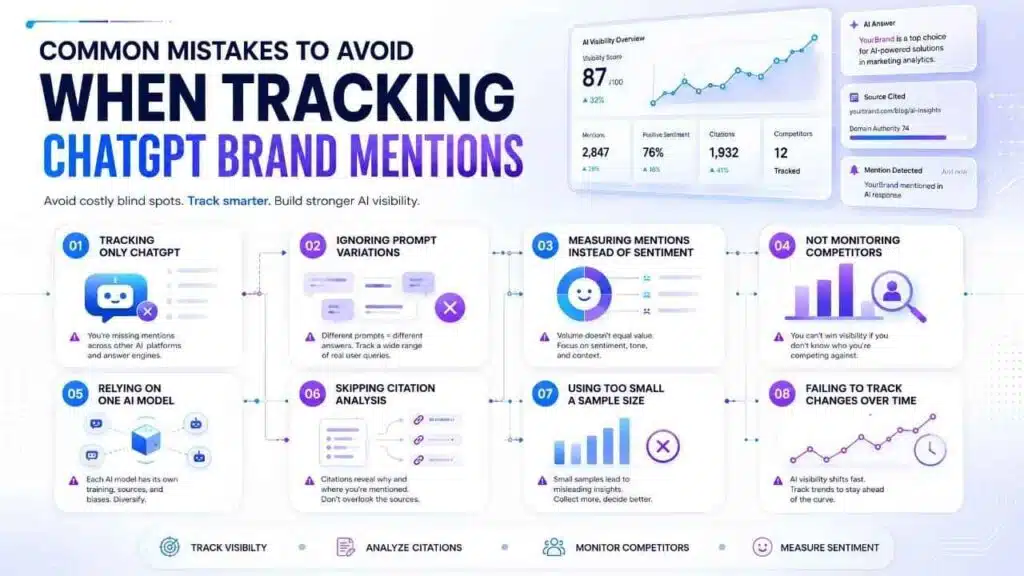
The most common error is measuring only rankings: a page can rank first on Google and still never be named by ChatGPT, which also draws on reviews and forums. The second is ignoring competitor share of voice. The third is tracking ChatGPT alone when buyers also use Gemini or Perplexity. The fourth is acting without history: one week’s swing is usually noise.
Frequently Asked Questions (FAQ)
How do AEO tools track ChatGPT brand mentions?
They run prompts you define against ChatGPT on a schedule, then scan each answer for your brand, competitors and cited sources. Results are logged with sentiment and position, so you can track mention frequency and share of voice over time rather than relying on one-off manual checks.
Can AEO tools increase my ChatGPT recommendations?
No tool can force ChatGPT to recommend you. These tools show which prompts you lose, which sources get cited instead, and where competitors win. Acting on that evidence — better pages, stronger citations, earned mentions on trusted sources — is what gradually improves recommendations over months.
Do Semrush or Ahrefs track ChatGPT mentions?
Yes — this corrects the old version of this article, which said they did not. Semrush’s AI Visibility Toolkit tracks brand mentions across ChatGPT, Google AI, Gemini and Perplexity for about $99 a month per domain with 25 prompts. Ahrefs Brand Radar tracks AI mentions and citations, with its AI Visibility Index from about $199 a month per platform.
How do AEO tools measure brand sentiment?
They use language analysis to classify each mention as positive, neutral or negative, and flag framing such as price objections or outdated features. Sentiment is directional, not precise: read the stored answer behind any negative spike before responding, since one qualified mention can skew a small sample.
Are ChatGPT brand-mention trackers compliant with privacy rules?
They do not read your private chats. They analyse the model’s public outputs for prompts they run themselves, and methods vary by vendor — some use browser-like sessions, others API access. Ask any vendor how it collects data and where it stores answers before running branded prompts at scale.
Conclusion
ChatGPT is now where shortlists are formed. AEO tools brand mentions chatgpt make that shortlist visible: which prompts name you, which cite rivals, and which sources the model trusts. Pick the tool matching your prompt volume and engine mix — start with a baseline, fix one cluster at a time, and judge progress over months.

Abdul Manan is a professional SEO content creator and AI-SEO strategist at seofyai.com. He specializes in helping businesses rank higher on Google through AI-powered, data-driven content optimization. Connect on LinkedIn or visit seofyai.com for expert SEO tips.