

How AI search optimization tools increase organic traffic is through three jobs done faster than manual SEO: finding the questions people actually ask, showing where a page falls short of the pages already ranking, and tracking whether fixes change anything. They do not replace judgement. A tool can flag a missing subtopic or a broken page; it cannot decide whether that subtopic deserves your voice, your data, or your time.
Results are no longer a simple list of ten links: Google’s AI Overviews, ChatGPT, and Perplexity now answer many questions before a visitor clicks. Clear, quotable pages stand a better chance of being cited there as well as ranking classically. This guide explains how AI search optimization tools work, which real tools fit which job, what they cost, and how to tell whether they earn their subscription.
What Are AI Search Optimization Tools?
An AI search optimization tool uses machine learning and natural language processing to analyse search results, your content, and competitors’ content, then recommend concrete changes. Traditional SEO software mainly reported data: rankings, backlinks, crawl errors. AI tools add interpretation — grouping keywords by intent, scoring topical coverage against top-ranking pages, and flagging technical problems in priority order.
One subscription rarely covers every job: keyword tools decide what to publish, content-scoring tools such as Surfer SEO and Clearscope improve what exists, and crawlers and analytics check site health. Most teams combine a research platform with one content tool, plus free Search Console and GA4.
How AI Search Optimization Tools Increase Organic Traffic
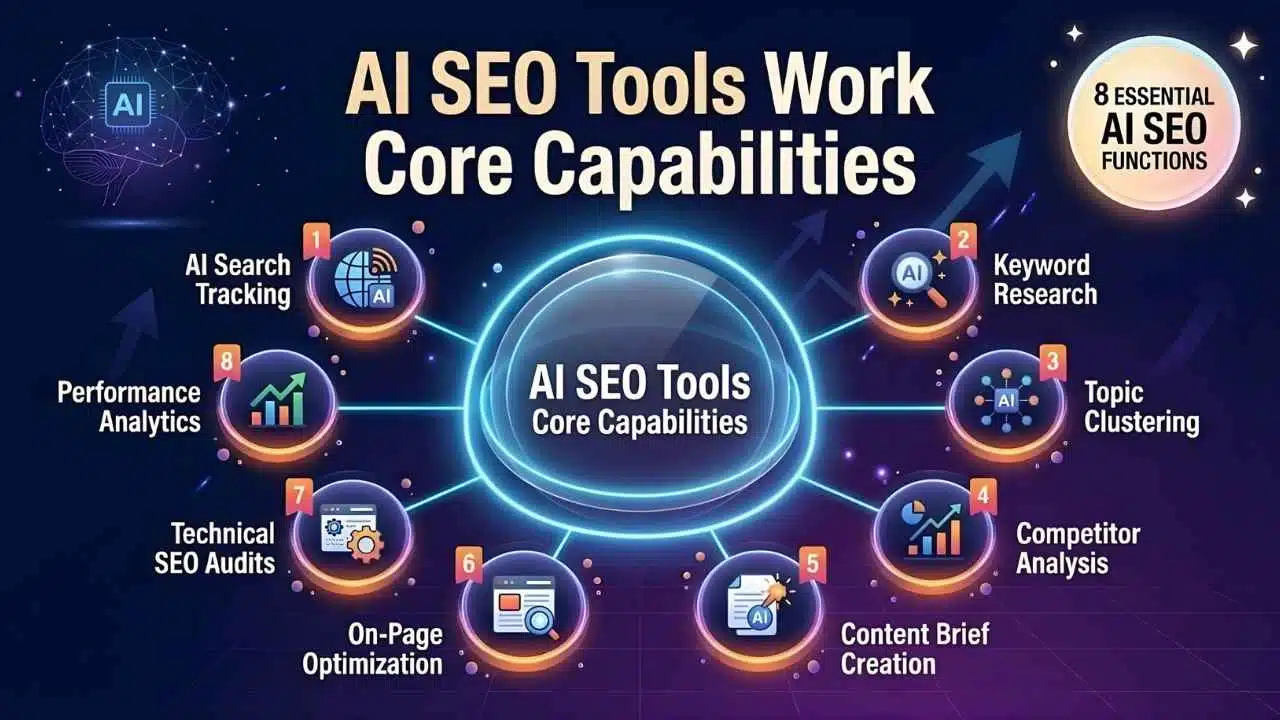
Traffic grows through a few mechanisms. AI tools widen coverage by clustering related queries, raise relevance by comparing your draft with pages Google already rewards, protect existing traffic by catching broken links early, and shorten the feedback loop: when a page slips, rank tracking shows it within days.
| AI capability | What it does | Traffic effect |
|---|---|---|
| Keyword and intent research | Groups queries by searcher intent | New pages matching real demand |
| Content optimization | Scores coverage and structure | Stronger rankings for existing pages |
| Technical SEO automation | Finds crawl and speed problems | Fewer lost rankings from site faults |
| AI visibility tracking | Checks mentions in AI answers | Visibility beyond classic blue links |
How Do AI Tools Match Content to Search Intent?
Search intent is the job behind the query: “Best CRM for startups” is comparison research, “CRM pricing” is closer to buying, and “how to import contacts into HubSpot” is a task to complete. AI tools infer intent from the results themselves — the mix of guides, comparison pages, and product pages ranking for a query. If the top results are tutorials and your draft is a sales page, that mismatch caps your ranking. That is how AI search optimization tools increase organic traffic in practice.
What Should AI Content Optimization Actually Change?
Content tools work best as a checklist against the competition, not a writing target. A Surfer or Clearscope report shows which terms and subtopics top pages cover. Treat missing subtopics as prompts, not orders: if three top pages explain pricing tiers and yours does not, add one from your own knowledge. Illustratively, a small plant shop might add light, soil, and overwatering sections its guide skipped — a hypothetical workflow, not a measured result. That is how AI search optimization tools increase organic traffic for existing pages.

A direct answer in the first two sentences of a section, followed by detail, gives a reader a reason to stay and an AI system a passage to cite. Internal links then connect related pages, helping search engines understand the topic cluster.
Can AI Tools Fix Technical SEO Without an Expert?
They can find problems and rank them, not safely fix all of them. A crawler such as Screaming Frog, or the audit inside Semrush or Ahrefs, lists broken links, redirect chains, duplicate titles, and slow pages. Broken links are straightforward fixes; changing robots.txt or canonical tags without understanding the consequences can remove pages from the index.
What Is GEO, and How Does It Differ From SEO?
Generative engine optimization, or GEO, is making content citable inside AI-generated answers, not only rankable in classic results. The distinction is useful but often oversold. Google’s Search Central guide, published in May 2026, states that AI Overviews and AI Mode run on the same core ranking and quality systems as ordinary Search, with no extra technical requirements or special markup needed for eligibility. An indexed, crawlable, genuinely useful page is already eligible; an unindexed page cannot be cited at all.

That guidance debunks popular shortcuts: an llms.txt file gives no priority, and no special “AI schema” unlocks citations. What helps is original information, clear answers, and structured headings. See Google’s framing in Google AI overviews.
Which AI SEO Tools Are Worth Paying For?
Start from the job, not the brand. Content quality first means a content-scoring tool; knowing what to publish first means a research platform; site health alone may need only a crawler plus Search Console. Prices below are as listed in October 2026 checks of the vendors’ pricing pages — re-check the live page before buying.
| Tool | Best for | Entry price (monthly billing) |
|---|---|---|
| Surfer SEO | Content scoring, AI visibility tracking | Discovery from $49/month billed annually ($59 monthly) |
| Clearscope | Content grading for editorial teams | Essentials from $129/month |
| Semrush | Keyword research, audits, rank tracking | Pro from $139.95/month ($117.33 billed annually) |
| Ahrefs | Backlinks, competitor research, audits | Lite from $129/month ($108 billed annually) |
| Search Console and GA4 | Free measurement of clicks and queries | Free |
A small site can start with Search Console and GA4 alone, adding one content tool when publishing volume justifies it. Buying every tool on day one is a common, expensive mistake.
How Do You Measure Organic Traffic Growth?
Measure three layers separately: rankings show where you appear, clicks whether appearance becomes visits, and conversions whether visits become business. A page can climb yet lose clicks if an AI Overview answers the query on the results page, which is why click-through rate by query in Search Console matters more than rank alone. Note pages whose impressions rise while clicks stay flat. Comparing the same pages and queries before and after shows how AI search optimization tools increase organic traffic.
What Mistakes Waste an AI SEO Subscription?
The most common waste is publishing unreviewed AI output, often generic or inaccurate, while search engines reward original insight. The second is chasing scores instead of readers: a score is a proxy for coverage, not a quality grade. The third is measuring only rankings while ignoring revenue: if traffic rises but enquiries do not, the topic strategy is wrong, and no tool setting fixes that. That is why showing how AI search optimization tools increase organic traffic for that topic matters.
Is AI Search Optimization Worth It?
For most sites, yes — as a force multiplier for work you would do anyway, not a substitute for it. The return is faster diagnosis, fewer missed topics, and earlier warnings when rankings slip. Teams that treat AI tools as junior analysts in need of supervision get value from them; teams that treat them as autopilot publish faster and rank worse. The same citation logic applies to assistants: read how AI SEO tools increase organic traffic through ChatGPT citations, where clickable source links, not just rankings, bring the visit. In short, how AI search optimization tools increase organic traffic depends on supervision, not autopilot.
Frequently Asked Questions
How do AI search optimization tools increase organic traffic?
How AI search optimization tools increase organic traffic is by finding demand you would miss, showing where your pages fall short of ranking rivals, and flagging technical faults before they cost rankings. Better coverage and relevance earn higher positions, and clearer, quotable answers earn citations in AI summaries. The tools accelerate diagnosis; ranking still depends on publishing genuinely better pages.
How can AI search optimization tools increase organic traffic for small businesses?
Small businesses benefit most from the free layer plus one paid tool. Search Console and GA4 show which queries already bring clicks, and a single content or research tool helps a small team close gaps without hiring an agency. Focus on a narrow topic cluster, fix the highest-traffic pages first, and add tools only when weekly publishing justifies the cost. That is how AI search optimization tools increase organic traffic for small teams.
Which AI search optimization tool should a beginner start with?
Start with Google Search Console, which is free and shows your real queries, clicks, and indexing problems. Add Surfer SEO or Clearscope when you publish regularly and need content scoring, or Semrush or Ahrefs when keyword research becomes weekly work. One tool used consistently beats four subscriptions opened once and forgotten.
Do AI search optimization tools guarantee higher rankings?
No tool can guarantee rankings, and any vendor promising a position should be treated with suspicion. Tools improve the odds by revealing gaps, intent mismatches, and technical faults, but rankings also depend on competition, site authority, content quality, and Google’s own systems. Treat a tool’s score as a diagnostic aid, not as a promise.
How long does it take AI search optimization tools to increase organic traffic?
Technical fixes and refreshed pages can show movement within weeks, because crawlers revisit changed pages quickly. New pages targeting competitive topics usually take months to build authority and stable rankings. Judge a tool over at least one quarter, comparing the same pages and queries before and after, rather than expecting one week’s report to prove value.

Abdul Manan is a professional SEO content creator and AI-SEO strategist at seofyai.com. He specializes in helping businesses rank higher on Google through AI-powered, data-driven content optimization. Connect on LinkedIn or visit seofyai.com for expert SEO tips.