
The most powerful AI tools in networking for 2026 share one job: taking the repetitive, error-prone work of running a network and giving it to software. Cisco AI Assistant answers troubleshooting questions in plain English. Juniper’s Marvis remediates wireless issues on its own. Selector correlates millions of alerts into a single root cause. These AI tools in networking are no longer experimental — they are how modern network operations teams stay ahead of outages, configuration drift, and the engineer shortage.
This guide covers the 10 strongest platforms, what each one does, and how to pick the right fit. Every product is real and purchasable, with capabilities verified against official product documentation — no placeholders, no fabricated test results.
What Are AI-Powered Network Automation Tools?

AI-powered network automation tools combine machine learning, telemetry analytics, and workflow engines into one operational layer. They continuously observe network behavior, detect anomalies in traffic or device health, and either recommend a fix or execute one automatically. The practical difference from legacy monitoring: old tools showed you a dashboard and waited; AI network operations platforms diagnose the problem, trace the blast radius, and increasingly resolve it without a human typing commands at 2 a.m.
Most of these platforms also speak natural language now. Engineers ask “why is the Boston office dropping packets?” and get an answer assembled from logs, metrics, and configuration state. Related reading: AI networking tools compared in our broader roundup.
Why Network Engineers Need AI Tools in 2026
Three pressures converged. Network estates got bigger and more hybrid — on-prem, multi-cloud, SD-WAN, and SaaS in a single week. The talent pool did not keep up; experienced engineers are scarce, so automation has to cover the gap. And vendor AI offerings matured past the demo stage: conversational assistants and autonomous agents now ship inside platforms teams already own.
Gartner’s 2025 Market Guide for Network Automation Platforms reinforced the direction, noting that fragmented tooling slows automation efforts and that enterprises need unified platforms that execute and orchestrate across that complexity. AI supplies the missing layer: correlation and decision-making across those fragmented tools, so fewer incidents ever reach a human.
Key Features to Look for in AI Tools in Networking
| Feature | Why it matters |
|---|---|
| Predictive analytics | Forecasts failures before users are affected |
| Event correlation | Groups thousands of alerts into one root cause |
| Natural language interface | Plain-English queries over live telemetry |
| Multi-vendor support | Covers Cisco, Juniper, Arista, and cloud estates |
| Closed-loop remediation | Applies approved fixes automatically |
| Audit and rollback | Every change logged and reversible |
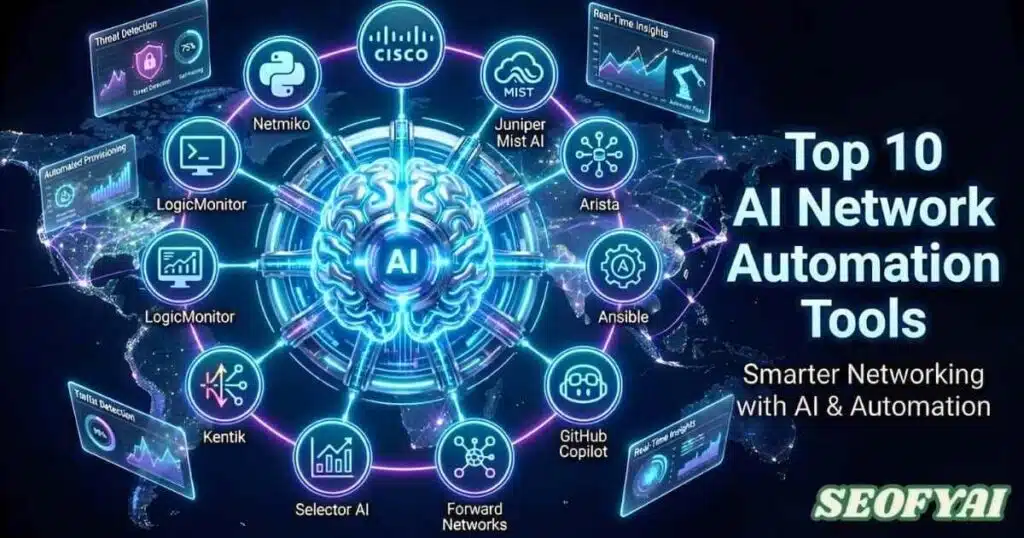
Top 10 AI Tools in Networking for Engineers in 2026
1. Cisco AI Assistant
Cisco’s conversational interface for network operations, built on its Deep Network Model trained on Cisco technical data. Engineers troubleshoot in plain English while Agentic Workflows automate multi-step tasks across Meraki, Catalyst Center, ISE, and Nexus Dashboard. Best for: large Cisco-heavy enterprises.
2. Juniper Mist Marvis
The virtual network assistant at the core of Juniper’s Mist platform. Using natural language processing and LLMs, it answers operational questions and finds root causes across wireless, wired, SD-WAN, and WAN domains. Marvis Actions resolve common issues on their own — firmware upgrades, missing VLANs, congested WAN circuits.
3. Arista AVA
Arista’s Autonomous Virtual Assist pairs a generative chatbot (Ask AVA) with a proactive analytics engine (AVA Insights) inside CloudVision. Ask AVA troubleshoots conversationally and automates provisioning; AVA Insights autonomously investigates issues before an operator asks. Best for: teams running Arista EOS fabrics.
4. Selector
A network-aware AIOps platform that ingests logs, metrics, events, and config data from virtually any source into one correlated view. Its causation models group millions of raw signals into incident clusters and determine true cause-and-effect relationships. Selector Foundry adds agentic agents that investigate incidents within guardrails and verify fixes.
5. Forward Networks (Forward Enterprise)
A mathematically precise digital twin of the entire network — every device, path, and policy across on-prem, hybrid, and multi-cloud environments, supporting 30+ vendors. Engineers test every proposed change against the model before touching production. Best for: change-heavy enterprises where one bad config is costly.
6. NetBrain
An adaptive network automation platform starting with dynamic mapping: a discovery engine models the live network and renders data-driven maps on demand. A/B path calculation emulates real packet forwarding end to end, and no-code runbooks automate documentation, troubleshooting, and change.
7. Itential
A low-code orchestration platform for network automation. Automation Studio’s drag-and-drop canvas builds workflows spanning CLI, API, and AI-driven execution across hybrid, multi-vendor environments. Engineers wrap scripts, Ansible playbooks, and device APIs into governed workflows with validation checks, automatic rollback, and ServiceNow integration.
8. Palo Alto Networks AIOps for NGFW
Built into Palo Alto Networks’ firewall portfolio, AIOps for NGFW uses machine learning over telemetry to predict firewall health, performance, and capacity problems before they disrupt traffic. It delivers continuous best-practice recommendations tailored to each deployment and works with Panorama’s centralized management.
9. SolarWinds Observability
Unifies infrastructure, application, database, network, and digital-experience monitoring with AI-powered anomaly detection and root-cause analysis. Network teams get NetPath path analysis, PerfStack metric correlation, and SD-WAN visibility. In October 2026 SolarWinds launched Avior, an agentic AI system that distills issues into single alerts and restores configurations.
10. IBM Watson AIOps
Correlates events, metrics, logs, and topology data to cut through alert noise and surface root causes faster than manual triage. Its event management, incident diagnosis, and topology discovery predict and resolve incidents across traditional, cloud, and hybrid environments — paired with Turbonomic’s real-time resource rightsizing.
Quick Comparison of These AI Networking Tools

| Tool | Primary strength | Ideal buyer |
|---|---|---|
| Cisco AI Assistant | Conversational troubleshooting, agentic workflows | Cisco-centric enterprises |
| Juniper Mist Marvis | Self-driving wireless, natural-language ops | Campus and wireless teams |
| Arista AVA | Agentic analytics on CloudVision telemetry | Arista data center fabrics |
| Selector | Cross-domain correlation, causal analysis | Service providers, alert-heavy NOCs |
| Forward Networks | Digital twin, pre-change verification | Risk-averse large enterprises |
| NetBrain | Dynamic mapping, no-code runbooks | Multi-vendor estates |
| Itential | Low-code orchestration, ITSM integration | NetOps standardizing automation |
| Palo Alto AIOps | Predictive firewall health, policy guidance | Palo Alto security shops |
| SolarWinds Observability | Full-stack AI monitoring, agentic remediation | Mid-market to enterprise hybrid IT |
| IBM Watson AIOps | Predictive incident management, rightsizing | IBM hybrid-cloud enterprises |
Choosing the Right AI Network Tool for Your Needs
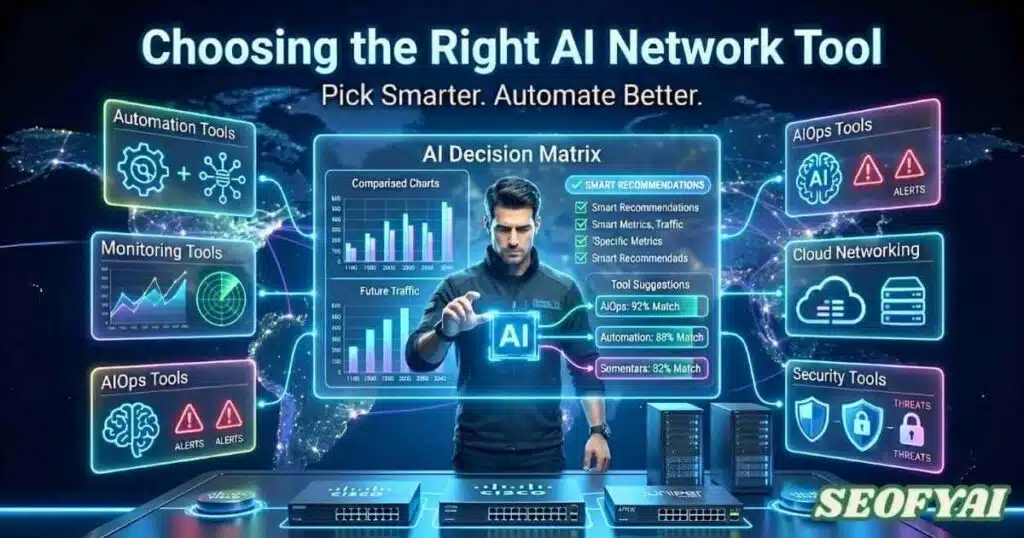
Match the platform to the problem you actually have. Teams drowning in alerts should start with correlation-first platforms like Selector; teams afraid of change windows should start with verification-first platforms like Forward Networks.
| Your situation | Start with |
|---|---|
| Wireless complaints dominate the helpdesk | Juniper Mist Marvis |
| Too many alerts, unclear root causes | Selector or IBM Watson AIOps |
| Config changes feel dangerous | Forward Networks or NetBrain |
| Scripts everywhere, no standardization | Itential |
| Firewall sprawl and policy drift | Palo Alto AIOps for NGFW |
| Need one pane for apps, infra, and network | SolarWinds Observability |
| Already standardized on Cisco or Arista | Cisco AI Assistant or Arista AVA |
Evaluate against your own telemetry during a trial — vendor demos use clean data, and your network is not clean. For a related deep-dive, see our AI network automation analysis.
Frequently Asked Questions
What are the most powerful AI tools in networking for 2026?
The strongest AI tools in networking for 2026 are Cisco AI Assistant, Juniper Mist Marvis, Arista AVA, Selector, Forward Networks, NetBrain, Itential, Palo Alto Networks AIOps, SolarWinds Observability, and IBM Watson AIOps. Each excels in a different area — conversational operations, wireless automation, correlation, digital twins, or orchestration — so the best choice depends on your infrastructure.
How do AI tools in networking reduce downtime?
AI tools in networking reduce downtime by detecting telemetry anomalies early, correlating thousands of alerts into one root cause, and applying approved remediations automatically — shrinking detection-to-recovery from hours to minutes.
Which AI networking tool is best for configuration automation?
For configuration automation, Itential and NetBrain are strong choices. Itential orchestrates low-code workflows across CLI, API, and Ansible playbooks with built-in validation and rollback; NetBrain’s executable runbooks automate documentation, troubleshooting, and change tasks from dynamic network maps.
Do AI network automation tools replace network engineers?
No — they change what engineers spend time on. The tools handle repetitive triage, documentation, and routine remediation, while engineers focus on architecture, policy, and exceptions automation cannot resolve. Vendors position these platforms as assistants and agents with human-in-the-loop options, not replacements.
What is a network digital twin and why does it matter?
A network digital twin is a precise software model of your entire production network. Platforms like Forward Networks use it to predict exactly how a proposed change will behave before it is applied — making risky changes testable and auditable instead of hopeful.
Conclusion
The most powerful AI tools in networking are not the ones with the boldest marketing — they are the ones whose documented capabilities map to real operational pain: alert noise, risky changes, skill gaps, and slow troubleshooting. Start from your biggest recurring cost, verify claims against your own data during a trial, and build the toolchain one proven platform at a time.

Abdul Manan is a professional SEO content creator and AI-SEO strategist at seofyai.com. He specializes in helping businesses rank higher on Google through AI-powered, data-driven content optimization. Connect on LinkedIn or visit seofyai.com for expert SEO tips.