
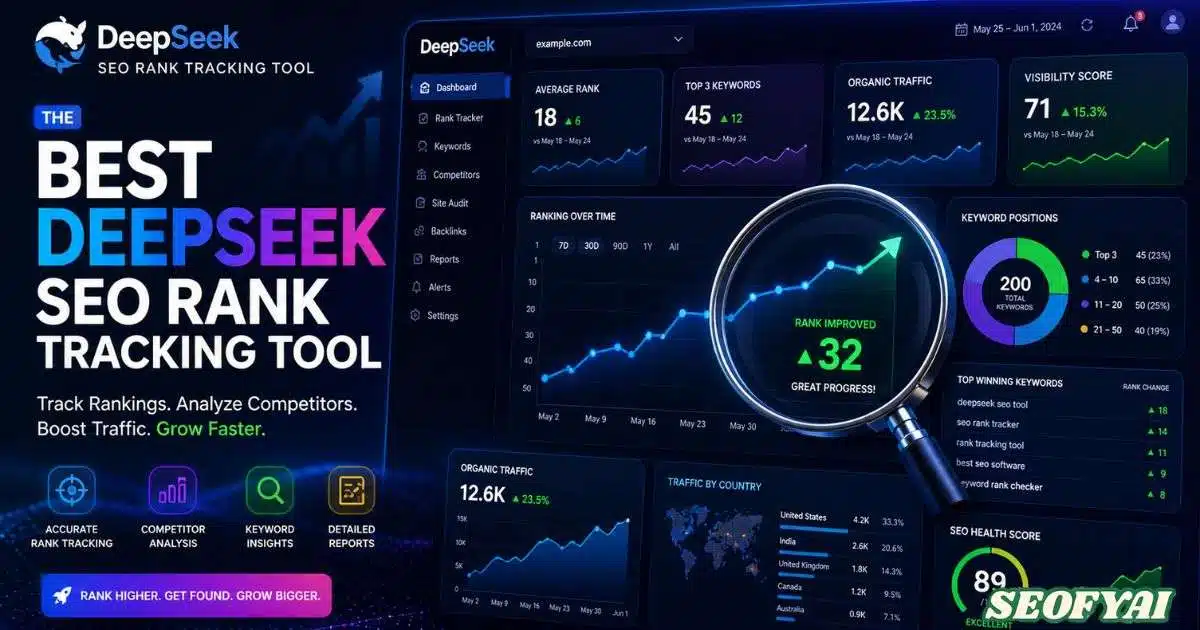
A DeepSeek SEO rank tracking tool monitors how often — and how favorably — your brand shows up inside DeepSeek’s AI-generated answers. Classic rank trackers watch positions on a results page; these tools run curated prompts through DeepSeek and record whether your brand was mentioned, cited, or recommended. If your buyers research vendors inside AI chat, this is the visibility layer you can no longer ignore.
What Is DeepSeek Rank Tracking?
Traditional SEO tracks where your pages rank on Google. DeepSeek rank tracking tracks something different: whether DeepSeek’s language model talks about you when users ask questions in your niche.
DeepSeek is a Hangzhou-based AI lab whose open-weight models — including DeepSeek-V4.1 Flash, released September 2026 under the MIT license — power a free chat app and one of the cheapest developer APIs available. Because the weights are open, DeepSeek surfaces everywhere: third-party apps, OpenRouter, self-hosted deployments. Tracking “rankings” here means tracking mentions across many surfaces, not one leaderboard.
The standard setup: define 20–50 prompts your buyers actually ask, run them against DeepSeek on a schedule, and log mention frequency, sentiment, competing brands, and cited sources. Citations are where the real leverage hides.
Why DeepSeek Visibility Matters in 2026
AI chat is now a discovery channel. Buyers shortlist vendors inside AI assistants before ever opening a search engine. A DeepSeek SEO rank tracking tool paired with broader LLM monitoring shows how these platforms interpret your authority — you can watch DeepSeek AI, ChatGPT search, and Perplexity AI side by side instead of guessing from Google data alone.
DeepSeek’s footprint is also outsized. Off-peak API pricing around $0.15 per million input tokens (per DeepSeek’s published pricing) makes it the default for cost-sensitive developers — quietly multiplying the number of products whose answers are DeepSeek-powered. And AI answers compress the funnel: when a model recommends three tools and yours isn’t among them, you never enter consideration. There is no page two.
How DeepSeek “Ranking” Actually Works

DeepSeek has no results page, so nothing “ranks” in the classic sense. When you ask a question, the model generates an answer from training patterns and — with search mode on — freshly retrieved web pages. What gets mentioned depends on a few observable factors:
- Training-data presence. Brands discussed clearly across reviews, docs, forums, and news surface more reliably from the model’s built-in knowledge.
- Retrieved sources. With search enabled, DeepSeek pulls in web results and cites them. Crawlable, well-structured, authoritative pages get retrieved more often.
- Entity clarity. A brand with one consistent name and category is easier to place correctly than one with three different taglines.
- Prompt framing. The same brand can appear for “best cheap CRM” and vanish for “best enterprise CRM.” Visibility is prompt-specific — which is why tracking a fixed prompt set is the whole game.
Nobody outside DeepSeek knows the exact weighting, and “DeepSeek algorithm secrets” are fiction. What you can do is measure outputs systematically and correlate them with the inputs you control: content, citations, and reviews.
What Makes a Good DeepSeek SEO Rank Tracking Tool?
- Tracks DeepSeek explicitly. Several big-name platforms still don’t include it — check the engine list before you buy.
- Scheduled prompt runs with full response capture, so you see trends rather than one-off answers.
- Mention, sentiment, and position detection — mentioned first, buried in a list, praised or merely listed?
- Citation reporting — which pages DeepSeek cited. This tells you where to invest; the cited page is often a third-party review, not your site.
- Competitor benchmarking on the same prompts, so you see share of voice, not just your own mentions.
Red flags: “rankings” built from a handful of prompts, dashboards with no citation data, vendors that won’t name the model version they query.
Best DeepSeek SEO Rank Tracking Tools for 2026
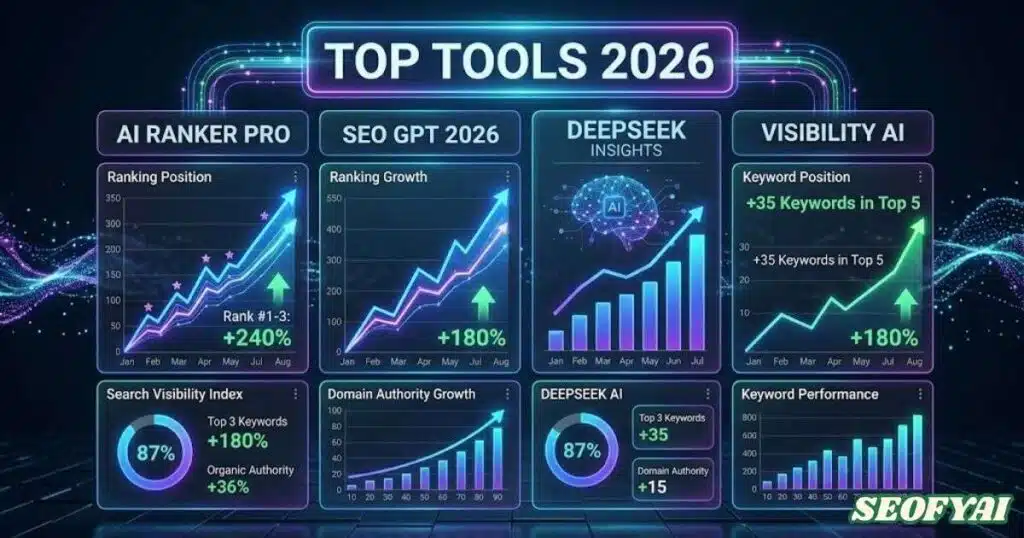
Real platforms with confirmed DeepSeek coverage. Pricing changes often — verify on each vendor’s site.
1. Peec AI — best dedicated monitor
Covers ten AI platforms including DeepSeek, ChatGPT, Gemini, Perplexity, Claude, Copilot, Grok, Llama, AI Overviews, and AI Mode. Prompt-level mention tracking, sentiment analysis, citation source classification, and an Actions system that turns findings into prioritized fixes. From ~€85/month; customers include HUGO BOSS, WIX, ElevenLabs, and n8n.
2. Profound — best for enterprise
Enterprise answer-engine visibility across up to nine engines including DeepSeek. Deep reporting and large prompt volumes for teams with dedicated analytics staff; self-serve plans from ~$99/month, enterprise custom.
3. Brand24 — best with social listening
Pairs social and web listening with AI visibility tracking across ChatGPT, Gemini, Claude, Perplexity, DeepSeek, Grok, Copilot, and AI Overviews. From $99/month with a 14-day trial.
4. Sona AI Visibility — best value
Tracks 11 answer engines — ChatGPT, Gemini, AI Mode, AI Overviews, Perplexity, plus Claude, DeepSeek, Grok, Copilot, Qwen, Mistral — from $75/month billed annually, 14-day trial, unlimited seats. Ties AI citations to pipeline and revenue on one timeline.
5. Meltwater GenAI Lens — best for PR teams
Monitors nine platforms including DeepSeek, showing how each describes your brand and which journalists get cited. Sits inside Meltwater for comms teams; quote-based pricing.
DeepSeek Rank Tracking Tools Compared
| Tool | DeepSeek? | Engines | From | Trial | Best for |
|---|---|---|---|---|---|
| Peec AI | Yes | 10 | ~€85/mo | Yes | Dedicated monitoring |
| Profound | Yes | 9 | ~$99/mo | Yes | Enterprise |
| Brand24 | Yes | 8+ | $99/mo | 14 days | Social + AI |
| Sona | Yes | 11 | $75/mo | 14 days | Value |
| Meltwater | Yes | 9 | Custom | Demo | PR teams |
One caveat: the two biggest SEO suites don’t currently list DeepSeek. Semrush’s AI Visibility Toolkit ($99/month per domain) covers ChatGPT, Gemini, and Perplexity; Ahrefs’ Brand Radar ($199/month add-on) covers AI Overviews, AI Mode, ChatGPT, Perplexity, Gemini, Copilot, and Claude. Confirm the engine list before paying — vendors add engines every quarter.
How to Track DeepSeek Rankings for Free
- Build a prompt list. Write 20–30 questions buyers genuinely ask — navigational, comparative, and category prompts — phrased the way customers talk.
- Run them in DeepSeek’s free chat. Fresh session per prompt; half with search mode on, half off.
- Log results in a spreadsheet. Per prompt: mentioned (yes/no), position in answer, sentiment, competitors mentioned, every source cited.
- Repeat monthly. One snapshot is trivia; a monthly log is a trend.
- Act on the citations. If DeepSeek keeps citing a competitor’s review page, that page — not your homepage — is your real target.
Past ~50 prompts the manual work gets tedious — that’s when a paid tool earns its keep. But teams that skip this step usually buy the wrong tool, because they never learned which prompts matter.
Step-by-Step: Using DeepSeek for SEO Content Optimization
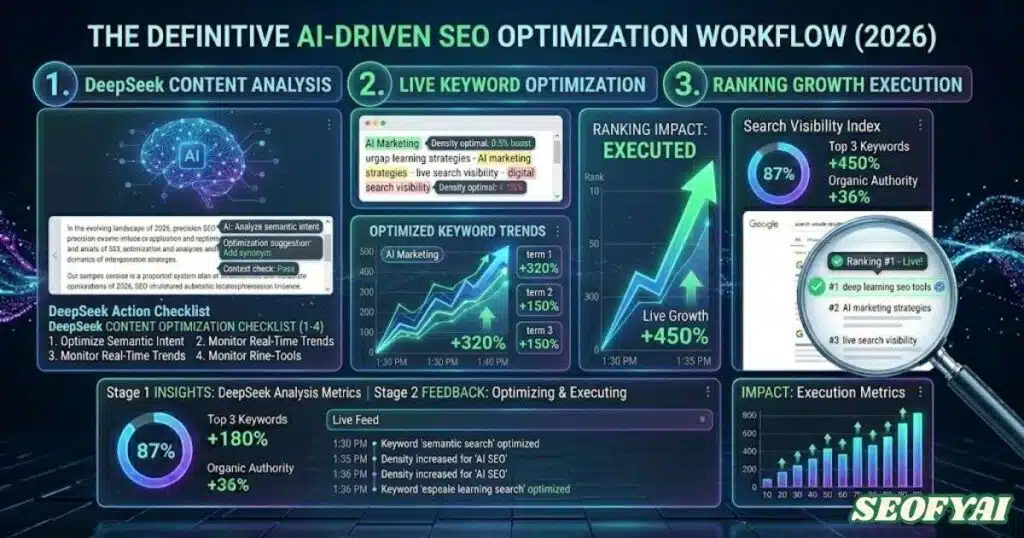
- Extract the questions. Ask DeepSeek: “List the 15 questions a [buyer persona] asks before buying [category], ordered by buying stage.” That’s your brief’s question inventory.
- Draft against the inventory. Give each question a direct, self-contained answer near the top of its section. AI engines quote pages that answer cleanly.
- Test the draft. Paste it into DeepSeek: “Using only the page below, answer [target question] in two sentences, then list which of my questions it cannot answer.” The gaps are your revision list.
- Strengthen entities. Keep brand name, category, and differentiators in consistent phrasing — plus schema markup.
- Publish, then verify. After indexing, run your tracking prompts. If a third-party page keeps winning the citation, improve that page’s accuracy about you.
- Match search intent. Give each page one clear intent — informational, comparative, or transactional. Review search intent optimization basics before you publish.
How to Improve Your Visibility Inside DeepSeek Answers
- Win the cited sources. Find which domains DeepSeek cites for your prompts, then get mentioned accurately there — reviews, listicles, docs hubs, forums.
- Publish citable facts. Retrieval favors specifics: pricing, benchmarks, original research. Generic guides say nothing quotable.
- Keep listings consistent. Conflicting details across directories confuse entity resolution — audit profiles like NAP data for local SEO.
- Track sentiment, not just mentions. Being “the budget option with poor support” is visibility to fix, not celebrate.
The Future of DeepSeek Rank Tracking
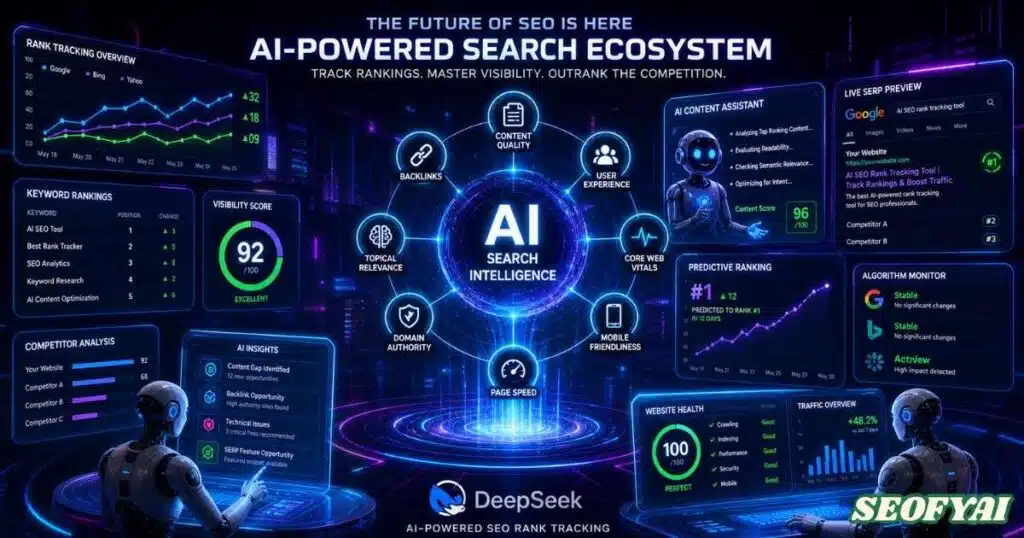
Tracking is moving from “were you mentioned?” to “how much revenue did AI discovery influence?” Expect prompt-level analytics to merge into mainstream SEO suites, and engine lists to keep expanding.
With the growing use of AI-powered search engines, the durable edge won’t come from gaming one model. Open-weight models like DeepSeek’s get forked, fine-tuned, and embedded everywhere. The winners will be brands with clear entities, accurate third-party coverage, and content any model can confidently cite.
Conclusion
A DeepSeek SEO rank tracking tool answers one question: when customers ask AI for help, does your brand come up? Start with the free manual method, graduate to a dedicated platform when volume justifies it, and spend most effort on what the data reveals — the sources DeepSeek cites, the competitors it prefers, the gaps in how the web describes you. Measure monthly, fix the inputs, watch the answers change.
Frequently Asked Questions
What is a DeepSeek SEO rank tracking tool?
It runs prompts through DeepSeek on a schedule and records whether your brand is mentioned, cited, or recommended — tracking mention frequency, sentiment, answer position, competitor share of voice, and cited sources. It’s the AI-search equivalent of rank tracking, since DeepSeek has no results page.
Which tools track DeepSeek brand mentions?
Confirmed options: Peec AI (10 engines, ~€85/month), Profound (up to 9 engines, enterprise pricing), Brand24 (8+ engines, $99/month), Sona (11 engines, $75/month), and Meltwater GenAI Lens (9 engines, custom quote). Semrush and Ahrefs don’t currently list DeepSeek.
How much does DeepSeek rank tracking cost?
Dedicated platforms start around $75–$99 per month; enterprise options are quote-based. The DIY route via DeepSeek’s API costs cents per day in tokens. Verify pricing and the engine list before buying — both change frequently.
Can I track DeepSeek rankings for free?
Yes. Run 20–30 realistic buyer prompts in DeepSeek’s free chat (half with search on, half off) and log mentions, sentiment, competitors, and citations monthly in a spreadsheet. Past ~50 prompts, a paid DeepSeek SEO rank tracking tool pays for itself.

Abdul Manan is a professional SEO content creator and AI-SEO strategist at seofyai.com. He specializes in helping businesses rank higher on Google through AI-powered, data-driven content optimization. Connect on LinkedIn or visit seofyai.com for expert SEO tips.