
When teams compare ChatGPT vs Gemini for SEO, they usually judge tone and speed, not what actually moves rankings. Both large language models now shape keyword research, content briefs, and citations inside Google AI Overviews, yet each one behaves differently once real search intent enters the picture.
ChatGPT crawls the web independently, so pages without deep domain authority still get cited when the content answers a question well. Gemini leans on Google’s own index, rewarding sites that already rank for technical SEO and structured data work. Understanding this split matters more than picking a favorite, since most agencies end up running both tools side by side for different tasks entirely.
Key Takeaways
- ChatGPT leads on keyword strategy, content briefs, and search intent mapping.
- Gemini leads on technical SEO, structured data, and real-time research.
- ChatGPT crawls independently, so pages that don’t rank on Google can still get cited.
- Gemini pulls mainly from Google’s index, so strong Google rankings still help.
- Entry-level pricing is nearly identical: ChatGPT Plus ($20/month) vs Google AI Pro ($19.99/month).
- Most SEO teams in 2026 use both tools rather than choosing just one.
ChatGPT vs Gemini for SEO: Quick Comparison Table
Here’s the shape of the decision at a glance before the detailed breakdown.
| Factor | ChatGPT | Gemini |
|---|---|---|
| Monthly visits (2026) | ~5.7–5.8 billion | ~1.8 billion |
| Entry paid plan | Plus, $20/month | AI Pro, $19.99/month |
| Top consumer tier | Pro, $200/month | AI Ultra, $99.99/month |
| Citation source | Crawls independently | Pulls from Google’s index |
| SEO strength | Keyword strategy, content briefs | Technical SEO, structured data |
| Context window (entry tier) | Not published to match | 1 million tokens |
Neither tool wins outright. The right choice depends on which SEO tasks eat up most of your week. A solo blogger writing three posts a month has different needs than an agency running technical audits across twenty client sites.
ChatGPT vs Gemini Traffic and Market Share in 2026
Raw traffic still tells you where audience attention sits, and right now it favors ChatGPT by a wide margin, even as that lead shrinks month over month. This matters for ChatGPT vs Gemini for SEO decisions because AI visibility only helps your content if enough people are actually asking that platform questions.
ChatGPT’s Monthly Visits vs Gemini’s Growth Rate
- ChatGPT holds roughly 5.7 to 5.8 billion monthly visits as of April 2026.
- Gemini sits closer to 1.8 billion monthly visits over the same period.
- The gap between them, once around 22x in mid-2025, had compressed to about 8x by January 2026.
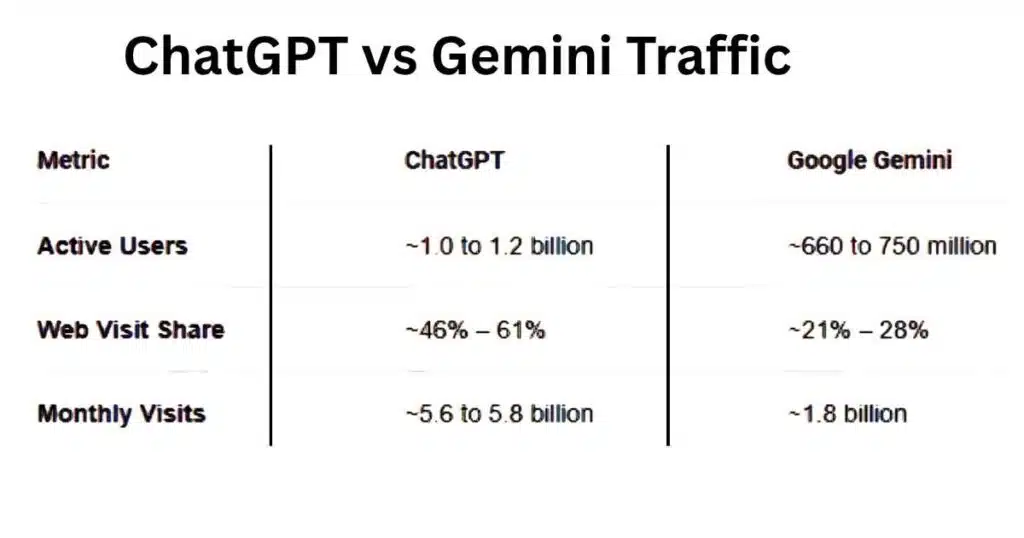
Google’s distribution advantage through Android, Chrome, and Workspace is doing most of that work, putting Gemini in front of users who never went looking for it directly.
Why Gemini Is Closing the Gap Faster Than Expected
Gemini’s global traffic share reached 0.0284% in January 2026, edging past Perplexity’s 0.0221% and locking in the number-two spot among AI-native platforms. Five months earlier, Perplexity had actually led Gemini by nearly 3x, so the reversal happened fast.
For anyone building an SEO strategy around AI visibility, the takeaway is simple: betting on one assistant staying dominant forever looks risky when the runner-up is gaining share at double-digit rates.
How ChatGPT and Gemini Get Their Citations
This is the part most ChatGPT vs Gemini for SEO guides skip, and it’s arguably the most important one for anyone doing GEO work.
ChatGPT Crawls Independently — Even Non-Ranking Pages Get Cited
ChatGPT generates inline citations by browsing the web on its own, separate from Google’s ranking system. A page sitting on page four of Google’s results can still get cited in a ChatGPT answer if the content directly answers the question well.
Picture a newer calculator or comparison site that hasn’t built up backlinks yet. On Google, it might sit buried for months. Inside ChatGPT, that same page can surface in an answer simply because it clearly solves the reader’s problem — one of the more overlooked opportunities in AI visibility work right now.
Gemini Relies on Google’s Index — Ranking Still Matters
Gemini behaves differently. It pulls primarily from pages that already rank well inside Google’s own index, then groups citations inline or at the bottom of its responses.
In practice, this means classic on-page SEO and optimizing for Google AI Overviews still improve your odds of being cited by Gemini specifically. If your site already ranks reasonably well on Google, Gemini tends to reward that existing authority rather than discover you independently.
ChatGPT vs Gemini Pricing for SEO Teams
Budget shapes which tool a team actually adopts day to day, and the two pricing ladders now sit close enough that features decide more than cost.
- ChatGPT: Free, Plus ($20/month), Pro ($200/month), Pro Max (above that for heavy users)
- Gemini (Google AI): AI Plus (~$5–8/month depending on region), AI Pro ($19.99/month), AI Ultra (from $99.99/month after a 2026 price cut)
At the $20 price point, the two are nearly identical, though Google AI Pro currently bundles a 1 million token context window and several terabytes of storage that ChatGPT Plus doesn’t publish a direct match for. Agencies juggling both tools alongside Claude and Perplexity commonly spend $80–110 a month just on headline tiers — a cost most recoup within a single billable project once the team standardizes which tool handles which task.
Where ChatGPT Wins for SEO Tasks
Independent agency testing across dozens of real SEO prompts keeps landing on the same pattern: ChatGPT edges ahead whenever a task requires understanding intent rather than reciting a definition.
Keyword Strategy and Search Intent
ChatGPT consistently produces stronger volume-to-intent matching and clearer reasoning about why a keyword fits a particular funnel stage. Ask it why a long-tail keyword like “best budget laptop for students” belongs in a comparison post rather than a product page, and it typically walks through the buyer’s mindset step by step — reasoning that saves real time when justifying keyword choices to a client.
Content Briefs and Funnel Mapping
ChatGPT also pulls ahead on content brief generation, mapping topics against top-of-funnel, middle-of-funnel, and bottom-of-funnel intent with clearer structure. Writers building blog outlines or landing page briefs tend to get usable structure faster, with less editing before the brief reaches a human writer.
Where Gemini Wins for SEO Tasks
Gemini’s advantage shows up in tasks that reward structure, precision, and access to current information over conversational polish.
Technical SEO and Structured Data
Ask both models to explain structured data, sitemaps, or robots meta tags, and Gemini tends to respond with tighter, more direct structure — precision that translates well to technical audits, where ambiguity costs time.
For example, asked to outline a schema markup fix for a broken FAQ page, Gemini tends to list the exact JSON-LD properties involved before explaining why each one matters, which suits developers who want a checklist over a conversation.
Real-Time Research
Gemini’s deeper integration with Google’s live index gives it an edge on fast-moving topics, including emerging AI search behavior itself. A researcher asking about last week’s Google update will generally get a more current answer from Gemini, since it pulls from a live index rather than a training snapshot that may lag by weeks or months
Conclusion: Which Should You Actually Use for SEO in 2026?
The honest answer to ChatGPT vs Gemini for SEO is that most serious teams end up using both. ChatGPT earns its place for keyword strategy, content briefs, and anything that needs a human tone. Gemini earns its place for technical audits, structured data explanations, and research tied to Google’s own index.
Pick based on which task eats the most hours in your week, not on which tool has better marketing. If your bottleneck is writing briefs and justifying keyword choices to clients, start with ChatGPT. If it’s technical audits and staying current on fast-moving algorithm changes, lean on Gemini instead.
Whichever you choose, keep a strategist in the loop. Both tools generate faster, but they still don’t replace the judgment that turns an AI-generated draft into content that actually ranks, earns trust, and holds up once a real reader or algorithm update puts it to the test.
Frequently Asked Questions
Which is better for SEO, ChatGPT or Gemini?
Neither wins outright. ChatGPT performs better for keyword strategy and content briefs, while Gemini performs better for technical SEO and real-time research tied to Google’s index.
Does ranking on Google help you get cited by ChatGPT?
Not necessarily. ChatGPT crawls independently, so pages that don’t rank highly on Google can still get cited if the content directly answers the question asked.
Does Gemini only cite pages that already rank on Google?
Largely, yes. Gemini pulls primarily from Google’s existing index, so classic SEO and strong Google rankings improve your odds of appearing in its citations.
How much does ChatGPT Plus cost compared to Gemini’s paid plan?
ChatGPT Plus costs $20/month, while Google’s equivalent AI Pro plan costs $19.99/month, making the entry tiers nearly identical in price.
Can AI tools replace an SEO strategist?
No. Both ChatGPT and Gemini speed up research and drafting, but neither can independently diagnose broken schema, misaligned strategy, or business priorities the way a human strategist can.

Abdul Manan is a professional SEO content creator and AI-SEO strategist at seofyai.com. He specializes in helping businesses rank higher on Google through AI-powered, data-driven content optimization. Connect on LinkedIn or visit seofyai.com for expert SEO tips.