
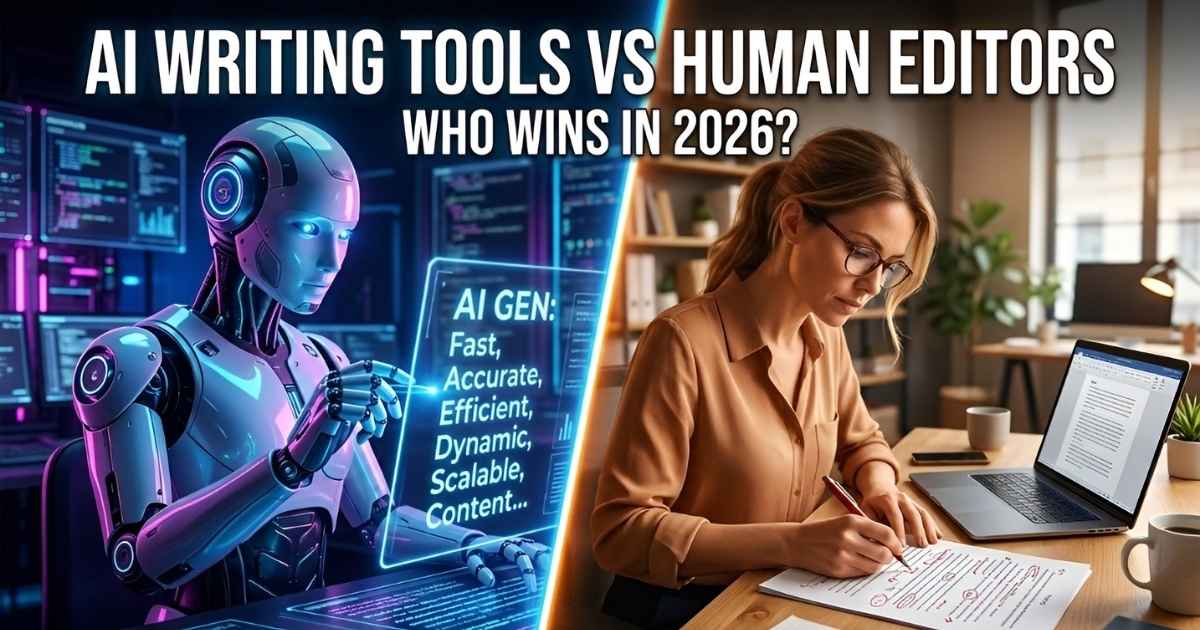
The debate over AI writing tools vs human editors is shaping the future of content creation in 2026. Businesses want faster publishing, lower costs, and scalable workflows, while readers continue to expect accuracy, originality, and authentic storytelling. AI-powered writing assistants can generate drafts, improve grammar, and streamline content production in minutes, but they often lack the emotional intelligence and editorial judgment that experienced professionals provide.
Human editors refine tone, verify facts, strengthen structure, and ensure every piece connects with its intended audience. In this guide, you’ll discover the strengths, limitations, and ideal use cases for both approaches, helping you choose the right solution for better SEO, higher engagement, and long-term content success.
| Editing Factor | AI Tools | Human Editors |
| Speed | Extremely fast | Moderate |
| Creativity | Limited | Strong |
| Emotional Understanding | Weak | Excellent |
| SEO Suggestions | Automated | Strategic |
| Cost | Lower | Higher |
| Fact Checking | Inconsistent | More reliable |
AI Writing Tools vs Human Editors: Understanding the Key Differences
The discussion around AI writing tools vs human editors continues to grow because businesses need to publish more content without sacrificing quality. AI writing platforms can generate articles, improve grammar, optimize readability, and speed up content production within seconds. However, efficiency alone does not guarantee meaningful communication or audience trust.
The biggest differences between AI and human writing become clear when emotion, creativity, and storytelling matter. While AI excels at repetitive editing tasks, experienced editors understand brand voice, audience expectations, and subtle context.
These human vs AI writing style differences often determine whether content feels authentic or robotic. As a result, many organizations adopt a hybrid workflow where AI handles routine tasks while editors focus on strategy, originality, and quality control.
How AI Editing Tools Work (Capabilities and Limitations)
Modern AI editing platforms rely on machine learning and natural language processing to identify grammar issues, improve readability, and optimize content structure. Today, AI content editing tools can also suggest SEO improvements, keyword placement, and formatting recommendations, helping marketers manage large publishing workflows more efficiently.
Many professionals now use an AI copy editor to create polished first drafts and reduce manual editing time.
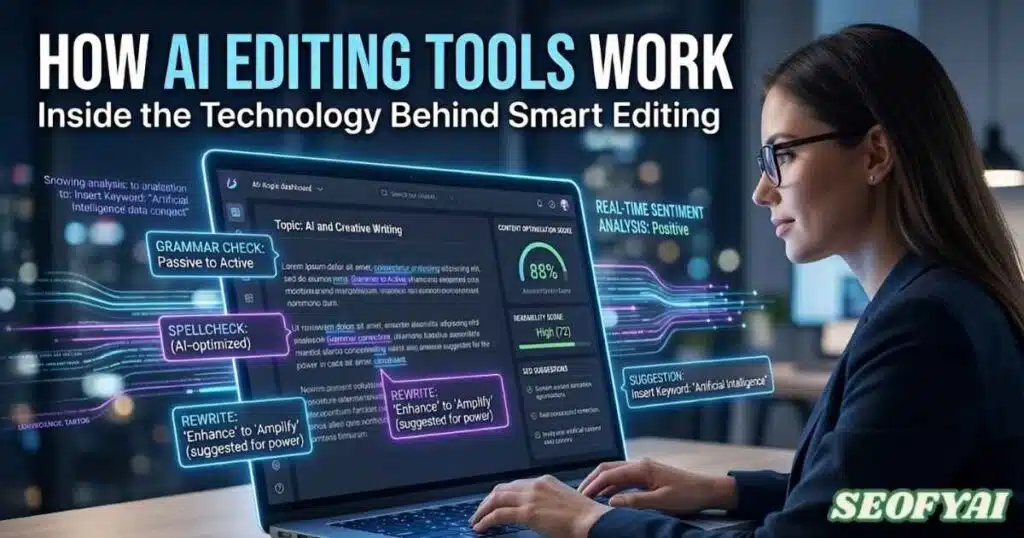
Despite these advantages, AI still has limitations. It cannot consistently understand emotion, cultural nuance, or complex context the way experienced editors can. Because of these limitations, AI copy editing should complement—not replace—professional editorial review.
Human expertise remains essential for fact-checking, refining messaging, and ensuring content aligns with brand values and audience expectations.
| AI Editing Capability | Performance Level |
| Grammar Checking | Excellent |
| Tone Detection | Moderate |
| Fact Accuracy | Inconsistent |
| Emotional Depth | Weak |
| SEO Optimization | Strong |
| Storytelling | Limited |
What Human Editors Bring to the Table
A skilled human editor contributes far more than grammar corrections. Professional editors improve clarity, strengthen arguments, maintain a consistent brand voice, and verify factual accuracy before content is published. Their ability to understand audience intent and emotional nuance makes every article more engaging and trustworthy.

An in-depth editor review also identifies weak transitions, repetitive language, and logical inconsistencies that automated tools often overlook. While AI can speed up drafting, human expertise ensures the final content meets high editorial standards, supports EEAT principles, and builds long-term credibility with both readers and search engines.
| Human Editing Strength | Why It Matters |
| Emotional Intelligence | Builds trust |
| Narrative Flow | Keeps readers engaged |
| Fact Verification | Improves accuracy |
| Tone Consistency | Protects brand image |
| Strategic Revisions | Improves conversions |
When to Use AI for Content Editing
AI works best during high-volume production cycles. Businesses publishing daily blog posts often use AI proofreading and editing workflow automation to save time. Ecommerce brands also depend on content optimization systems for product pages and category descriptions. These tools accelerate production dramatically. Companies handling repetitive content benefit most from AI because speed becomes more important than emotional storytelling.
Startups and small businesses often choose AI because budgets remain tight. Automated systems improve grammar, readability, and SEO quickly without expensive labor costs. Moreover, editing productivity rises sharply when teams automate repetitive corrections.
AI can also simplify technical editing services involving repetitive formatting and consistency checks. However, businesses should still review content manually before publication to avoid factual errors and robotic tone issues.
When to Hire a Human Editor Instead
Although AI tools can automate many writing tasks, there are situations where hiring a human editor is the better investment. High-value content such as legal documents, healthcare articles, technical guides, brand messaging, and thought leadership pieces often requires careful review, fact verification, and editorial judgment that AI cannot consistently provide.

Many businesses use an AI copy editor to accelerate drafting before sending the content for a professional editor review. This hybrid approach combines speed with accuracy, ensuring every article is optimized for readability, SEO, and user trust. By balancing AI efficiency with human expertise, organizations can publish content that performs well in search results while delivering a better experience for readers.
The Hybrid Approach: Combining AI and Human Editing
Today, many organizations no longer see AI writing tools vs human editors as competing solutions. Instead, they combine both to build a faster and more effective content workflow. AI streamlines repetitive tasks such as drafting, grammar correction, and basic formatting, while human editors focus on storytelling, strategic messaging, brand voice, and content accuracy. This balanced approach increases productivity without compromising quality or authenticity.
A successful editorial process often begins with AI-assisted content creation, followed by thorough AI copy editing and a professional editor review to improve clarity, SEO, and user engagement. Experienced teams understand the differences between AI and human writing and use each where it delivers the greatest value.
By combining automation with human creativity, businesses can publish high-quality, search-optimized content more efficiently while maintaining audience trust and long-term brand authority.
| Hybrid Editing Stage | Main Purpose |
| AI Draft Creation | Speed |
| Automated Proofreading | Grammar cleanup |
| Human Revision | Tone and structure |
| SEO Optimization | Search visibility |
| Final Review | Accuracy control |
Cost Comparison: AI Tools vs Professional Editors
The cost difference between automation and manual editing remains substantial in 2026. Most AI platforms charge monthly subscription fees ranging from affordable starter plans to enterprise solutions. Businesses using AI writing assistant platforms reduce staffing expenses significantly. This affordability makes AI attractive for startups and content-heavy websites. However, lower pricing sometimes leads to weaker long-term results if quality declines.

Human editing services cost more because expertise requires experience and time. Experienced freelance editing business professionals may charge hourly or project-based rates depending on complexity.
Yet businesses often recover those costs through stronger engagement and better conversions. Poor editing damages credibility quickly. Therefore, investing in quality often prevents expensive reputation problems later.
| Editing Solution | Average 2026 Cost |
| AI Editing Tools | $15–$100 monthly |
| Freelance Editors | $40–$200 hourly |
| Agency Copyediting | $500–$5000 project-based |
Best AI Editing Tools in 2026 (Free and Paid Options)
The market for AI editing software continues to expand, giving businesses and creators more options than ever. Popular platforms like Grammarly excel at grammar correction and readability improvements, while Jasper focuses on AI-powered marketing content and SEO writing.
ProWritingAid is widely used for long-form editing, style enhancement, and consistency checks, whereas Hemingway Editor helps simplify complex writing for better readability and user engagement.
Many organizations also rely on AI content editing platforms that include advanced AI copy editing features, tone customization, and SEO optimization. Some AI tools learn a company’s writing style to deliver more personalized suggestions, while others specialize in strategic editing, keyword optimization, and content refinement.
Choosing the right AI copy editor depends on your workflow, content goals, and editorial requirements. Comparing features, accuracy, integrations, and collaboration tools ensures you invest in a solution that improves productivity without sacrificing content quality.
| Tool | Best Feature | Best For |
|---|---|---|
| Grammarly | Grammar accuracy | General editing |
| Jasper | Marketing content generation | Agencies |
| Hemingway | Readability improvement | Bloggers |
| ProWritingAid | Long-form writing analysis | Authors |
| ChatGPT | Flexible AI drafting | Content teams |
How to Choose the Right Editing Solution for Your Needs
Selecting between AI writing tools vs human editors depends on your content goals, budget, and publishing strategy. Businesses producing large volumes of blog posts or product descriptions often benefit from AI-powered workflows that improve speed and consistency.
In contrast, brands creating thought leadership content, technical documentation, or high-conversion copy usually achieve better results with a skilled human editor who can strengthen messaging, verify facts, and maintain a consistent brand voice.
Many organizations now combine automation with professional editor review to build a more efficient editorial process. An AI copy editor can accelerate drafting and grammar improvements, while experienced editors refine tone, storytelling, SEO, and audience engagement.
Choosing the right solution ultimately depends on balancing productivity with content quality to support long-term business growth.
Future of Editing: Where AI and Human Expertise Are Heading
The future of AI writing tools vs human editors is centered on collaboration rather than replacement. As AI continues advancing through better language models, personalization, and workflow automation, it will become an even stronger assistant for drafting, research, and AI content editing.
Businesses will increasingly customize AI systems using brand guidelines, editorial standards, and audience data to improve consistency and efficiency.
Even with these innovations, human expertise remains essential. A professional human editor brings critical thinking, creativity, emotional intelligence, and strategic decision-making that AI cannot fully replicate. Ongoing editor review ensures content is accurate, trustworthy, and aligned with EEAT principles.
Organizations that combine AI efficiency with human creativity will be best positioned to produce high-quality, search-optimized content and stay competitive in the evolving digital publishing landscape.
Conclusion
The discussion around ai writing tools vs human editors no longer has a simple answer. AI provides incredible speed, scalability, and automation benefits for modern businesses. Yet humans continue delivering emotional intelligence, storytelling power, and strategic refinement that machines cannot fully replicate. The strongest publishing strategies now combine both approaches carefully.
Businesses should choose editing solutions based on goals, audience expectations, and quality standards. AI works wonderfully for repetitive optimization tasks. Human expertise shines during high-stakes communication and premium storytelling. In the end, companies that blend technology with human insight will build stronger brands, higher trust, and better long-term growth.
Frequently Asked Questions (FAQ)
Can AI writing tools replace human editors completely?
No. AI writing tools handle grammar, proofreading, and basic editing well, but human editors are still essential for creativity, brand voice, context, and strategic content improvements.
What are the main advantages of using AI writing tools?
AI writing tools save time, reduce costs, and speed up proofreading, grammar correction, SEO optimization, and first-draft creation while maintaining consistent output.
When should I hire a human editor instead of using AI?
Hire a human editor for creative, technical, or brand-critical content where accuracy, emotional nuance, storytelling, and audience trust matter most.
How much does AI writing cost compared to human editors?
AI writing tools typically cost $10–$50 per month, while professional human editors generally charge $30–$100+ per hour, depending on expertise and project complexity.

Abdul Manan is a professional SEO content creator and AI-SEO strategist at seofyai.com. He specializes in helping businesses rank higher on Google through AI-powered, data-driven content optimization. Connect on LinkedIn or visit seofyai.com for expert SEO tips.