
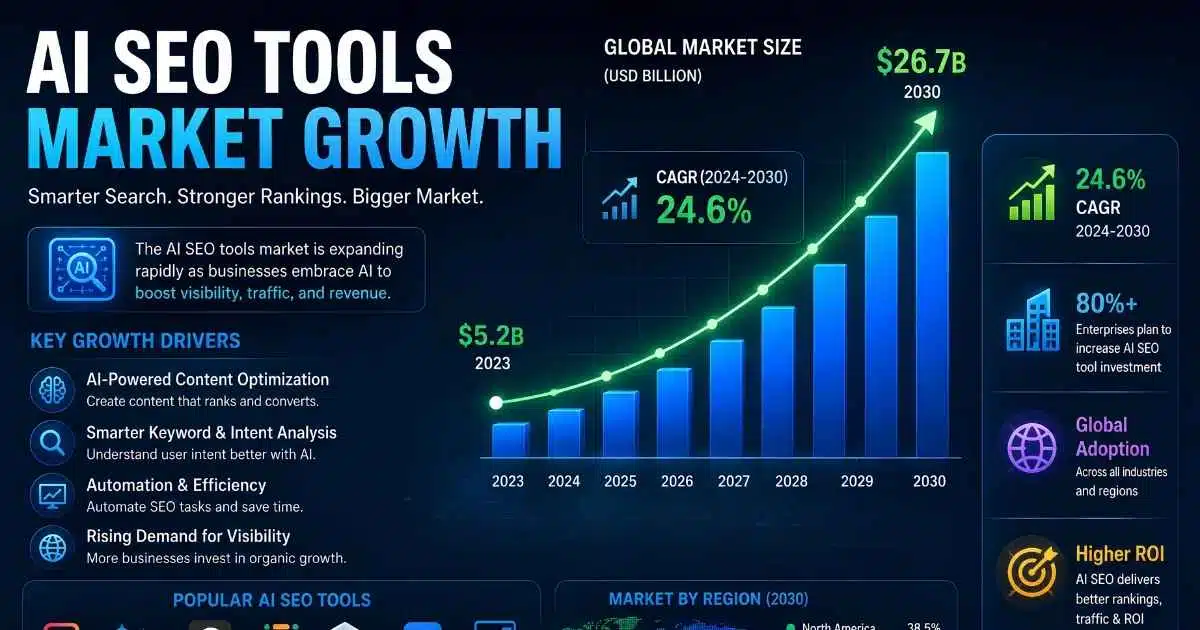
Search for market data on this topic, and you’ll see numbers that don’t agree with each other at all. One report says the market is worth $1.2 billion. Another says $19.35 billion. A third says over $68 billion. That’s not a small gap. That’s a completely different story depending on which page you happen to land on.
This confusion is the real story behind AI SEO tools market growth in 2026. Before you trust any single number, you need to know why they differ, what’s actually driving this growth, and what it means for a business your size. This guide walks through all of that with real sources, not guesswork, so you finish reading actually knowing something useful.
Why Every “AI SEO Market” Report Shows a Different Number
Most people assume market research reports measure the same thing. They don’t, and that single assumption causes most of the confusion around this topic. Some reports count only pure AI SEO tools, small startups doing one specific job like AI visibility tracking. Others count the entire SEO software industry, including tools that barely use AI at all beyond a marketing checkbox on their homepage.
AI SEO Tools vs Broader SEO Software Market
Grand View Research, a well-established and ISO-certified research firm, values the full SEO software market at $91.1 billion in 2026, growing toward $154.6 billion by 2030. That number covers everything: social media tools, email marketing platforms, and general SEO software, not just AI-specific tools built around machine learning from the ground up.
Compare that to GII Research, which tracks only AI-based SEO tools specifically. Their number sits at $19.35 billion in 2025, growing to $54.39 billion by 2032. Same industry, completely different scope, completely different number. Neither report is wrong. They’re just measuring different things, and neither headline tells you that outright.
The Real Market Size Range (With Sources Compared)
Once you understand the scope problem, the numbers actually start to make sense together instead of contradicting each other.
Low-End vs High-End Estimates Explained
At the low end, DemandSage puts the AI SEO tools market at $1.2 billion in 2024, growing to $4.5 billion by 2033 at a 15.2% CAGR. That’s a narrow, strict definition, likely counting only dedicated AI SEO software, not broader platforms that added AI features later.
At the higher end, GII Research’s $19.35 billion figure for 2025 likely includes bigger platforms like Semrush and Ahrefs, which built AI features into existing, much larger products. Neither number is fake. They’re just drawing the line differently around what counts as “AI SEO.”
What’s Actually Driving This Growth
Behind every one of these numbers sits a real shift in how businesses work, and that shift is the actual engine behind AI SEO tools market growth this year. Generative AI adoption for SEO tasks jumped fast: 56% of marketers were already using generative AI for SEO by early 2026, and that number kept climbing through the year.
Search itself changed too. Google’s AI Overviews now reach 2.5 billion monthly users worldwide, according to Google’s own CEO. That forces businesses to track a completely new kind of visibility, not just search rankings but citations inside AI-generated answers. Tools built for that job barely existed two years ago. Now they’re one of the fastest-growing categories inside this whole market.
Adoption Stats That Matter More Than Market Size
Dollar figures matter to investors. For your own business, adoption numbers tell a more useful story.
How Many Businesses Are Actually Using AI SEO Tools
The share of marketers using AI in their work jumped from 63% to 91% in a single year, according to Jasper’s 2026 State of AI Marketing report. Separately, 68% of businesses report having adopted AI-based SEO tools specifically, per Business Research Insights. Nearly all content marketing programs, 97%, now involve AI somewhere in the workflow.
That’s the real headline. Adoption is running well ahead of most market forecasts, which suggests the dollar figures analysts publish today may already be underestimating where this market lands by 2030.
Regional Growth: Where Adoption Is Fastest
North America currently leads by a wide margin, holding roughly 35% to 42% of the global market depending on which report you check, driven by mature digital infrastructure and heavy existing investment in marketing technology. Europe follows, pushed forward partly by data protection regulations that favor compliant, well-documented AI tools.
Asia Pacific is the one to watch closely. Growth rates there consistently outpace North America and Europe, fueled by rapid digital transformation and a fast-expanding e-commerce sector that needs SEO tools built for scale from day one.
Real Example: How One Small Agency Rode This Growth Curve
Consider a four-person SEO agency that added one AI visibility tracking tool to its stack in early 2025, back when almost none of its competitors offered anything like it. The agency didn’t build custom technology or raise funding. It simply subscribed to one existing tool and started reporting AI citation data to clients alongside normal ranking reports every month.
Within a year, that single addition became the agency’s main differentiator in new client pitches, the one slide every prospect asked follow-up questions about. Two competing agencies in the same city eventually added similar tools too, but by then this small agency already had case studies and client trust built up that a brand-new competitor couldn’t match overnight.
That’s AI SEO tools market growth playing out at ground level: not abstract billions, just one small team getting ahead by adopting early instead of waiting for the trend to become obvious.
What This Growth Means for Small Businesses and Agencies
You don’t need to understand every market report to benefit from this trend. What matters is timing. Early adopters in any fast-growing category typically capture disproportionate advantage before the tools become commoditized and everyone has access to the same capability.
Right now, dedicated AI visibility tracking still isn’t universal among small businesses. That gap won’t last forever, but while it exists, adding even one AI SEO tool to your stack, keyword research, content optimization, or citation tracking, puts you ahead of competitors still relying purely on traditional methods.
Enterprise vs SMB Adoption: A Widening Gap
Large enterprises are adopting AI SEO tools faster than small businesses, and the reason isn’t mysterious. Bigger budgets simply absorb subscription costs more easily, and larger marketing teams have someone dedicated to evaluating and implementing new tools.
Why 46% of SMBs Still Can’t Afford AI SEO Tools
Nearly 46% of small and medium-sized businesses report that subscription and implementation costs restrict their ability to adopt AI SEO solutions, based on data from Business Research Insights. That’s a real, structural barrier, not just hesitation. Many enterprise-focused AI SEO platforms price entry tiers well above what a small business marketing budget can justify.
The gap is starting to close, though. More vendors are launching budget-friendly, entry-level tools specifically aimed at small teams, recognizing that SMBs represent a huge, underserved slice of this growing market.
Risks Slowing Down Market Growth
Growth this fast rarely comes without friction. Data privacy regulations, particularly in Europe, add compliance overhead that slows enterprise rollout timelines. Intense competitive pressure among vendors also means some tools launch before they’re fully mature, leading to inconsistent quality across the category.
Cost barriers, as covered above, keep a meaningful share of the addressable market on the sidelines longer than growth forecasts assume. And general uncertainty about AI accuracy, since AI Overviews and chatbot answers still occasionally include factual errors, makes some businesses cautious about leaning too heavily on AI-driven SEO decisions without human review.
Where This Market Is Headed by 2030
Every forecast, regardless of which starting number it uses, agrees on the growth direction: strongly upward, with double-digit CAGR figures ranging from roughly 10% to 16% depending on the report’s scope. That range itself tells you something useful. Even the most conservative estimates still point to a market more than doubling within the next several years.
The Shift From Content Tools to AI Visibility Platforms
The category’s center of gravity is moving. Early AI SEO tools mostly focused on content generation, writing blog posts, meta descriptions, and product copy faster. The newer growth wave centers on AI visibility platforms instead, tools that track whether ChatGPT, Perplexity, and Google’s AI Overviews actually cite your content.
That shift mirrors the broader move from traditional SEO toward generative engine optimization (GEO), and it’s likely to define which specific tool categories grow fastest through 2030.
Conclusion: The Number That Actually Matters
Chasing the single “correct” market size figure for AI SEO tools market growth misses the more useful point entirely, and most readers who go looking for one exact number end up more confused than when they started. Every credible source, regardless of scope or methodology, agrees this category is growing fast, adoption is accelerating faster than most forecasts predicted, and the shift toward AI visibility tracking is reshaping what these tools actually do.
The number that matters most isn’t $2 billion or $19 billion or $91 billion. It’s whether your own business has adopted at least one AI SEO tool yet, while that decision still counts as early rather than standard. That’s the real advantage sitting inside all this market data, and it’s available to you regardless of which billion-dollar figure ends up being right.
Frequently Asked Questions
How big is the AI SEO tools market in 2026?
Estimates vary widely by scope, ranging from roughly $2 billion to over $22 billion depending on whether a report counts only dedicated AI SEO tools or broader SEO software with AI features included.
Why do different reports show such different market size numbers?
Reports define “AI SEO tools” differently. Some count only standalone AI-native tools, while others include large platforms like Semrush or Ahrefs that added AI features to existing, much bigger products.
What’s driving AI SEO tools market growth the most?
Rapid adoption of generative AI in marketing workflows, combined with the rise of AI Overviews and chatbot search, which created entirely new demand for AI visibility tracking tools that barely existed before 2025.
Is AI SEO tools market growth good news for small businesses?
Yes, generally. Early adoption of even one AI SEO tool can create a real competitive advantage while gaps in the market still exist, though cost remains a genuine barrier for many smaller teams right now.
Which region is growing fastest in AI SEO tool adoption?
Asia Pacific consistently shows the fastest growth rates, driven by rapid digital transformation and e-commerce expansion, even though North America still holds the largest overall market share today.

Abdul Manan is a professional SEO content creator and AI-SEO strategist at seofyai.com. He specializes in helping businesses rank higher on Google through AI-powered, data-driven content optimization. Connect on LinkedIn or visit seofyai.com for expert SEO tips.