
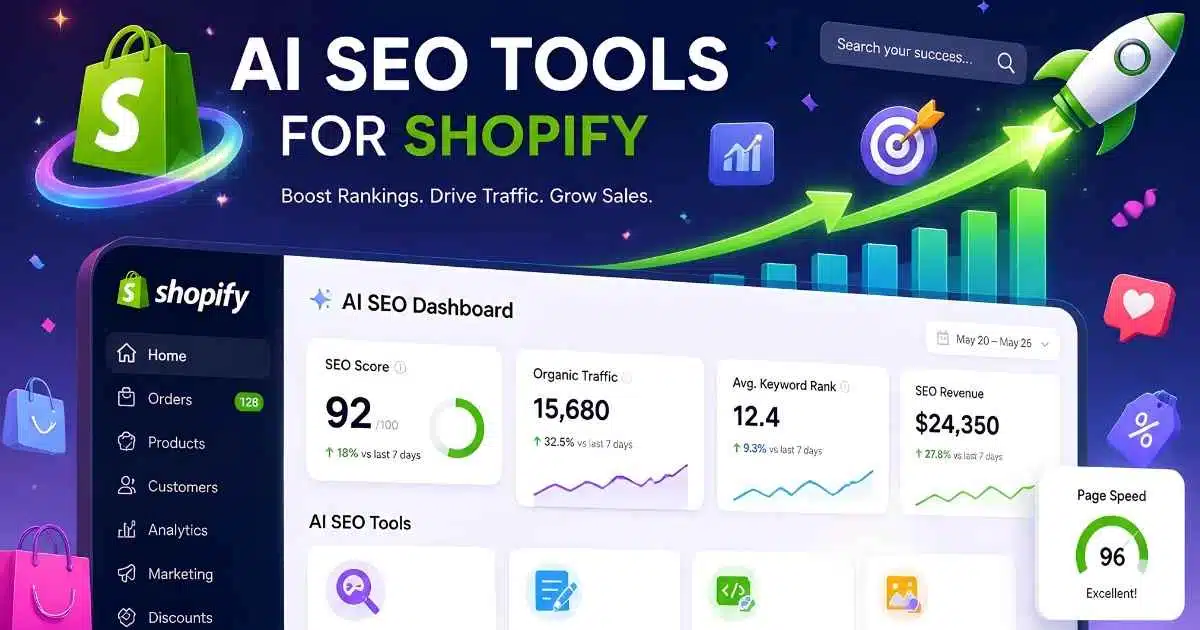
Search for AI SEO tools for Shopify and you will get two completely different answers depending on where you look. Shopify’s own blog points you toward external platforms like Semrush and Surfer. Review sites point you toward native App Store apps instead. Almost nobody explains how the two categories actually relate or which one fits your store’s actual size.
This guide covers both honestly, walks through llms.txt setup for AI visibility, and flags a conflict warning most merchants only discover after something breaks on a live site. None of it requires guessing. Match the tool to your catalog size and budget, not whichever platform ranks highest in search results today
Key Takeaways
- Native apps (Tiny SEO, SEOWILL, SEOLab) suit smaller catalogs with no-code, low-cost setup.
- External platforms (Semrush, Surfer SEO) suit larger catalogs needing deeper competitor research.
- Shopify Magic is free on every plan and the lowest-risk entry point for AI content.
- Tools fall into three tiers: read-only audits, copy-paste content generators, and direct write-access tools.
- Never run two full-featured SEO apps together — it causes duplicate meta tags and schema conflicts.
- Set up llms.txt and structured data once your core meta tags and content are already solid.
Native Shopify Apps vs External AI SEO Platforms: What’s the Difference
Native apps install directly through the Shopify App Store and integrate with your theme and admin panel automatically, no separate login or dashboard required.
External platforms, like Semrush or Surfer SEO, run outside Shopify entirely, meaning you copy generated content back into your store manually unless the platform offers a direct integration.
Native apps generally cost less and require zero technical setup, which suits smaller catalogs well. External platforms typically offer deeper competitor research and content optimization, but that depth comes with a steeper learning curve and a higher monthly price tag.
Neither category replaces the other completely, and many established stores end up running one of each rather than picking a single winner.
Best Native Shopify AI SEO Apps
Several App Store options now build AI directly into their core feature set rather than bolting it on as an afterthought.
Tiny SEO combines image optimization with AI-generated metadata and an llms.txt generator, starting free with paid tiers up to $49 a month for higher AI credit limits.
SEOWILL leans hardest into AI integration specifically, offering AI blog generation and keyword research from $29.99 a month, with a genuinely useful free tier for smaller stores testing the waters.
SEOLab remains genuinely free while still including structured data and llms.txt support, an unusually generous offer for a newer app in this space, though the company has indicated paid tiers are coming eventually.
For merchants comparing AI SEO tools for Shopify on a tight budget, these three cover the essentials without requiring a card on file.
What to Check Before Installing (Pricing, AI Credits, llms.txt Support)
Before installing anything, confirm three things: whether AI credits reset monthly or accumulate, whether the plan you need actually includes structured data support, and whether llms.txt generation is included or sold as an add-on. Free tiers often cap AI credits low enough that they only work for testing, not daily use across a real catalog.
Best External AI SEO Platforms for Shopify Stores
For stores that have outgrown basic App Store tools, external platforms fill the gap.
Semrush offers an AI SEO Toolkit tracking your brand’s visibility across ChatGPT, Perplexity, and Google AI Overviews alongside traditional keyword research, priced from $139.95 a month. Surfer SEO focuses specifically on content optimization, scoring your product and category pages against top-ranking competitors, starting at $99 a month.
Shopify Magic, built directly into every Shopify plan at no extra cost, generates product descriptions and images without leaving your admin panel.
For a store just starting to experiment with AI SEO tools for Shopify, Shopify Magic remains the lowest-risk entry point since there’s no separate subscription to evaluate before you commit to something bigger.
Read-Only Audits vs Copy-Paste Tools vs Write-Access Tools
Not every tool that calls itself “AI SEO” does the same job. Some only audit your site and hand you a report, leaving every fix to you manually, which still saves research time even if it adds implementation work back onto your plate.
Others generate content you copy and paste into Shopify yourself, a middle ground that speeds up writing without touching your store’s backend directly.
A smaller group connects directly to your store and applies changes automatically, whether through a native app’s built-in permissions or an external platform’s API integration.
That distinction matters more than feature-list length when comparing options. A tool that only audits saves research time but not implementation time, while a tool with direct write access saves both, provided you trust it enough to review changes rather than let it run fully unsupervised on a live catalog with real customer traffic.
How AI Is Used in Shopify SEO: Keyword Research to Technical Fixes
AI-assisted keyword research finds high-intent, product-specific phrases faster than manual lookup, and it flags competitor keywords you’re currently missing entirely. As Hiten Patel, an SEO account director quoted in Shopify’s own guide, put it, results depend heavily on which language model you use and how much product data you feed it.
On the technical side, AI tools scan for slow page speed, duplicate content, and broken links, then suggest or automatically apply fixes. Content generation covers product descriptions, meta tags, and blog posts at a scale manual writing simply can’t match for stores with hundreds of SKUs.
Consider a small candle brand with around 200 SKUs across a dozen scent lines, run by a single owner handling marketing alongside everything else.
The owner installed a native app for bulk meta description generation, then used Shopify Magic to draft product descriptions for new arrivals each week rather than staring at a blank text box every launch day.
Within two months, pages that previously shipped with placeholder meta tags started ranking for long-tail searches like “unscented soy candles for sensitive noses,” traffic the store had never captured before because nobody had time to write two hundred unique meta descriptions by hand.
The AI didn’t invent a new strategy. It just cleared a backlog that had been sitting untouched for over a year.
Setting Up llms.txt and AI Visibility Tracking for Your Store
An llms.txt file gives AI models a structured summary of your most important pages, separate from your regular sitemap. Several native apps, including Tiny SEO and SEOLab, now generate this file automatically from your dashboard in under ten minutes.
Pair that with structured data on your product, review, and FAQ pages, since AI models consistently prefer sources they can parse cleanly over pages with messy or missing markup. Google’s AI Overviews specifically cite pages with clear schema more often than pages without it, based on Shopify’s own guidance on the topic.
The One Warning Every Shopify Merchant Ignores: App Conflicts
Running two full-featured SEO apps simultaneously causes real problems: duplicate meta tags, conflicting schema output, and theme code that doesn’t fully remove itself even after you uninstall the app.
Independent app reviewers have flagged this specific issue directly, warning merchants against stacking too many SEO apps on a single live store, since the leftover code can linger for months unnoticed.
Pick one primary app or platform for your core SEO functions. If you want an additional AI-specific layer, like dedicated llms.txt generation, a lightweight single-purpose app can usually coexist safely, since it isn’t duplicating the same meta tag or schema functions your primary tool already handles.
The distinction that matters is full suite versus full suite, not any two tools that happen to touch SEO.
How to Choose the Right AI SEO Setup for Your Store
Match your choice to catalog size and budget rather than whichever tool has the flashiest demo video.
Stores under 500 products generally do fine with one solid native app and Shopify Magic for content, since the free-to-cheap tier covers most day-to-day needs. Stores managing thousands of SKUs across multiple collections typically need an external platform’s bulk optimization features to keep pace with that scale.
Technical comfort matters too. If you want a no-code, click-and-done experience, native apps and Shopify Magic fit better than platforms requiring manual content transfer and custom integration work.
Budget realistically as well: a $99-a-month tool only makes sense once it’s saving more than $99 worth of your time each month, not before.
Conclusion: Building Your Shopify AI SEO Stack
The right AI SEO tools for Shopify depend entirely on where your store sits right now, not on which platform currently dominates search results for this exact question.
A new store with 50 products needs a free native app and Shopify Magic, not a $500-a-month enterprise platform sized for a catalog ten times larger.
Start with one tool that solves your biggest bottleneck, avoid stacking multiple full SEO apps on the same store, and add llms.txt and structured data once your core meta tags and content are solid. That sequence beats buying every tool in a comparison roundup on day one, and it keeps your monthly costs pointed at problems your store actually has.
Frequently Asked Questions
Are native Shopify apps or external platforms better for AI SEO?
Neither wins universally. Native apps suit smaller catalogs needing simple, no-code setup. External platforms suit larger stores needing deeper competitor research and bulk content optimization.
Do I need to pay for AI SEO tools for Shopify to see results?
Not necessarily. Shopify Magic is free on every plan, and several native apps like SEOLab offer genuinely useful free tiers covering structured data and llms.txt generation.
Can I run two SEO apps on my Shopify store at once?
Avoid running two full-featured SEO apps together, since this causes duplicate meta tags and schema conflicts. A single-purpose add-on alongside one main app is generally safe.
What is llms.txt and does my Shopify store need one?
It’s a file summarizing your most important pages specifically for AI models. As AI-driven product discovery grows, having one improves your odds of getting cited in AI-generated answers.
Does Google penalize AI-generated Shopify product descriptions?
No, not simply for being AI-assisted. Google penalizes thin, unedited content produced purely to manipulate rankings, regardless of whether a human or AI wrote the first draft.

Abdul Manan is a professional SEO content creator and AI-SEO strategist at seofyai.com. He specializes in helping businesses rank higher on Google through AI-powered, data-driven content optimization. Connect on LinkedIn or visit seofyai.com for expert SEO tips.