
Somewhere between the hype and the skepticism sits a smaller, more useful question: is AI actually moving the needle for content teams, or is it just producing faster mediocrity? The honest answer depends entirely on the workflow around the tool. Looking at real AI content marketing case studies — not vague promises, but documented numbers from named companies — gives you a much clearer picture than another generic “AI will transform marketing” panel discussion.
This guide walks through what’s actually working, what’s quietly failing, and how to judge whether a case study is worth copying for your own content strategy.
What Are AI Content Marketing Case Studies (And Why They Matter)
An AI content marketing case study documents how a specific company used artificial intelligence to solve a real content problem — scaling product descriptions, improving SEO rankings, or cutting production time — and what measurable result followed. The value isn’t in the novelty of the tool. It’s in the before-and-after data that shows whether the effort actually paid off.
You’ll notice a pattern once you read enough of these: the companies getting real results rarely just “turned on AI.” They built a system around it — structured source material, brand voice rules, and a human reviewing the output before it shipped. That distinction matters more than which generative AI tool a company picked.
AI Content Marketing Case Studies at a Glance
Before diving into the details, here’s a quick comparison of the case studies covered in this article.
| Company | AI Tool Used | Result |
|---|---|---|
| Adore Me | Writer AI Studio | 40% increase in non-branded SEO traffic |
| Tomorrow Sleep | MarketMuse | 4,000 to 400,000 monthly visitors in one year |
| Otto’s Grotto | Jasper, ChatGPT | Revenue more than doubled in 2024 |
| Amarra | ChatGPT | 60% reduction in content creation time |
Rectangle vs Reality: Reading These Numbers Correctly
A word of caution before you get excited about any single row in that table: percentage gains and traffic multiples always depend on the starting point. A company going from 4,000 to 400,000 visitors had a lot more room to grow than an established brand already ranking well. Keep that context in mind as you read the fuller stories below.
Enterprise AI Content Marketing Case Studies
Larger companies tend to have more resources but also more complexity — legal review, multiple markets, and established brand voice guidelines that AI has to respect rather than override.
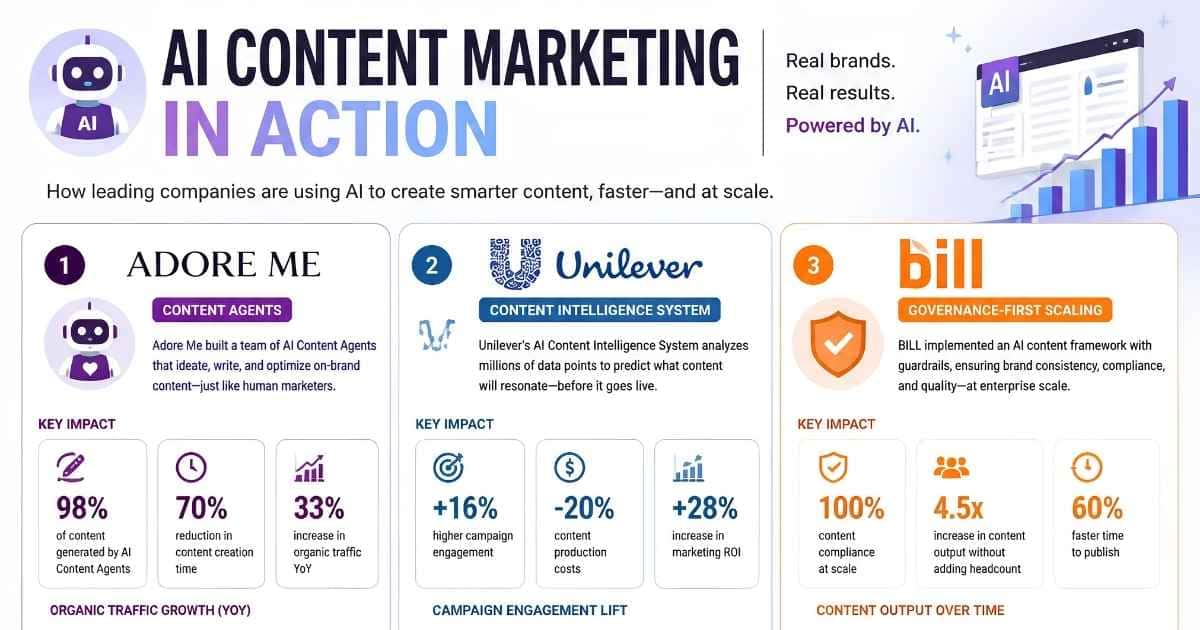
Case Study: Adore Me’s Content Agents
Adore Me, a direct-to-consumer lingerie brand, needed to scale product descriptions, multilingual copy, and stylist notes without expanding headcount or losing brand tone. Rather than outsourcing, the company built role-specific AI agents using Writer’s AI Studio, training one agent for SEO-optimized descriptions, another for Spanish translation, and a third for stylist notes that humans then refined.
The results were substantial: stylist note writing time dropped by 36%, product description generation went from 20 hours to 20 minutes per batch, and non-branded SEO traffic rose by 40%. What made this work wasn’t the AI alone — it was pairing each agent with a clearly defined task and a human checkpoint before publishing.
Case Study: Unilever’s Content Intelligence System
Unilever, managing hundreds of brands globally, built an AI platform called U-Studio to analyze past content performance and predict how new creative would land before launch. The system reduced production costs by roughly 30% across several campaigns and cut campaign planning time in half in some cases.
The lesson here transfers well beyond a company with Unilever’s resources: feeding AI your own historical performance data, rather than asking it to guess in a vacuum, produces sharper recommendations.
Case Study: BILL’s Governance-First Scaling
As BILL expanded its use of AI in content workflows, leadership recognized that scale without structure creates inconsistency fast. The company responded by building governance frameworks and accuracy standards before increasing output volume — a smaller but important reminder that speed without a quality gate just moves problems downstream instead of solving them.
Small Business & Solopreneur AI Content Marketing Case Studies
Most case studies spotlight household names, which can make AI feel out of reach for smaller teams. These two examples say otherwise.
Real-Life Example: Otto’s Grotto, a One-Person Sticker Shop
Therese Waechter runs Otto’s Grotto, an Indiana-based online sticker shop, largely on her own. Instead of hiring a copywriter or developer, she used AI tools like Jasper and ChatGPT to write product descriptions, generate hashtags, and even refine her Shopify storefront’s code — a practice she nicknamed “vibe coding.” According to Business Insider, her revenue more than doubled in 2024, and she improved her site’s functionality without ever hiring a developer.
This case matters precisely because it’s unglamorous. There’s no seven-figure ad campaign or celebrity tie-in — just one person using accessible tools to punch above her weight.
Case Study: Amarra’s Lean Content Operation
Amarra, a New Jersey-based formal gown distributor, used ChatGPT to write product descriptions, cutting content creation time by 60%. The company paired that with an AI-driven inventory system, which together reduced overstocking by 40% and let chatbots handle 70% of customer inquiries. Small teams rarely have room for trial and error, so a 60% time savings on writing alone frees up hours that go directly back into other parts of the business.
AI Content Marketing Case Studies for SEO & Organic Traffic Growth
If your main goal is organic visibility rather than product copy, one example stands out clearly above the rest.
Tomorrow Sleep’s 100x Traffic Growth
Tomorrow Sleep entered the mattress market in 2017 with a genuinely innovative product but a content strategy that wasn’t landing. The team turned to MarketMuse, an AI-powered content intelligence platform, using its research tools to identify high-value topics and its competitive analysis features to find gaps in what rivals were already ranking for.
Within a year, organic traffic climbed from roughly 4,000 to 400,000 monthly visitors — a hundredfold increase that put the startup ahead of established competitor Casper on several key search terms, including a featured snippet placement.
Key Content KPIs to Track
Whatever tool you use, track these metrics rather than vanity numbers alone:
- Organic traffic growth month over month
- Keyword ranking movement for target terms
- Featured snippet or “People Also Ask” captures
- Content production time per piece
- Conversion rate from organic content pages
Cost & ROI Breakdown of AI Content Marketing Tools
Pricing varies widely depending on scale and features, so treat these as starting points rather than fixed numbers.
| Tool | Starting Price | Best For |
|---|---|---|
| ChatGPT | Free; $20/month for Plus | General content drafting |
| Jasper | From $39/month | Marketing copy at scale |
| Surfer SEO | From $79/month | SEO content optimization |
| Writer | Custom/enterprise pricing | Brand-trained content agents |
Time Saved vs Dollar Cost
The real ROI question isn’t the subscription fee — it’s what that fee replaces. Amarra’s 60% time reduction on descriptions and Adore Me’s drop from 20 hours to 20 minutes per batch both represent labor hours saved that would have cost far more than any software subscription. When you’re evaluating a tool, calculate the hourly rate of the work it replaces before comparing sticker prices.
What Doesn’t Work — AI Content Marketing Failures & Lessons
Not every AI content push goes smoothly, and pretending otherwise does readers a disservice.
Common Mistakes Brands Make With AI Content
- Skipping structured source material and letting the model invent facts or context.
- Sending first drafts straight to senior reviewers instead of a lower-stakes editor.
- Measuring content volume instead of usable, published output.
- Using vague brand guidelines the model can’t consistently apply.
- Scaling production before a quality-control step exists.
Coca-Cola’s AI-generated holiday ad campaign is a well-known cautionary tale: the company produced thousands of pieces of content quickly, but faced public criticism over the visuals feeling generic and inauthentic. Speed without a quality filter created more content, not necessarily better content.
What to Check Before Copying These Case Studies
Before adapting any case study above to your own strategy, ask yourself: do you have approved source material, clear brand voice rules, and someone accountable for reviewing AI output before it publishes? Skipping that groundwork is the most common reason teams end up disappointed with results that looked so promising on paper.
GEO & AEO Case Study — Optimizing Content for AI Search Engines
Search behavior itself is shifting, and this deserves its own spotlight rather than a footnote.
How Brands Are Adapting to AI Overviews and Chat-Based Search
As platforms like ChatGPT, Claude, and Google’s AI Overviews increasingly answer questions directly, being cited by these systems matters as much as ranking on a traditional results page. Brands that show up in trusted, authoritative sources — press coverage, guest articles, and well-structured content — are more likely to get referenced by these AI systems than brands relying purely on traditional keyword-stuffed pages.
Schema Markup & FAQ Structuring for AI Citations
Structuring content with clear FAQ sections and FAQPage schema markup gives both traditional search engines and generative AI systems an easy, extractable answer format. This is a genuinely underused tactic among most AI content marketing case studies published so far, and it’s one of the easiest improvements to make on existing content.
Step-by-Step Template to Replicate These Case Studies
Rather than trying to copy any one company’s exact setup, use this simple framework:
- Identify one repeatable content task — product descriptions, blog drafts, or social captions.
- Gather structured source material: past content, brand guidelines, and examples of strong work.
- Train or prompt the AI tool with that material rather than a generic instruction.
- Set a clear review checkpoint before anything publishes.
- Track one or two KPIs relevant to that specific task, and revisit monthly.
Conclusion
The strongest AI content marketing case studies share a common thread: none of them treated AI as a magic shortcut. Adore Me, Tomorrow Sleep, and even a one-person sticker shop all paired the technology with structure — clear source material, defined review steps, and a specific problem to solve.
If you’re considering where to start, pick one content task that’s currently eating up your time, apply the same structure these companies used, and measure the result before scaling further. That’s a far more reliable path to real gains than chasing whichever tool made headlines this month.

Abdul Manan is a professional SEO content creator and AI-SEO strategist at seofyai.com. He specializes in helping businesses rank higher on Google through AI-powered, data-driven content optimization. Connect on LinkedIn or visit seofyai.com for expert SEO tips.