
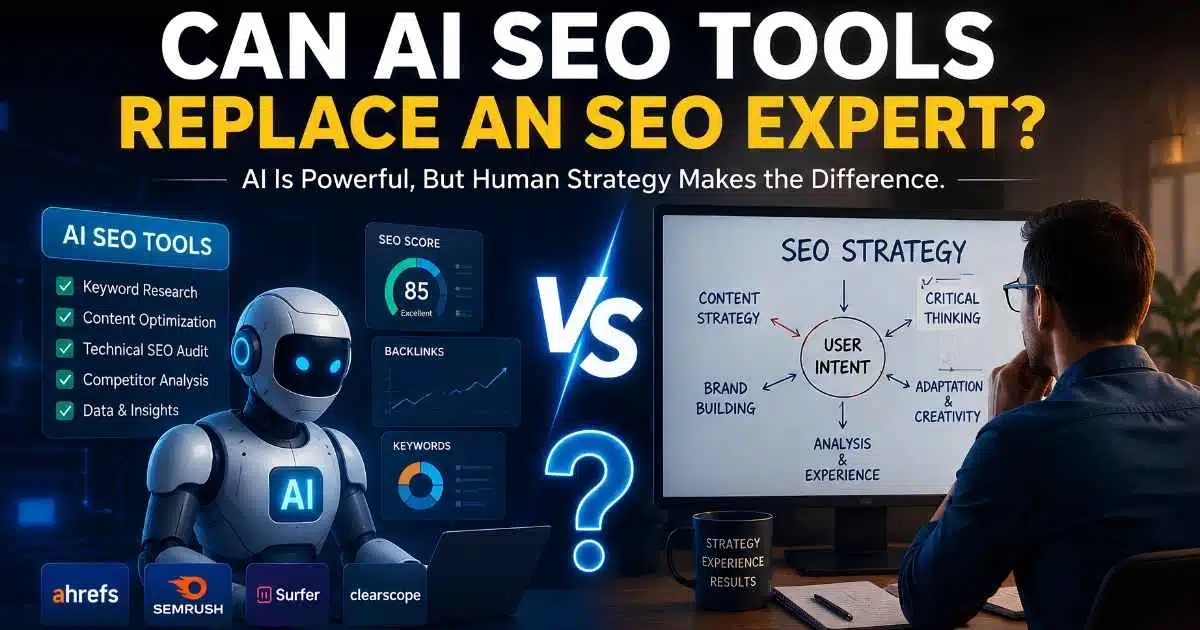
Every SEO software company’s homepage promises the same thing: automate your rankings, skip the consultant, let AI handle it. The pitch is tempting, especially for a small business watching every marketing dollar closely, and the tools genuinely do more than they did even a year ago. So can AI SEO tools replace an SEO expert in 2026?
The short answer is no, not fully, but the more useful answer explains exactly which tasks AI now handles well, which ones still need a human, and what it actually costs to get either approach wrong. That’s what this guide covers, with real numbers and a real failure case instead of vague reassurance.
Key Takeaways
- AI SEO tools excel at keyword research, technical audits, and reporting — repetitive, data-heavy work.
- Strategy, judgment during algorithm updates, and firsthand-expertise content still need a human.
- A local practice that ran AI content solo for 6 months saw traffic stall and 2 pages drop from Google’s index.
- A hybrid approach ($500–$2,500/month) often beats a full agency retainer while still catching strategic mistakes.
- “Will ChatGPT replace Google” and “can AI tools replace an SEO expert” are two different questions — don’t confuse them.
The Short Answer: What AI Handles vs What It Can’t
AI SEO tools excel at repetitive, pattern-based work: keyword clustering, technical audits across thousands of pages, meta tag generation, and performance reporting.
They process data faster than any human team, and they don’t get tired compiling the same weekly report for the fortieth time, freeing up hours that used to disappear into spreadsheet work every week.
What they can’t do is set strategy, weigh business priorities against each other, or take accountability when a ranking drop needs diagnosing under pressure.
Search intent shifts constantly, and reading that shift requires judgment AI tools simply don’t carry, since they work from historical patterns rather than genuine foresight about where a market or a search behavior is heading next.
What AI SEO Tools Actually Do Well
Keyword research is the clearest win. AI tools identify keyword variations, cluster related terms, and surface competitive gaps in minutes rather than the days manual research used to require.
That speed gives smaller teams access to research depth that used to be an enterprise-only advantage. Technical audits benefit similarly, flagging broken links, duplicate content, and missing meta tags across a large site faster than any manual crawl could realistically cover.
Content drafting has genuinely improved too, producing solid first-draft outlines and copy for straightforward, informational topics that don’t demand firsthand experience or specialized expertise.
Reporting and pattern detection round out the list: spotting a traffic drop or a sudden ranking swing happens automatically now, where it used to mean someone manually cross-referencing spreadsheets every Monday morning.
A small example shows the scale of this shift. A solo freelance photographer used an AI tool to generate meta descriptions for 80 old gallery pages in one afternoon, a task that would have taken her a full weekend of manual writing before. Nothing strategic changed. The tedious part just got faster.
Where AI SEO Tools Fall Short (Real Failure Patterns)
Here’s what over-reliance on AI actually looks like in practice, not as a hypothetical scenario dreamed up to scare you into hiring someone.
A local medical practice began running an AI content tool entirely on its own in early 2026, without any SEO oversight guiding the strategy behind it.
Over six months, the practice published nearly 40 posts, a genuinely impressive output pace for a small operation. Traffic barely moved.
Worse, two of the site’s older, thinner pages dropped out of Google’s index entirely, a problem reported by the agency Wowbix after the business finally brought in outside help to diagnose what had gone wrong.
Nothing was technically broken in the writing itself. The strategy behind it, keyword prioritization, internal linking, and knowing which pages actually mattered to the business, had simply never been set by anyone paying attention to the bigger picture.
That’s the pattern worth internalizing when weighing can AI SEO tools replace an SEO expert for your own site. AI tools execute what they’re pointed at with real efficiency. They don’t notice when the target itself is wrong, and nobody flags that gap until traffic has already stalled for months.
AI Tools vs Hiring an SEO Expert: Real Cost Comparison
Numbers make this decision concrete instead of theoretical, which matters more than another round of abstract pros-and-cons debate.
| Option | Typical Cost | What You Get |
|---|---|---|
| AI SEO tool (Semrush, Ahrefs) | $30–$500/month | Automated audits, keyword data, reporting |
| Freelance SEO consultant | $75–$200/hour | Strategy, execution, judgment on specific tasks |
| SEO agency retainer | $1,000–$10,000+/month | Ongoing strategy, execution, and accountability |
| Hybrid (tool + part-time expert) | $500–$2,500/month | Automated execution, human strategic oversight |
The hybrid row matters most for small businesses weighing whether AI SEO tools can genuinely stand in for hiring an expert outright.
Pairing a $150-a-month AI toolset with a few consulting hours monthly often costs less than a full retainer while still catching the strategic mistakes AI alone tends to make, the same category of mistake that quietly cost the medical practice in the example above six months of wasted publishing effort.
How Much AI Should You Use? A Framework by Team Size
Match your AI reliance to your actual stakes, not to whichever tool has the flashiest demo video promising instant results.
A solo blogger or hobby site can lean almost entirely on AI tools, since a missed opportunity here costs little beyond a slower growth curve than a fully optimized approach might deliver.
A small business with real revenue on the line should treat AI as the execution layer and budget for at least periodic expert review, whether that’s a few consulting hours monthly or a one-time strategy audit before committing to a full year of AI-only content.
Mid-market and enterprise sites need the reverse ratio: AI accelerates the mechanical work, but a human strategist owns direction, especially around algorithm updates and any technical change touching revenue-critical pages. This is really the heart of the can AI SEO tools replace an SEO expert question, answered by company stage rather than by a single universal rule.
The Automate vs Keep-Human Checklist
Some tasks clearly belong to AI. Others clearly don’t, and knowing the difference in advance saves a lot of trial-and-error frustration down the road.
Here’s the practical split worth pinning to your actual workflow.
Safe to automate: keyword research and clustering, technical audits at scale, meta description generation, first-draft outlines, routine performance reporting, and flagging obvious duplicate content across large sites.
Keep human-led: overall strategy and prioritization, content requiring genuine firsthand expertise, decisions during a ranking drop or algorithm update, link-building relationships built on real trust, and any change carrying real business risk if it goes wrong.
Treat this list as a starting point rather than a permanent rule, since your own risk tolerance and team capacity will shift which items land on which side over time.
ChatGPT vs Google ≠ AI Tools vs SEO Experts: Don’t Confuse These
These are two separate questions that keep getting mixed together, and the confusion muddies a lot of otherwise decent advice floating around online.
Whether ChatGPT will replace Google as a search platform is a question about where people search. Whether can AI SEO tools replace an SEO expert is a question about who does the work once you already know where your audience is searching.
Google still dominates traditional search by a wide margin, and that’s a genuinely different debate from whether a business needs human strategic oversight for the SEO work happening on whichever platforms actually matter to its audience.
Conflating the two leads to confused strategy: worrying about the wrong threat while missing the real one sitting inside your own content process, exactly as happened with the medical practice example earlier in this guide.
Conclusion: The Businesses Getting This Right in 2026
The honest answer to can AI SEO tools replace an SEO expert is that the businesses winning right now aren’t choosing one over the other, no matter how tempting that binary framing sounds on a vendor’s pricing page.
They’re using AI to handle the mechanical, repeatable layers of SEO work, and keeping a human accountable for the strategy sitting on top of it.
Skip the false choice between automation and expertise entirely. Budget for both, sized to your actual stakes rather than to a marketing promise, and you’ll avoid both the wasted spend of over-hiring for genuinely simple tasks and the quiet traffic decline that follows when nobody’s actually steering the strategy behind your content.
That balance, not a total win for either side, is what 2026’s most effective SEO teams have actually settled on.
Frequently Asked Questions
Can AI SEO tools replace an SEO expert completely?
No. AI handles repetitive, data-heavy tasks well but lacks the business context, accountability, and strategic judgment an experienced SEO professional brings to decisions with real consequences attached to them.
Is it safe for a small business to rely only on AI SEO tools?
For very simple, low-stakes sites, largely yes. As competition, technical complexity, or revenue stakes increase, periodic human oversight becomes increasingly worth the cost, even if it’s just a quarterly strategy check-in rather than a full retainer.
What SEO tasks are safest to automate with AI?
Keyword research, technical audits, meta tag generation, and routine reporting are well-suited to automation. Strategy, judgment calls, and firsthand-expertise content still benefit meaningfully from human involvement at some stage in the process.
Does AI-generated SEO content get penalized by Google?
Not simply for being AI-assisted. Google’s guidance focuses on whether content is genuinely helpful and accurate, not on whether a human or AI drafted the first version of a given page.
How do I know if my business needs an SEO expert instead of just AI tools?
If a wrong strategic call would meaningfully hurt revenue, or your market is competitive enough that execution alone won’t win, human oversight is worth budgeting for alongside your AI tools rather than instead of them.

Abdul Manan is a professional SEO content creator and AI-SEO strategist at seofyai.com. He specializes in helping businesses rank higher on Google through AI-powered, data-driven content optimization. Connect on LinkedIn or visit seofyai.com for expert SEO tips.