
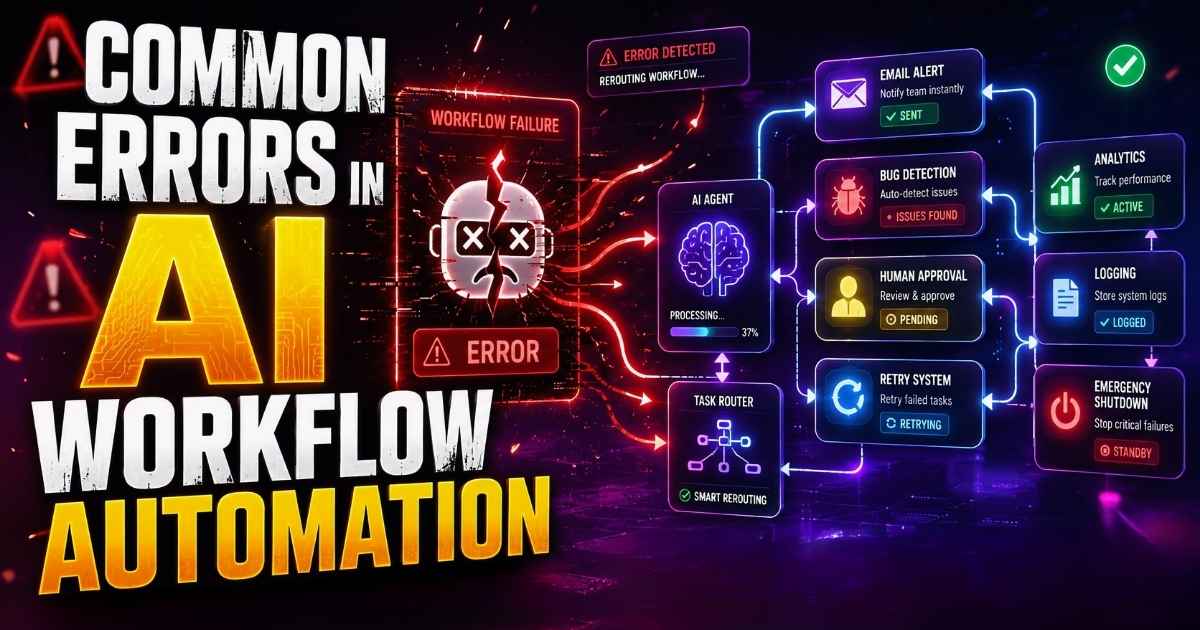
In today’s rapidly evolving digital landscape, Common Errors in AI Workflow Automation are becoming a critical concern for businesses that depend on smart systems to manage operations. As organizations adopt AI workflow automation to improve speed and efficiency, many still overlook hidden risks that can disrupt entire processes. Issues such as poor data handling, weak system integration, and lack of monitoring often lead to costly failures in enterprise workflow automation environments.
Moreover, without proper planning, even advanced tools like intelligent automation and AI-driven process automation can behave unpredictably. Understanding these challenges early helps businesses build more reliable, scalable, and efficient systems that truly support long-term growth and digital transformation success.
What Is AI Workflow Automation and Why Do Errors Happen?
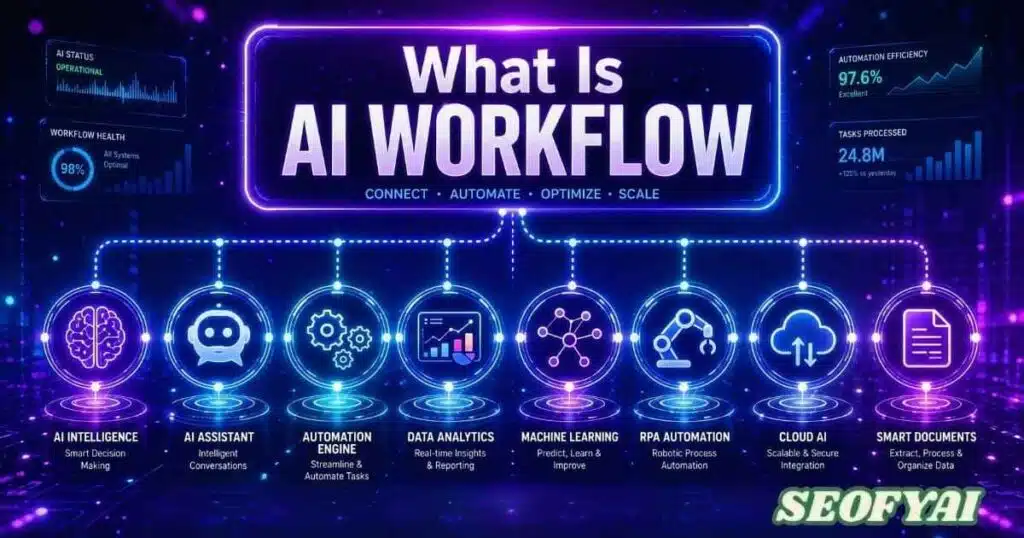
At its foundation, AI workflow automation combines machine learning, predictive analytics, and software integrations to automate repetitive business activities intelligently. Traditional automation follows rigid rules. Modern systems adapt dynamically based on incoming information.
For example, ecommerce companies use AI-driven process automation to personalize recommendations while banks use intelligent systems to detect fraud patterns instantly. This evolution has transformed operational efficiency across nearly every industry in the United States.
However, automation systems fail because AI behaves probabilistically instead of deterministically. Modern models generate outputs using statistical predictions. That means responses can vary depending on data quality, prompt context, and infrastructure conditions. Businesses deploying intelligent workflow automation frequently underestimate these variables.
Weak governance structures, unstable integrations, and fragmented data pipelines increase workflow fragility dramatically. Consequently, organizations experience hidden performance issues long before failures become visible publicly.
Traditional Automation vs AI Workflow Automation
| Feature | Traditional Automation | AI Workflow Automation |
| Logic Type | Rule-based | Adaptive learning |
| Flexibility | Limited | Dynamic |
| Maintenance | Minimal | Continuous |
| Learning Ability | None | Self-improving |
| Error Sources | Coding issues | Data and model instability |
| Scalability | Moderate | High but complex |
Another important factor involves the growing complexity of adaptive automation architecture. Enterprises now connect CRM systems, cloud databases, APIs, AI copilots, and analytics engines into one ecosystem. This creates deep dependency chains. One disconnected integration can trigger workflow failures across multiple departments simultaneously. Therefore, successful automation depends heavily on resilient infrastructure and proactive operational oversight.
Mistake 1 — Skipping Proper Workflow Planning Before Automation
One major reason businesses encounter Common Errors in AI Workflow Automation involves poor workflow planning. Organizations often rush into deployment because competitors are adopting AI aggressively. Executives hear promises about efficiency gains and operational savings then immediately purchase automation platforms. Unfortunately, many skip the process analysis stage entirely. That decision creates confusion, duplicated tasks, disconnected systems, and workflow bottlenecks.
A logistics company in Illinois recently implemented an advanced AI orchestration platform to automate shipment approvals and inventory forecasting. Leadership expected faster operations and lower labor costs. Instead, delays increased because departments used inconsistent approval structures. Certain requests looped endlessly between systems. Employees became frustrated while customers experienced shipping delays. This situation illustrates why workflow mapping matters before deployment begins.
Organizations also make the mistake of assuming automation can replace strategic human judgment entirely. While AI handles repetitive activities effectively, nuanced decision-making still requires people. Businesses that combine employees with human-in-the-loop AI typically achieve stronger reliability, higher customer trust, and better long-term operational resilience.
Workflow Planning Failure Impact
| Planning Mistake | Business Consequence | Better Strategy |
| No process mapping | Workflow confusion | Visualize operations first |
| Undefined KPIs | Weak performance tracking | Set measurable goals |
| Poor team alignment | Department conflicts | Cross-functional planning |
| Ignoring scalability | Expensive rebuilds | Plan future expansion |
| No testing environment | Operational failures | Use sandbox validation |
Strong planning also reduces future automation maintenance overhead because teams understand infrastructure dependencies from the beginning. Businesses with documented workflows can diagnose failures faster and optimize systems more effectively over time.
Mistake 2 — Choosing the Wrong AI Tools or Platforms
Another critical issue appears when businesses choose automation platforms based on popularity instead of operational compatibility. The market for enterprise workflow automation tools has expanded rapidly. Vendors promise instant transformation through predictive automation, AI copilots, and advanced analytics. Yet many platforms fail under real-world production conditions because they lack scalability, integration flexibility, or governance controls.
Organizations frequently deploy low-cost software without evaluating API compatibility or infrastructure resilience. That creates unstable workflows and rising maintenance costs. Businesses then spend months fixing integrations instead of improving productivity. Companies using production-grade AI systems require secure, scalable platforms capable of handling large operational workloads consistently.
Another hidden risk involves vendor lock-in. Some automation providers restrict migration flexibility, making future transitions extremely expensive. Enterprises should prioritize interoperability, governance features, and security certifications before implementation. Otherwise, automation systems become difficult to scale as operational demands increase.
Common AI Tool Selection Mistakes
| Mistake | Operational Risk | Better Approach |
| Selecting tools based on price only | Scalability limitations | Evaluate long-term ROI |
| Ignoring integrations | Workflow instability | Test APIs early |
| Weak governance controls | Compliance exposure | Review certifications |
| Overcomplicated interfaces | Employee resistance | Prioritize usability |
| Vendor dependency | Expensive migrations | Use flexible ecosystems |
Strong platforms improve AI workflow execution, support observability dashboards, and enable reliable escalation controls. Businesses should also test how systems perform during sudden traffic spikes or unexpected infrastructure disruptions.
Mistake 3 — Ignoring Data Quality and Governance Issues
Data quality directly determines automation reliability. Even advanced AI systems fail when businesses feed them inaccurate or inconsistent information. Dirty datasets often include duplicates, missing values, outdated records, or biased historical patterns. Those issues create unstable predictions and unreliable automation outcomes. Consequently, organizations experience customer frustration, operational delays, and compliance concerns.
Businesses implementing AI decision automation frequently underestimate governance complexity. Effective governance includes validation rules, permission controls, data lineage tracking, and compliance oversight. Without these safeguards, AI systems may expose sensitive information accidentally or generate biased decisions. Industries such as healthcare and finance face especially high risks because regulatory standards remain strict.
Another challenge involves model training bias. AI systems learn patterns from historical data. If training datasets contain discrimination or inaccuracies, automation amplifies those problems automatically. Companies therefore need strong AI validation layers to maintain fairness and consistency throughout operational workflows.
Organizations with mature governance structures experience stronger AI model reliability over time. They also reduce infrastructure instability significantly because systems operate on standardized, verified information. According to the NIST AI Risk Management Framework robust governance remains essential for sustainable enterprise automation.
Mistake 4 — Underestimating AI Model Stochasticity and Unpredictability
Modern AI systems generate outputs probabilistically rather than deterministically. This concept, commonly called LLM stochasticity, explains why models sometimes produce different responses under similar conditions. Businesses expecting fixed consistency often become frustrated because AI behavior changes dynamically depending on prompts, context, and environmental variables.
These probabilistic AI outputs create operational risk inside customer support, legal reviews, and financial automation. A chatbot may provide accurate guidance during one interaction then generate misleading recommendations later. This inconsistency reduces customer trust quickly. Many organizations mistakenly assume successful testing guarantees stable long-term performance. In reality, AI requires continuous validation under changing workloads and scenarios.
Advanced contextual AI systems become even more unpredictable because outputs depend heavily on historical interactions and conversational context. Small wording changes can dramatically alter results. Therefore, enterprises should implement confidence scoring mechanisms, validation checkpoints, and human oversight before executing high-risk decisions automatically.
Deterministic vs Probabilistic AI Systems
| System Type | Behavior Pattern | Stability Level |
| Rule-Based Software | Fixed outputs | Highly stable |
| Generative AI Models | Variable outputs | Context dependent |
| Hybrid AI Systems | Mixed behavior | Moderately stable |
Organizations building resilient AI systems usually combine automation with layered review processes. This strategy minimizes hallucinations while improving operational reliability across production environments.
Mistake 5 — Over-Automating or Automating the Wrong Processes
Another hidden contributor to Common Errors in AI Workflow Automation involves excessive automation. Many businesses attempt to automate every operational process regardless of emotional complexity or strategic importance. While automation excels at repetitive tasks, it struggles with empathy, negotiation, and contextual reasoning.
Several SaaS businesses recently adopted fully automated onboarding using AI-powered onboarding and AI onboarding automation systems. Initially, onboarding speed improved significantly. However, customer retention declined because users lacked personalized assistance during technical setup issues. Consequently, trial-to-paid conversion rates dropped despite faster onboarding workflows.
Businesses should focus on selective automation instead of complete replacement. Repetitive administrative tasks work extremely well with AI. Crisis management and strategic negotiations do not. Organizations that combine automation with contextual AI assistance typically achieve stronger customer experiences and more sustainable operational growth.
Excessive complexity also increases infrastructure fragility. Companies deploying dozens of disconnected tools simultaneously create unstable environments that become difficult to monitor or optimize effectively.
Mistake 6 — No Error Handling Plan or Exception Management
Automation systems inevitably fail at some point. APIs disconnect. Databases crash. AI models generate inaccurate outputs. Yet many businesses deploy systems without recovery plans or escalation protocols. When failures occur, workflows stop completely. Customer requests disappear while operational delays multiply rapidly.
Strong AI escalation workflows prevent isolated problems from spreading across interconnected systems. Organizations should implement rollback procedures, retry logic, real-time monitoring alerts, and disaster recovery plans from the beginning. Unfortunately, many executives prioritize deployment speed instead of resilience. That creates dangerous operational fragility.
Modern enterprises increasingly depend on AI execution engine technologies to coordinate workflow activities across departments. One failed integration can therefore affect multiple operational layers simultaneously. Businesses must build systems capable of recovering quickly during unexpected disruptions.
Advanced organizations now deploy self-healing automation capabilities that automatically reroute workflows and restart failed processes without manual intervention. These features improve uptime while reducing operational risk dramatically.
Mistake 7 — Failing to Monitor, Maintain and Track Performance
Many organizations incorrectly believe automation becomes self-sustaining after deployment. In reality, systems require continuous monitoring and optimization. Data evolves constantly. User behavior changes rapidly. Regulatory requirements also shift over time. Without maintenance, automation quality gradually deteriorates.
Businesses managing large-scale AI workflow automation systems should monitor output accuracy, task completion rates, workflow interruptions, and customer satisfaction continuously. Weak observability allows hidden problems to remain undetected for months. By the time failures become visible publicly, operational damage may already be severe.
Companies implementing advanced workflow orchestration environments often use observability dashboards to monitor APIs, infrastructure health, and processing performance in real time. This improves operational visibility while helping teams identify bottlenecks faster.
Essential AI Monitoring Metrics
| Metric | Purpose | Warning Indicator |
| Accuracy Rate | Measures reliability | Frequent corrections |
| Workflow Speed | Tracks efficiency | Delayed execution |
| Error Frequency | Detects instability | Rising failures |
| Customer Satisfaction | Measures experience quality | Negative feedback |
| Model Drift | Detects degradation | Prediction inconsistency |
Continuous optimization also improves AI implementation ROI because organizations reduce downtime and operational inefficiencies proactively. Monitoring should therefore remain a permanent operational priority rather than a temporary deployment task.
Mistake 8 — Neglecting Human-AI Collaboration and Change Management
Technology alone cannot guarantee successful automation. Employees must understand how systems operate and why automation matters. Unfortunately, many organizations ignore change management entirely. Workers fear redundancy, surveillance, and loss of control. This resistance quietly undermines adoption efforts.
Businesses that combine people with AI effectively often outperform fully automated competitors. Customer support teams using conversational AI frequently resolve repetitive inquiries faster while maintaining empathy during complex interactions. Employees become more productive because AI handles repetitive tasks first.
Strong communication also improves AI-assisted product adoption across enterprises. Leaders should explain how automation enhances employee capabilities rather than replacing workers entirely. Companies using digital adoption platform solutions often experience smoother onboarding because employees receive guided support during workflow transitions.
Transparency matters deeply as well. Employees trust automation systems more when organizations explain decision logic clearly. Companies that prioritize collaboration, training, and visibility usually achieve stronger operational stability and higher employee engagement.
How to Prevent AI Workflow Automation Errors — Pro Tips Checklist
Preventing Common Errors in AI Workflow Automation requires strategic planning, infrastructure resilience, governance controls, and continuous optimization. Businesses should begin with small pilot projects instead of enterprise-wide deployment immediately. Testing smaller environments helps identify hidden risks before large-scale implementation.
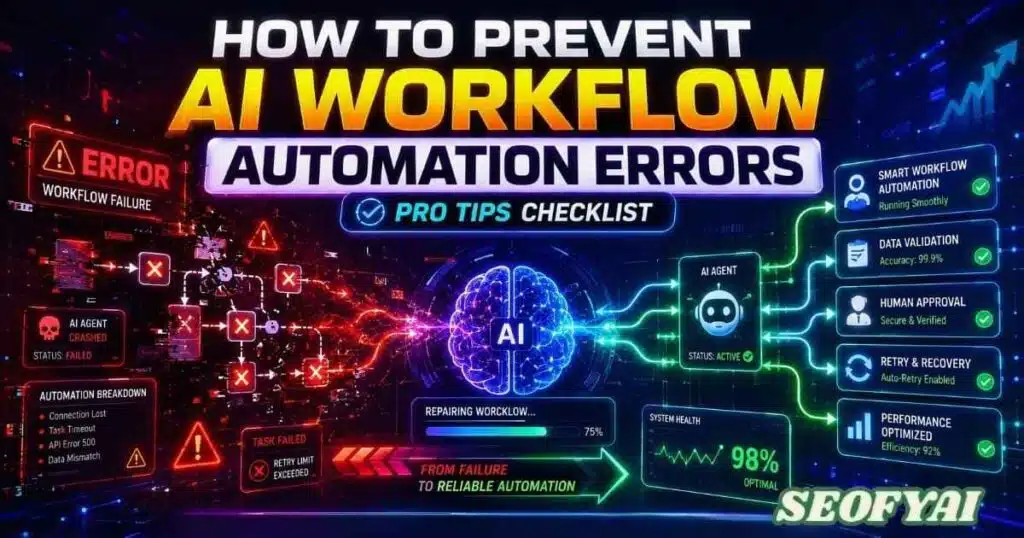
Organizations achieving sustainable automation success invest heavily in monitoring, employee training, validation systems, and cybersecurity protections. They combine AI efficiency with human oversight instead of pursuing unrealistic autonomy. Strong governance frameworks improve reliability while reducing operational disruptions significantly.
AI Workflow Automation Prevention Checklist
| Prevention Strategy | Business Advantage |
| Workflow mapping before deployment | Reduces confusion |
| Continuous data validation | Improves output accuracy |
| Human review checkpoints | Prevents risky decisions |
| KPI monitoring systems | Detects issues early |
| Sandbox testing | Reduces deployment failures |
| Employee AI training | Increases adoption |
| Rollback mechanisms | Improves resilience |
Businesses should also maintain continuous AI workflow optimization practices because operational environments evolve constantly. Companies that adapt proactively remain more competitive as automation technology advances through 2026 and beyond.
Best AI Tools to Reduce Workflow Automation Errors in 2025
Modern platforms now provide advanced orchestration, governance, and observability capabilities. Solutions like UiPath and Microsoft Power Automate support enterprise-grade scalability with strong monitoring systems and integration controls.
Other platforms specialize in AI customer onboarding, predictive automation, and workflow intelligence. Many organizations now deploy systems featuring integrated process mining and task mining capabilities to identify operational inefficiencies automatically. Advanced solutions also support embedded AI agent technologies for contextual assistance during workflow execution.
Companies focused on ARR growth through AI frequently combine onboarding analytics, workflow intelligence, and engagement automation to improve user activation, increase retention, and strengthen long-term operational efficiency.
Conclusion
The future of enterprise operations increasingly depends on intelligent automation. Yet automation without governance often creates instability instead of efficiency. Businesses that rush implementation typically face hidden infrastructure weaknesses, inconsistent outputs, employee resistance, and rising maintenance costs.
Understanding the Common Errors in AI Workflow Automation helps organizations avoid expensive operational failures before they occur. Companies that prioritize planning, testing, monitoring, governance, and human collaboration consistently achieve stronger results. As automation technology continues evolving, resilient systems and adaptive strategies will define the next generation of digital business success.
Frequently Asked Questions (FAQ)
What are the most common failure points in automated workflows?
The most common failure points in automated workflows include poor data quality, weak system integration, missing error handling, and lack of continuous monitoring in AI workflow automation systems.
What are the problems with AI automation?
AI automation often struggles with biased data, unpredictable outputs, and integration issues that reduce reliability in enterprise workflow automation environments.
What is a common mistake when implementing AI?
A common mistake is deploying AI without proper planning, governance, and testing, which leads to unstable AI workflow automation performance.
What is the biggest flaw of AI?
The biggest flaw of AI is its dependency on data quality and probabilistic behavior, which can cause inconsistent decisions in intelligent automation systems.
Why do 85% of AI projects fail?
Most AI projects fail due to poor strategy, low-quality data, lack of skilled execution, and weak alignment between business goals and AI workflow automation implementation.

Abdul Manan is a professional SEO content creator and AI-SEO strategist at seofyai.com. He specializes in helping businesses rank higher on Google through AI-powered, data-driven content optimization. Connect on LinkedIn or visit seofyai.com for expert SEO tips.