

Every few months, someone writes a headline that says SEO is dead. This year, the reason is AI. ChatGPT answers questions. Google shows AI summaries at the top of the page. People click less. So the panic feels real, and it spreads fast on social media.
But panic is not data. Is SEO dead now with AI, or is something smaller and more interesting happening underneath all the noise? This guide looks at the real numbers, explains what changed and what didn’t, and gives you a simple plan you can actually use, even if you run a small blog with no big team behind it.
The Short Answer (With the Data Behind It)
No, SEO is not dead. Google still holds about 90% of the global search market, based on recent StatCounter data, a number that barely moved despite a year of AI headlines. Organic search still sends roughly 53% of all website traffic, more than any paid channel combined.
Here’s the part that surprises people asking is SEO dead now with AI: AI answers still lean heavily on traditional search rankings. A large meta-analysis of 54 AI citation studies by Cyrus Shepard found that search rank is the second-strongest factor in whether AI tools cite your page, just behind basic URL accessibility. In plain words, if you don’t rank, AI mostly won’t quote you either.
What Actually Changed: AI Overviews and Zero-Click Search
Something did change, and it’s worth naming clearly. AI Overviews now sit at the top of many Google results, answering the question before anyone clicks a link. This is called zero-click search, and it’s grown fast.
The Real Click-Through Numbers
Pew Research found that people click a normal search result only 8% of the time when an AI summary appears, compared to 15% when it doesn’t, roughly cutting click rates in half. Ahrefs measured an even bigger drop for top-ranked pages, with click-through rates falling by 34.5%, and later by as much as 58%, on queries where AI Overviews show up prominently.
That’s a real shift, and dismissing it would be dishonest. But notice what it isn’t: it isn’t proof that SEO stopped working entirely. It’s proof that simple, easy questions now get answered directly on the page, without a click, which changes which kind of content deserves your time most.
SEO vs AEO vs GEO: What’s the Actual Difference
These three terms get mixed up constantly, so let’s separate them simply.
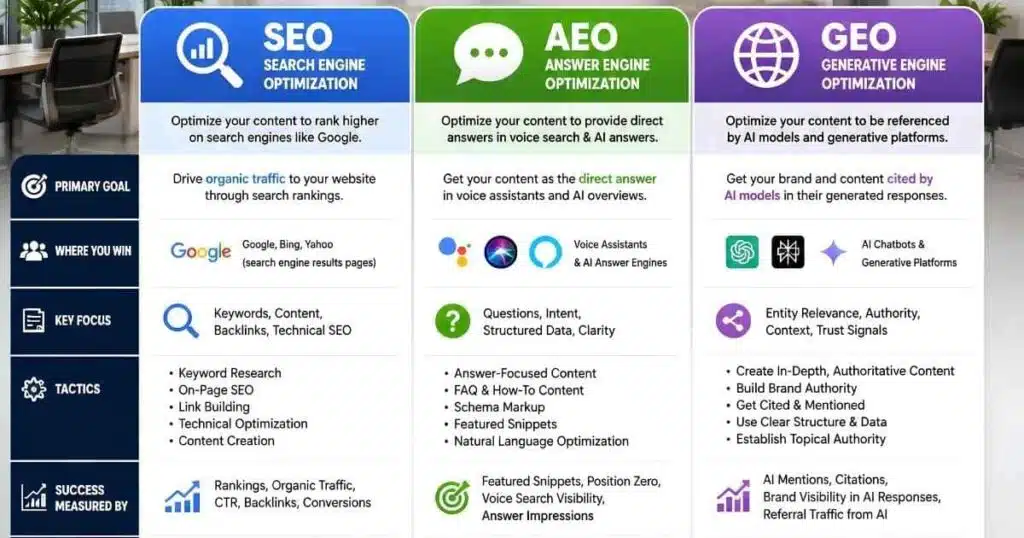
SEO (search engine optimization) is the work of ranking well in traditional search results, the same discipline that’s existed for over two decades.
AEO (answer engine optimization) is about getting your content picked as the direct answer inside search features and AI tools rather than just appearing as a link.
GEO (generative engine optimization) is the newer layer, focused on how AI models like ChatGPT and Perplexity pull, summarize, and cite your content when generating a full response.
Think of it like layers on a cake. SEO is the base. AEO and GEO sit on top, shaping how that base content gets picked and quoted once it’s already baked. You can’t skip the base and expect the top layers to hold up on their own, no matter how much marketing hype suggests otherwise.
Google’s Own “Ignore These” List: GEO Myths Debunked
Here’s something most articles about AI and search skip entirely. Google published its own AI optimization guide, and it directly tells you what NOT to bother with, which is rare honesty from a company that usually keeps its ranking factors vague.
Google says you don’t need an llms.txt file; their systems don’t use it. Breaking your content into tiny chunks “for the AI” doesn’t help either, since Google’s systems already handle full pages fine. Rewriting every page for every long-tail keyword variation is also unnecessary, because modern models already understand synonyms and intent without needing every phrasing spelled out.
And piling on extra schema markup beyond the basics won’t earn you extra AI visibility on its own, contrary to what some SEO tool vendors imply.
What actually helps, according to Google, is the same thing that’s always helped: clear, useful, original content built around real expertise and honest experience.
Why AI Overviews Still Depend on Traditional Rankings
This is the part that answers is SEO dead now with AI most directly. AI Overviews are not magic. They pull their answers from pages that are already indexed, crawled, and ranked by normal search systems.
The 38% Citation Overlap
Ahrefs found that 38% of AI Overview citations come straight from Google’s top 10 organic results. Widen the window past the top 10, and the overlap grows even more. AI tools aren’t inventing new sources out of nowhere. They’re extracting from the same pool of content that traditional SEO has always targeted.
The Ghost Citation Problem: Getting Used Without Getting Credit
Here’s a real risk that deserves more attention than it usually gets. Research from Kevin Indig, covering nearly 4,000 domains across multiple AI search engines, found that 61.7% of AI citations are “ghost citations.” That means the AI used your content, your data, your conclusions, but never actually named your brand in the answer it gave the user.
Only about 13.2% of the time did a brand get both a citation and a proper mention together. The fix isn’t complicated, though. Naming your brand directly inside your own claims, like “Our 2026 audit of X found Y,” makes it much easier for an AI system to carry that attribution forward instead of quietly stripping it out during summarization.
AI Agents Are Now Visitors Too — Not Just Chatbots
Something else is shifting quietly in the background. Tools like OpenAI’s Operator and Google’s browsing agents can now visit websites, compare products, and even fill out forms, all without a human clicking anything.
This means your site has a new kind of visitor: an AI agent acting on someone’s behalf. Content built with clear structure, honest pricing, and simple navigation serves this new visitor just as well as it serves a human one. It’s a genuinely new consideration, and one most “is SEO dead” articles never mention at all.
What Died vs What Just Changed
Being precise here matters more than being dramatic. Nothing about ranking well, earning trust, or writing genuinely useful content has died. What’s fading fast is a specific, older style of content.
The Content Formats That Stopped Working
Generic listicles built from common knowledge, the kind any AI tool could write in thirty seconds, are losing ground fast. Thin, keyword-stuffed pages built only to rank, not to help, are also fading. Purely informational content answering a simple factual question, the kind AI Overviews now answer directly on the results page, sees the sharpest click declines.
What still works, and works better than before, is original research, first-hand experience, named case studies, and content built around real proof rather than repackaged summaries.
A Realistic Action Plan for Solo Bloggers and Small Sites
Most advice about AI and SEO assumes you have a marketing team and a big budget behind you. You probably don’t, and that’s genuinely fine. Here’s a smaller, realistic plan that answers is SEO dead now with AI for someone working alone.
Your First 30 Days
Start by putting a clear, direct one-sentence answer right after your main heading on your top five pages, since that’s the sentence AI systems tend to extract first. Add a short TL;DR block near the top of older posts, just three to five plain bullet points summarizing the key takeaway. Name your own brand or your own name directly inside any original claim or data point you share, so credit sticks rather than getting stripped out.
Finally, pick your two or three best-performing posts and add one genuine, specific detail no competitor page has, a real number, a real result, a real story. That single change often does more than a dozen small technical tweaks.
Consider a small local bakery blog that added a simple TL;DR block and a direct one-line answer to its five best posts, changing nothing else about the writing itself. Within a few weeks, two of those posts started appearing inside AI Overview summaries for local baking questions, something that had never happened before, simply because the content became easier to extract cleanly.
Common Mistakes Businesses Make Panicking Over “SEO Is Dead”
The biggest mistake is cutting SEO spending entirely out of fear, then quietly losing the 53% of traffic organic search still reliably sends. A close second is chasing every new acronym, GEO, AEO, LLMO, without fixing basic content quality first, which is like decorating a cake before you’ve baked it.
Some businesses also over-invest in technical tricks Google has explicitly said don’t matter, like llms.txt files or excessive content chunking, wasting time that would be better spent on original research or clearer writing.
Conclusion: SEO Isn’t Dead, But Doing It Like 2019 Is
The honest answer to is SEO dead now with AI is that the discipline is very much alive, just wearing a different outfit. AI Overviews, zero-click search, and generative answers all still lean on the same foundation: real content, real rankings, real trust signals.
What’s actually dead is the lazy version of SEO, generic listicles, thin pages, and keyword stuffing with no substance behind it. Build content worth citing, name your claims clearly, and keep an eye on the new AI-agent visitors alongside your human readers. Do that, and SEO keeps working exactly the way it always has: quietly, in the background, for the businesses willing to do it properly.
Frequently Asked Questions
Is SEO dead now with AI in 2026?
No. Google still holds about 90% of global search share, and 38% of AI Overview citations come directly from top-10 organic results, meaning traditional ranking still drives AI visibility.
Does AI Overview really reduce website traffic?
Yes, for simple factual queries. Click-through rates drop significantly when an AI summary appears. Commercial and detailed queries still generate strong clicks, since users want more than a one-line answer.
What’s the difference between SEO, AEO, and GEO?
SEO is ranking in traditional search. AEO is getting picked as a direct answer. GEO is being cited and summarized accurately by AI models like ChatGPT. They build on each other rather than replacing one another.
Do I need an llms.txt file for AI search visibility?
No. Google has stated directly that its systems don’t use llms.txt files, so creating one won’t improve your AI search visibility.
How long does it take to see results from optimizing for AI search?
Structural changes, like adding direct answers and TL;DR blocks, can show citation changes within a few weeks. Broader brand recognition inside AI answers usually takes one to three months to build.

Abdul Manan is a professional SEO content creator and AI-SEO strategist at seofyai.com. He specializes in helping businesses rank higher on Google through AI-powered, data-driven content optimization. Connect on LinkedIn or visit seofyai.com for expert SEO tips.