
Understanding how marketing automation affects SEO starts with one blunt reality: manual SEO is dying fast. Brands across the USA now lean on marketing automation software to handle repetitive tasks, scale content production, and dominate Google rankings without burning out their teams. The competition in 2026 is fiercer than any year before it — every day spent clicking through spreadsheets manually, a sharper competitor automates the same work and pulls ahead.
Digital marketing automation connects your entire SEO workflow into one system that runs around the clock, tracking keywords, monitoring technical health, and scheduling content automatically. That’s exactly how marketing automation affects SEO at scale, turning scattered weekly chores into one continuous engine.
What Is SEO Marketing Automation and How Does It Actually Work?
SEO Automation means using software to handle repetitive Automated SEO Tasks automatically. Instead of manually checking rankings or fixing broken links every week, tools do it for you around the clock. This frees your team to focus on strategy, creativity, and real growth.
Think of it like hiring a tireless assistant who never sleeps. Platforms like SEMrush and Ahrefs run SEO audits, monitor keyword tracking, and flag technical errors the moment they appear. The result is faster fixes, stronger website health, and better Google rankings without burning out your entire team.
The Core Mechanism Behind SEO Automation
At its core, SEO Workflow automation connects your data sources, tools, and publishing platforms into one smooth pipeline. A trigger happens — say, a page drops in rank — and the system alerts you instantly. That speed is exactly what separates automated teams from manual ones in 2026.
How Marketing Automation Affects SEO: Growing Your Brand Together
Digital marketing automation and SEO chase the same target — the right visitor, at the right moment. Once you see how marketing automation affects SEO, growth stops being additive and starts compounding. Email sequences and social scheduling pull people back repeatedly, and every return visit lifts your organic search traffic and search rankings.
Why Integration Between the Two Is Non-Negotiable in 2026
US buyers cross five or six touchpoints before converting, and automation stitches those into one journey. This is how marketing automation affects SEO strategy for teams that once worked in silos.
Turning Data Into Decisions
When CRM data feeds your SEO dashboard, you see which pages actually drive your marketing funnel — that’s how marketing automation affects SEO at the metric level.
Key SEO Tasks That Benefit Most from Marketing Automation
Some SEO tasks are perfect for automation. Rank tracking, broken link monitoring, metadata optimization, and automated reporting are repetitive by nature. Doing them manually every week wastes hours that your team could spend on high-impact creative strategy work. This is exactly how marketing automation affects SEO efficiency at scale.
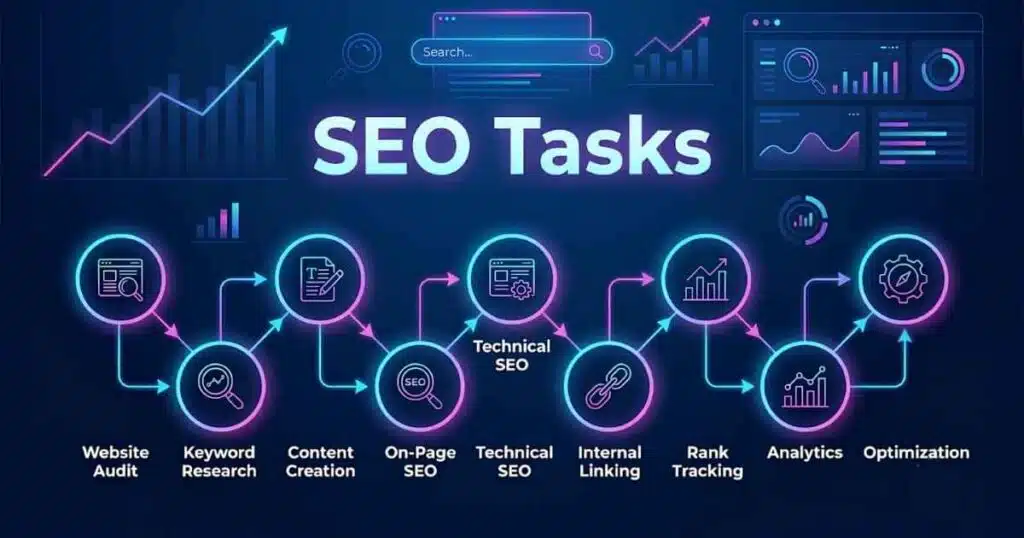
Content automation is another massive win for growing brands. Scheduling blog posts, updating old content, and pushing metadata changes across hundreds of pages becomes completely effortless. SEO scalability jumps dramatically when your workflow automation handles the heavy lifting quietly behind the scenes.
Which Workflows Deliver the Highest ROI When Automated
The highest-return automation tasks are the ones you repeat most often. Traffic monitoring, keyword monitoring, and technical SEO health checks run daily in the background without any manual effort. Your team wakes up every morning to a clean, actionable report — not a pile of exhausting manual work waiting on the desk.
3 Ways Marketing Automation Directly Revolutionizes Your SEO Strategy
First, automation scales your content automation for tech operations without scaling your headcount or budget. You can publish more, optimize more, and monitor more — all without hiring a bigger team. That directly improves your SEO efficiency and bottom line month after month.
Second, automated content management keeps your existing pages consistently fresh. Content freshness is a real Google ranking factor that most brands ignore completely. Pages that get regular updates outperform stale ones every time. Automation schedules those updates so nothing important ever gets forgotten or left behind.
From Reactive to Proactive — How Automation Shifts Your SEO Game
Manual SEO is always reactive. You notice a problem only after it has already damaged your rankings significantly. Marketing workflows powered by automation flip that dynamic entirely. You get alerts, reports, and smart recommendations before small issues grow into serious ranking penalties that cost real traffic.
How Marketing Automation Impacts Your Search Rankings
Knowing how marketing automation affects SEO rankings helps you prioritize the right signals from the start. Search Rankings respond to dozens of signals simultaneously — page speed, content freshness, click-through rates, and dwell time all matter deeply. Automated SEO Tasks monitor and improve these signals continuously at a scale no human team can match manually.
Technical SEO health directly influences how Google crawls and indexes your entire site. Automation catches crawl errors, broken redirects, and slow pages in real time before they hurt you. Fixing these issues fast keeps your search visibility high and your competitors consistently guessing your next move.
The Direct Ranking Signals Automation Helps You Control
| Ranking Signal | How Automation Helps |
| Page Speed | Flags slow pages instantly for quick fixes |
| Content Freshness | Schedules regular content updates automatically |
| Keyword Rankings | Tracks daily movement and alerts on drops |
| Technical Errors | Detects crawl issues before Google penalizes |
| Backlink Health | Monitors lost or toxic links in real time |
Building Stronger Customer Relationships Through SEO Automation
Google rewards websites that people genuinely love and return to repeatedly. Lead scoring and personalized email outreach sequences bring users back to your site consistently. Every return visit boosts your engagement metrics and tells Google your content is absolutely worth ranking higher than your competitors.
Outreach campaigns powered by automation build backlinks faster and at far greater scale than manual efforts allow. Backlink Outreach that once took weeks of tedious manual emailing now runs on complete autopilot. More quality backlinks mean stronger domain authority and better organic traffic flowing in month over month without extra effort.
How Personalization at Scale Drives Organic Engagement
When users receive relevant content at exactly the right moment, they engage far more deeply with your brand. Longer sessions, more page views, and lower bounce rates all feed back into your SEO Reporting data positively. Automation makes that level of precise personalization possible even for small lean teams operating on tight budgets.
Common Pitfalls and Misconceptions About Marketing Automation in SEO
The biggest misconception is that SEO Automation fully replaces strategy and human thinking. It absolutely does not. Automation handles execution efficiently — but the thinking, planning, and creative direction still require sharp human intelligence. Misusing tools is the fastest way to misunderstand how marketing automation affects SEO long term.
Over-relying on automated content management without regular quality checks is genuinely dangerous for your rankings. Poorly written auto-generated pages hurt your SEO Performance badly and quickly. Always pair automation with human review and editorial oversight. The goal is SEO efficiency — never cutting corners on the quality your audience deserves.
Mistakes That Kill Your Rankings Instead of Boosting Them
Spammy Backlink Outreach automation is one of the fastest ways to earn a serious Google penalty. Sending hundreds of identical outreach emails through automation tools triggers spam filters and damages your domain reputation permanently. Personalization matters deeply even inside fully automated outreach campaigns targeting real editors and webmasters.
Will Google Penalize You for Automating Your SEO Tasks?
Google does not penalize smart and responsible automation at all. What Google penalizes is manipulation and consistently low-quality output. Smart marketers who truly understand how marketing automation affects SEO never cross into manipulation or deceptive tactics. Automated SEO Tasks like rank tracking, SEO audits, and traffic monitoring are completely safe and encouraged.
The line gets crossed when automation produces content automation output that adds zero real value to the reader. Auto-generated pages stuffed with keywords, fake backlink schemes, and cloaked redirects all violate Google’s core guidelines directly. Stay on the right side and Digital Marketing Automation becomes a genuine superpower — not a costly liability.
What Google’s Guidelines Actually Say About SEO Automation
Google’s helpful content system rewards pages that genuinely serve the real reader’s needs. Automation that helps you publish more helpful content faster is perfectly aligned with that important goal. Use marketing workflows to scale quality consistently — never to scale spam or thin meaningless content across your domain.
Best SEO Marketing Automation Tools to Use in 2026
The right tool stack completely transforms your entire SEO Workflow from top to bottom. Platforms like SEMrush handle keyword tracking, SEO audits, and automated reporting inside one powerful dashboard. HubSpot connects your CRM directly to your Content Optimization pipeline for a complete picture of how SEO actually drives measurable revenue.
Ahrefs excels at broken link monitoring and Backlink Outreach tracking at serious scale. Surfer SEO automates metadata optimization and content scoring with impressive precision. Zapier connects all your favorite tools together into seamless marketing workflows that run smoothly without any manual intervention from your team.
| Tool | Primary SEO Use |
| SEMrush | Rank tracking and full SEO audits |
| HubSpot | CRM-connected content and SEO automation |
| Ahrefs | Backlink monitoring and outreach tracking |
| Surfer SEO | Content optimization and metadata scoring |
| Zapier | Connecting tools into automated workflows |
How to Get Started with SEO Marketing Automation Step by Step
Start by auditing your manual tasks honestly. List everything your team repeats weekly — rank tracking, reporting, content scheduling, and technical health checks. That list becomes your SEO marketing automation roadmap, so prioritize whatever eats the most time first.
Choose tools that match your budget and goals rather than chasing every feature. Trying to automate everything at once overwhelms teams fast. Begin with keyword monitoring and automated reporting as your foundation. Once those run smoothly, layer in content automation gradually — this staged approach is how SEO marketing automation scales without breaking your workflow.
Week one covers setup: connect your tools, build dashboards, define key metrics. Week two introduces smart automation rules — triggers for rank drops and site-health alerts. By week three, your SEO marketing automation system runs largely on autopilot.
Measuring the Real SEO Impact of Your Automation Efforts
Numbers tell the truth about progress. Track organic traffic growth monthly against your pre-automation baseline, and watch rankings climb as automation keeps technical SEO clean across every page — clear proof your SEO marketing automation setup is paying off.
KPIs That Actually Tell You If Automation Is Working
Monitor organic sessions, average ranking position, crawl errors, and hours saved weekly. Strong efficiency gains from SEO marketing automation typically surface within 60 to 90 days of disciplined tracking.
Conclusion
How marketing automation affects SEO comes down to one powerful core truth speed, scale, and consistency win decisively in 2026. Brands that automate smartly outpublish, outrank, and outgrow those still grinding through everything manually every single day. Marketing Automation is not the future anymore. It is the present competitive standard every serious USA brand must embrace right now to survive and thrive.
Frequently Asked Questions: Marketing Automation and SEO
Does marketing automation hurt my site’s SEO?
No automation boosts your SEO Performance when configured correctly and only hurts rankings if you mass-produce low-quality AI content spam.
Will automated email campaigns help my Google rankings?
Indirectly yes automated emails drive returning visitors and trigger branded searches, which Google treats as a powerful search visibility trust signal.
Can automation replace manual keyword research?
No automation handles keyword tracking and rank shifts efficiently but human judgment is still essential for analyzing real user intent and final targeting strategy.
How does automation help with link building?
Automation scales your Backlink Outreach by instantly distributing content across social media and email newsletters, naturally attracting editors and bloggers who link back to you.
Can I use automation to fix technical SEO issues?
Absolutely SEO Automation tools scan your entire site for broken links, missing alt text, and redirect loops, flagging every technical error before Google penalizes your pages.

Abdul Manan is a professional SEO content creator and AI-SEO strategist at seofyai.com. He specializes in helping businesses rank higher on Google through AI-powered, data-driven content optimization. Connect on LinkedIn or visit seofyai.com for expert SEO tips.