

If you’re asking why choose ZipTie AI search performance tool in 2026, the short answer is this: it answers a question traditional SEO software can’t. When a potential customer asks ChatGPT which tool to buy, or when Google’s AI Overviews summarize the best options in your niche, are you mentioned — and if not, whose pages are being cited instead? ZipTie is a specialist AI search visibility platform built by the team behind the technical SEO agency Onely. It tracks how your brand appears inside AI-generated answers across seven answer engines, scores that visibility, and — unusually for this category — tells you specifically what to change on your pages to get cited more often.

What is ZipTie AI search performance tool?
ZipTie is a cloud-based GEO (generative engine optimization) monitoring platform with one job: measuring and improving your brand’s visibility inside AI-generated search answers. It was built by Tomasz Rudzki, Bartosz Góralewicz, and Sebastian Skowron — the founders of Onely, a technical SEO agency known for deep crawling and rendering work.
The platform runs the prompts you care about — branded queries, competitor comparisons, informational searches — through AI answer engines and records what happens: whether you’re mentioned, whether your pages are cited, where in the answer you appear, and the sentiment of the surrounding text.
How does ZipTie track AI search visibility?
Most AI visibility tools query language models through APIs. That works for standalone chatbots, but it breaks down for Google AI Overviews, which are served inside authenticated Google sessions. ZipTie instead uses real browser sessions to capture the rendered response — the same view an actual searcher gets — and stores screenshots as downloadable evidence.
That choice matters because AI summaries are now a permanent, expanding layer of the results page — Google’s own search announcements confirm as much. In practice, you define prompts (or let ZipTie generate them from your site and Google Search Console data), pick engines and refresh cycles, and each check captures the full AI response, cited sources, competitor mentions, and sentiment — filterable by URL, query, and platform.
What are the key features of ZipTie?
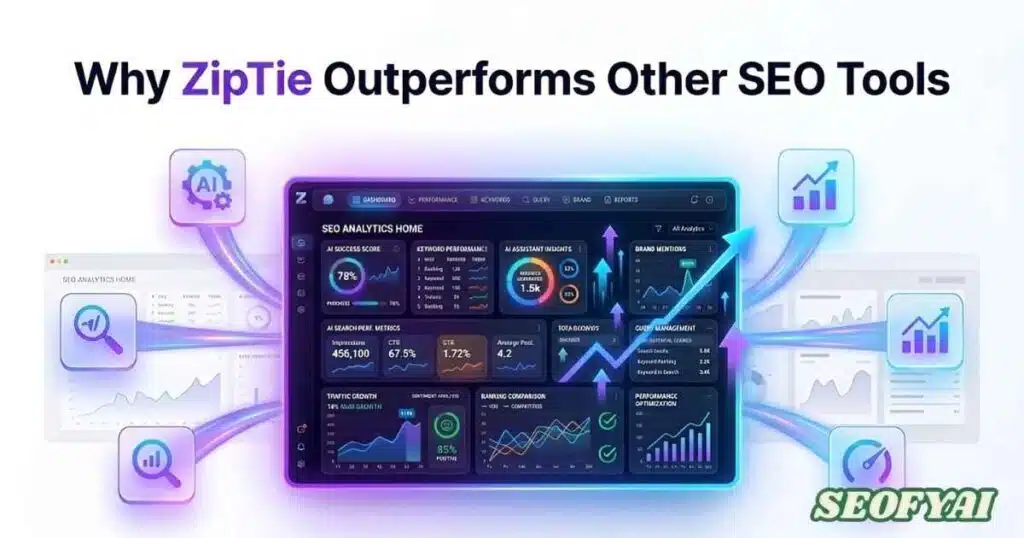
AI Success Score. ZipTie’s proprietary composite metric blends mention frequency, citation presence, answer placement, and sentiment into a single per-query score, weighted by engine and region — used to triage which queries to fix first.
Indexation audits. ZipTie flags pages that AI bots can’t reach — rendering issues, blocked resources, missing structured data — before you optimize copy that would never be cited. Few competing AI-visibility tools go this deep technically.
Content optimization briefs. The standout module. Where most tools show a dashboard and stop, ZipTie produces page-specific improvement briefs — flagging, for instance, that a paragraph needs a statistical claim or that a key entity is missing from an introduction. This bridges the gap between diagnosis and fix.
Query generation and GSC import. Connect a Google Search Console property (read-only) and ZipTie pulls your clicks and impressions alongside AI visibility data, then auto-suggests prompts drawn from queries you already rank for.
Exports, sharing, API. CSV, Excel, and PDF exports plus public share links that need no account. A $10/month add-on exposes prompts, responses, mentions, citations, and sentiment via REST API and Model Context Protocol.
Paid add-ons. UGC Impact Analysis maps which third-party platforms (Reddit threads, YouTube videos) AI engines actually cite when describing you; Content Generation drafts AI-search-optimized briefs and finished pieces with a built-in fact-check loop.
How much does ZipTie cost in 2026?
ZipTie recently replaced its old fixed tiers with a usage-based configurator — ignore articles still quoting the old Basic/Standard/Pro prices. The current model charges for the prompts you monitor, how often they run, and how many engines run them: roughly $0.01 per prompt per engine per check, or about $0.0087 per check when run across all seven engines. Published worked examples:
| Setup example | Estimated monthly cost | Best for |
|---|---|---|
| 50 daily, 300 weekly, 1,000 monthly prompts, all 7 engines | $230.95/mo | In-house brand teams |
| Ten clients at 50 weekly prompts each, all 7 engines | $130.72/mo | Agencies |
| 1,000 monthly prompts, all 7 engines | $61.00/mo | Long-tail monitoring |
Longer billing periods discount the prompt subtotal (3 months: 5%, 6 months: 10%, annual: 20%). Seats, projects, and competitors are unlimited with no per-user charge; GSC connection, exports, and share links never appear on the invoice. There are no credit packs, top-ups, or overage charges. The 7-day free trial covers ChatGPT, Google AI Overviews, and Copilot with 25 daily prompts — no credit card required.

What are the pros and cons of ZipTie?
Where ZipTie is strong
- Browser-based accuracy: real browser sessions give more trustworthy Google AI Overviews data than API-only competitors.
- Optimization, not just monitoring: page-specific content briefs close the loop from diagnosis to fix.
- Technical depth: indexation audits for AI crawlers are rare in this category and genuinely useful.
- Cheap focused setups: the configurator makes small tracking projects affordable (~$61/month example).
- Unlimited seats and projects: agencies add clients without per-seat penalties.
Known limitations
- Specialist, not suite: no backlinks, keyword rankings, or technical SEO audits — you still need a traditional platform alongside it.
- Thin formal reviews: no G2 or Trustpilot profiles yet; validation comes from community threads and independent reviews.
- No white-label reports: exports carry ZipTie branding, which some agencies dislike.
- Coverage ceiling: seven engines is solid, but teams whose audiences use Grok, Meta AI, or DeepSeek heavily will find broader coverage in enterprise alternatives.
Who should use ZipTie AI search performance tool?
ZipTie fits technical SEO teams, agencies, and mid-market companies treating AI visibility as an extension of existing search work. It’s also practical for publishers and e-commerce brands whose recommendations increasingly happen inside conversational answers — pair measurement with a traffic playbook like how to drive website traffic from ChatGPT for both metrics and tactics. It’s a weaker fit if you need bundled traditional SEO features or white-labeled client reports.
How do you get started with ZipTie?
- Start the 7-day trial. No card required; 25 daily prompts across ChatGPT, Google AI Overviews, and Copilot. Trial it on commercial-intent prompts first — “best [category] tool,” “[your brand] vs [competitor]” — where AI answers most directly influence revenue.
- Connect Google Search Console. The query generator seeds prompts from searches you already rank for — monitoring with real traffic potential.
- Sort by AI Success Score. Your lowest-scoring high-traffic queries are the first optimization targets.
- Act on the content briefs. Add statistics, clearer entity mentions, direct answers — then watch scores move on the next refresh.
- Expand deliberately. Add weekly/monthly cadences and the remaining engines once the core workflow proves its value.

Conclusion: is ZipTie worth it?
Why choose ZipTie AI search performance tool comes down to one calculation: if a meaningful share of your customers now discover products through AI-generated answers, flying blind on that surface is the expensive option. ZipTie offers honest measurement via browser-based capture, a useful scoring system, and tells you what to fix on your pages — with a no-card trial to verify data quality on your own brand first. Keep your traditional SEO stack for rankings and links; add ZipTie for the conversational layer those tools can’t see.
Frequently Asked Questions
What is ZipTie AI search performance tool?
ZipTie is an AI search visibility platform built by the founders of technical SEO agency Onely. It tracks how your brand appears inside AI-generated answers across ChatGPT, Google AI Overviews, Copilot, Perplexity, Google AI Mode, Bing AI Overview, and Gemini — scoring each query with its proprietary AI Success Score.
How much does the ZipTie AI search performance tool cost?
ZipTie uses usage-based pricing: about $0.01 per prompt per engine per check, based on prompt volume, refresh frequency, and engine coverage. Worked examples range from ~$61/month to ~$231/month, with annual billing saving 20%. A 7-day free trial requires no credit card.
What does the ZipTie AI Success Score measure?
The AI Success Score blends mention frequency, citation presence, answer placement, and sentiment into one per-query score, weighted by engine and region. It ranks queries by optimization priority so you focus on the prompts with the most realistic upside first.
Does ZipTie replace traditional SEO tools like Ahrefs or Semrush?
No. ZipTie is a specialist that measures visibility inside AI-generated answers — a surface traditional rank trackers don’t monitor. Most teams run it alongside a traditional SEO platform: one for blue-link rankings and links, one for the conversational AI layer.
Which AI engines does ZipTie monitor?
Seven: ChatGPT, Google AI Overviews, Microsoft Copilot, Perplexity, Google AI Mode, Bing AI Overview, and Google Gemini. The free trial covers the first three; the other four unlock on a paid plan. This is broader coverage than ZipTie offered in earlier versions of the product.
Is there a free trial of the ZipTie AI search performance tool?
Yes — a 7-day free trial with 25 daily prompts across ChatGPT, Google AI Overviews, and Microsoft Copilot. No credit card is required at signup, and the trial doesn’t auto-convert to a paid plan, so you can test it risk-free.

Abdul Manan is a professional SEO content creator and AI-SEO strategist at seofyai.com. He specializes in helping businesses rank higher on Google through AI-powered, data-driven content optimization. Connect on LinkedIn or visit seofyai.com for expert SEO tips.