
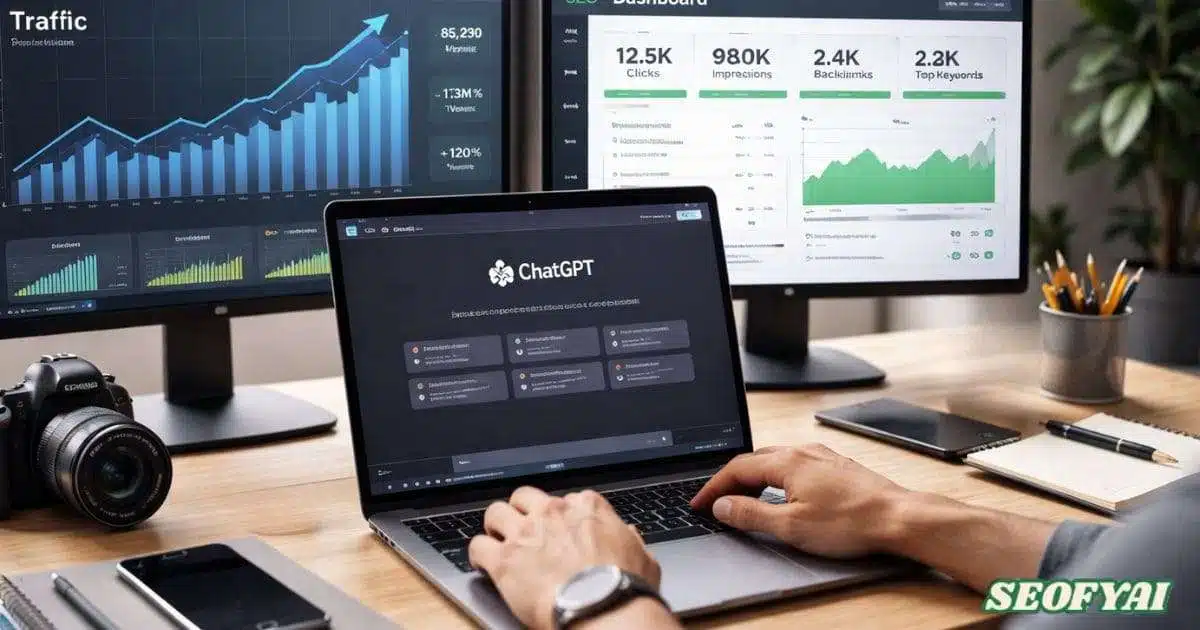
Short answer: Yes — here’s how to drive website traffic from ChatGPT. When its web search cites your page, it attaches a clickable source link, and those clicks arrive as chatgpt.com referrals. Winning citations is concrete: let OpenAI’s search crawler reach your pages, get indexed in Bing, answer real questions, and publish quotable content.
OpenAI confirmed in September 2026 that its products reach more than one billion weekly active users — every session a moment where ChatGPT decides whose website to mention. Here’s how that decision works and what you can do about it.
How Does ChatGPT Actually Send Visitors to Your Site?
Traffic from ChatGPT arrives through one mechanism: clickable source links inside AI-generated answers. When ChatGPT runs a web search, it pulls from live pages, synthesizes an answer, and attaches citations — and readers wanting the full detail click through.
Not every answer includes links — many come from the model’s training knowledge with no browsing. Live citations appear only when a question needs current or specific information, so your traffic comes from the search-with-citations side of ChatGPT, not from the model “knowing” your brand. ChatGPT’s live search also leans heavily on the Bing index: citation analyses show high overlap between its cited sources and top Bing results, so Bing indexation is a prerequisite. Clicks typically carry a utm_source=chatgpt.com tag and appear in GA4 as chatgpt.com / referral.
What Does It Take to Drive Website Traffic from ChatGPT?
No signup form and no ad platform buy your way in — citation eligibility is earned through accessibility, clarity, and reputation. These six moves are what work.
1. Let the right crawler in — and stop blocking it by accident
OpenAI documents three crawlers with different jobs: GPTBot (model training), OAI-SearchBot (surfacing pages in ChatGPT search results), and ChatGPT-User (fetching a page only after a user asks ChatGPT to visit it). Opting out of OAI-SearchBot removes you from ChatGPT search answers; blocking GPTBot only affects training data.
This is where sites kill their own traffic: a blanket Disallow: / under a wildcard User-agent: * can block OAI-SearchBot too, and CDN or WAF bot presets sometimes drop it before robots.txt is consulted. Allow OAI-SearchBot explicitly, check for conflicting wildcard rules, and verify key pages are indexed in Bing Webmaster Tools. Allowing GPTBot (training) is separate and not required for citations.
2. Answer one question per section, starting with the answer
ChatGPT extracts short, self-contained spans — not whole pages. Cited pages open each section with a direct 40–60 word answer to the section’s question, before any background. Phrase headings as questions, and name entities explicitly: “ChatGPT Search relies on the Bing index” is extractable; “it relies on their index” is not.
3. Publish things worth quoting
ChatGPT cites pages that give it something a generic summary can’t: specific numbers, step-by-step procedures, comparison tables, original data. A pricing table, a checklist, or a five-tool comparison are exactly the artifacts an AI reaches for when answering “which tool is best?” Keep one statistics page updated twice a year with dated figures and named sources. When you optimize content for readers first, quotability follows: the specificity that earns backlinks in classic SEO earns citations in AI answers.
Illustrative example: a small invoicing app publishing a dated price comparison against three competitors gives ChatGPT exactly the data every “which invoicing tool is cheapest?” question needs. Hypothetical, not a case study.
4. Get your brand mentioned across the web
AI systems learn which players matter from the open web: review sites, forums, comparison articles, news coverage. A brand appearing consistently across Reddit threads, product roundups, and expert lists is far easier for ChatGPT to recommend than one existing only on its own domain.
Practically, this is digital PR aimed at being listed and discussed: get into the comparison articles in your category, contribute genuinely in relevant communities, and publish data or rankings that bloggers pick up.
5. Use structure that machines can parse
Clean HTML with real headings, short paragraphs, lists, and tables gets extracted accurately. Add Article and FAQPage schema so the structure is unambiguous. Don’t hide key content behind JavaScript that only renders in a browser — OpenAI’s search crawlers see the raw page, and content needing full client-side rendering may be skipped.
6. Skip the low-return side quests
Custom GPTs sound promising but the GPT Store has weak discovery — nobody finds one without you driving the audience yourself. Build one only if you already have distribution. The llms.txt file (a markdown site summary for AI agents) is a reasonable developer convenience, but there is no evidence it earns citations in consumer ChatGPT search. Prioritize robots.txt and Bing indexation first.
How to Drive Website Traffic from ChatGPT: Measuring Results in GA4
In GA4, go to Reports → Acquisition → Traffic acquisition, switch the primary dimension to Session source / medium, and search for “chatgpt”. You’ll see chatgpt.com / referral (clicks from cited answers). Add Landing page + query string as a secondary dimension to see which pages ChatGPT recommends — then strengthen them, because citations snowball.
Expect undercounting: some clicks arrive without referrer data, so GA4 files them under Direct or Unassigned — your true volume is higher than the referral row shows. Use GA4’s “AI Assistant” channel plus a custom channel group for AI sources, and pair it with one of the best ChatGPT rank tracker tools so you watch both the traffic arriving and the citations producing it.
Is the traffic worth having? Early data says yes: Adobe Analytics data reported in June 2026 found visitors arriving at US retail sites from AI sources converted at a 54% higher rate than average, with AI-driven traffic to those retailers up 393% year over year in Q1 2026. Retail-specific figures — but the pattern is clear: AI-referred visitors arrive with intent already formed.
Mistakes That Keep Sites Out of ChatGPT Answers
- Blocking everything in robots.txt. A wildcard Disallow meant for training crawlers can also block OAI-SearchBot. Scope blocks to individual user-agents.
- Ignoring Bing. No Bing indexation means ChatGPT search has little to cite. Bing Webmaster Tools is not optional here.
- JavaScript-only content. Key text that renders only after heavy client-side JavaScript may be read as an empty shell. Server-render what you want cited.
- Burying the answer. Paragraphs of throat-clearing give ChatGPT nothing extractable. Lead with the answer, then explain.
- Content nobody would quote. Generic advice with no numbers, steps, or examples has no citation value.
- Expecting Search Console data. Google Search Console shows nothing about ChatGPT visibility. Use GA4 referrals plus a brand-mention tracker.
What Comes Next for ChatGPT-Driven Traffic

The direction is clear: more answers, fewer clicks overall — but higher-intent clicks for cited sources. The publishers who win are those whose pages are machine-readable, fact-dense, and widely referenced. Most sites haven’t done any of this yet, so early movers compound.
Conclusion
To drive website traffic from ChatGPT, think like a citation, not like a ranking. Make pages reachable to OAI-SearchBot and indexed in Bing, open each section with a direct answer, publish facts worth quoting, and build the off-site mentions that establish your brand.
Frequently Asked Questions
Can you drive website traffic from ChatGPT for free?
Yes. Citations in ChatGPT answers are earned, not bought — no ad product places your link in AI responses. The cost is editorial and technical work: crawler access, Bing indexation, quotable content, and brand mentions. A small site can win citations with one excellent, fact-dense page.
How long does it take to drive website traffic from ChatGPT?
Expect weeks to a few months. Pages must be crawled by OAI-SearchBot and indexed in Bing before ChatGPT can cite them; established, well-linked content with direct answers gets picked up fastest. Track chatgpt.com referrals weekly in GA4 to spot traction.
Why does my ChatGPT traffic show as Direct in GA4?
Some ChatGPT clicks arrive without referrer data, so GA4 files them under Direct or Unassigned. Your true ChatGPT traffic is higher than the referral row shows, and a custom channel group covering chatgpt.com only partly closes the gap — treat referral counts as a floor.
Does traffic from ChatGPT help Google rankings?
No confirmed evidence links ChatGPT referral traffic to better Google rankings. Treat it as its own channel with its own metrics: referral sessions, engagement, and conversions from chatgpt.com. It may help indirectly if visitors link to you or search your brand later.
Do I need to allow GPTBot to get traffic from ChatGPT?
No. GPTBot crawls for model training; OAI-SearchBot is the crawler that makes pages eligible for ChatGPT search citations, per OpenAI’s documentation. You can disallow GPTBot while allowing OAI-SearchBot and still appear in ChatGPT answers — just never block OAI-SearchBot with a wildcard robots.txt rule.
Which pages get the most traffic from ChatGPT?
Pages answering specific questions with extractable facts: pricing tables, step-by-step how-tos, comparison tables, statistics pages, and clear definitions. In GA4, check where your chatgpt.com referrals land — the pages ChatGPT already cites are your templates for what to build next.

Abdul Manan is a professional SEO content creator and AI-SEO strategist at seofyai.com. He specializes in helping businesses rank higher on Google through AI-powered, data-driven content optimization. Connect on LinkedIn or visit seofyai.com for expert SEO tips.