

If you want to know whether your brand shows up inside Microsoft Copilot’s answers, five tools do that job better than anything else in 2026: Scrunch AI (best all-rounder), Otterly.AI (best for small budgets), Profound (best for enterprise), Ahrefs Brand Radar (best for teams already inside Ahrefs), and Peec AI (best for agencies). They track brand mentions, citations, and share of voice across Copilot responses — the metrics that matter now that answers, not blue links, are the product.
Copilot changed what “ranking” means. People ask one question and trust the generated answer. If your brand isn’t named or cited, you don’t lose a position — you lose the whole opportunity, silently. Copilot rank tracking tools fix that blind spot by running real prompts against Copilot on a schedule, recording the answers, and showing where you stand versus competitors. For a companion view, our guide to AI ranking tools covers the same AI-visibility category from the Grok side.
Why Copilot visibility deserves its own tracker
Microsoft has wired Copilot into Bing, Edge, the Windows taskbar, and Microsoft 365 apps like Word and Teams. A traditional rank tracker reporting “position 4 on Bing” says almost nothing about whether Copilot recommended you to a buyer mid-meeting.
A Copilot tracker measures three things: brand mentions (did Copilot name you?), citations (did it link one of your pages as a source?), and share of voice (how often are you mentioned versus competitors?). Being mentioned without being cited is an awareness gap; being cited inaccurately is a messaging gap — and the fixes are completely different.
One honest caveat. Much Copilot usage happens inside private Microsoft 365 tenants no external tool can observe, so every vendor’s numbers are estimates from sampled public-surface prompts. Treat weekly wiggles as noise; watch direction and gaps. Independent 2026 comparisons agree: Copilot tracking is a survey instrument, not a security camera.
How Copilot rank tracking tools work
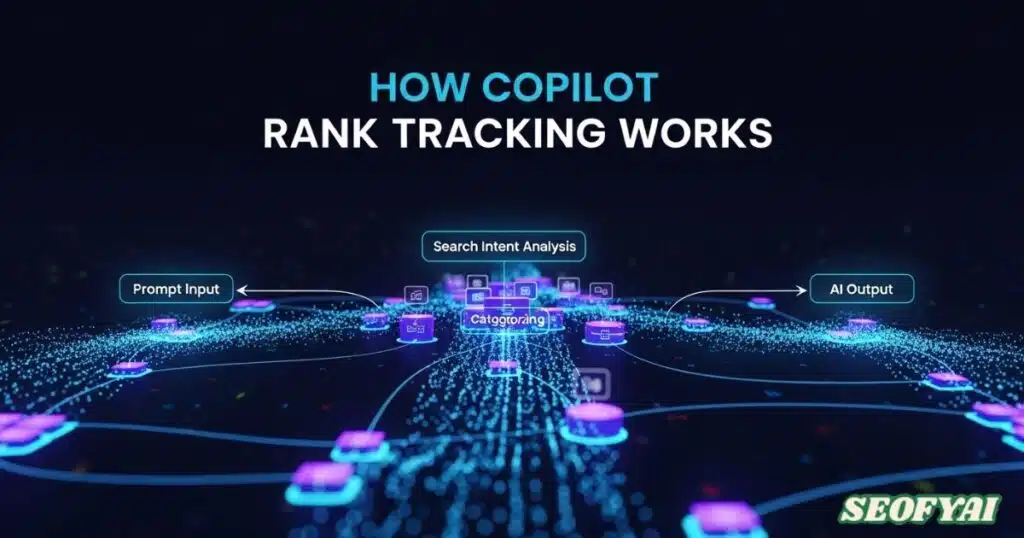
You define 30 to 150 prompts — real buyer questions, not keywords. The tool runs them against Copilot’s public surface on a schedule, captures the answers, and parses them for brand names, cited domains, and sentiment. Over weeks, that builds a trend line: are you appearing more or less often, and in what tone?
Better platforms add source intelligence — which third-party domains Copilot cites for your category, revealing why a rival wins citations — and recommendations that turn gaps into content briefs. None of this replaces a free baseline: Bing Webmaster Tools includes a free AI performance report showing which of your pages Copilot and Bing AI summaries cite. Run that first; it’s first-party data and costs nothing.
The 5 best Copilot rank tracking tools, ranked for 2026
Every tool below was checked against vendor pricing and at least two independent 2026 comparisons. All five genuinely track Microsoft Copilot.
1. Scrunch AI — best all-rounder
The Core plan at $250/month tracks 125 prompts across ChatGPT, Perplexity, Google AI Overviews, and Copilot, with 5 monthly site audits, 5 seats, and a 7-day trial needing no credit card. Refreshes run daily for two weeks, then roughly every 72 hours. Sitecore acquired Scrunch in June 2026 for a reported ~$225M; it runs standalone with 500+ brand customers including Lenovo and Penn State.
2. Otterly.AI — best for small budgets
Lite starts at $29/month and tracks ChatGPT, AI Overviews, Perplexity, and Copilot on all base plans — Copilot isn’t gated behind a premium tier. Weekly refreshes suit baseline-building. The GEO Audit module checks your site’s AI-readiness (structured data, parsability, entity signals) and returns prioritized fixes instead of raw dashboards. Nothing else credible touches this price.
3. Profound — best for enterprise
The category’s unicorn — $96M Series C at a $1B valuation, clients including Target, Walmart, Figma, and MongoDB. Enterprise tracks up to nine answer engines including Copilot, with SOC 2/HIPAA compliance and SSO. The catch: Starter ($99/month) covers ChatGPT only; Growth is $399/month; Copilot sits on custom-priced Enterprise. The standard when compliance and daily multi-market data are non-negotiable.
4. Ahrefs Brand Radar — best for teams already in Ahrefs
An index of 400M+ search-backed prompts across seven AI surfaces — AI Overviews, AI Mode, ChatGPT, Perplexity, Gemini, Copilot, Grok — lets you look up any brand’s mentions, citations, and share of voice instantly, even retroactively. It’s an add-on at $199/month per platform, or $699/month for all platforms with 2,500 custom prompt checks. The chatbot indexes refresh monthly: superb for research, weaker as a week-over-week monitor without paid custom prompts.
5. Peec AI — best for agencies
From around €89/month, Peec tracks prompts daily across six engines including Copilot, in 115+ languages, with unlimited seats and shareable client workspaces. Breadth per euro is the pitch: daily runs, prompt-level mention data, and competitor comparisons on all six engines with no per-seat pricing. The most practical pick for multi-client Copilot reporting.
Comparison table of the top Copilot rank trackers
| Tool | Best for | Copilot tracking | Starting price | Refresh |
|---|---|---|---|---|
| Scrunch AI | All-round AI visibility | Yes, on Core | $250/mo | Daily, then ~72h |
| Otterly.AI | Small budgets, first audits | Yes, base plans | $29/mo | Weekly |
| Profound | Enterprise, compliance | Yes, Enterprise tier | $99/mo (Copilot on Enterprise) | Daily |
| Ahrefs Brand Radar | Existing Ahrefs users | Yes, index + custom prompts | $199/mo add-on + base plan | Monthly |
| Peec AI | Agencies, multi-client | Yes | ~€89/mo | Daily |
Key features to look for in a Copilot rank tracker
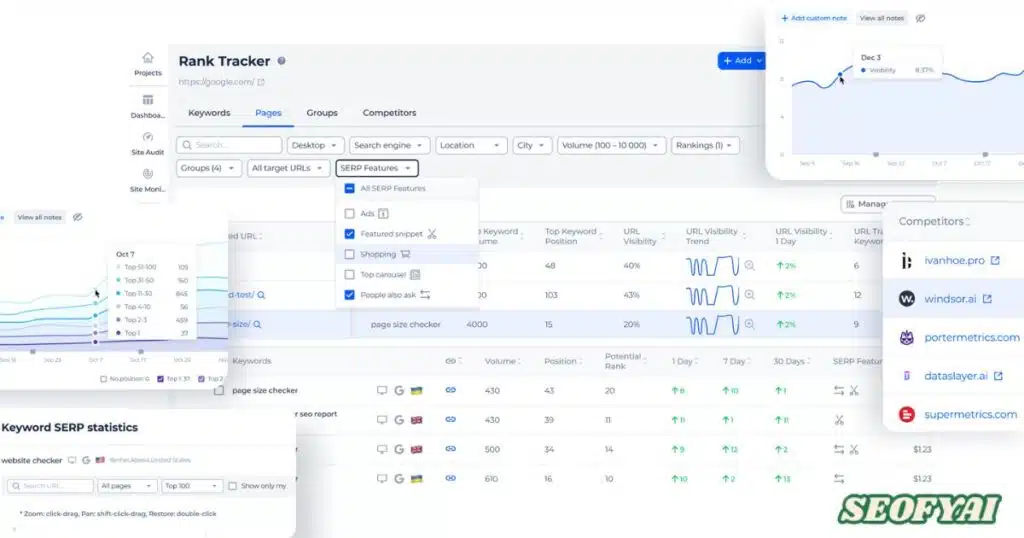
Confirm genuine Copilot coverage on the plan you’d actually buy — several tools advertise “AI tracking” but only cover ChatGPT and Perplexity. Demand mention vs. citation separation: one merged “visibility score” hides whether you need PR (awareness gap) or clearer content and schema (extractability gap). Also worth paying for: sentiment analysis (are you “the leader” or “the budget option”?), competitor benchmarking on the same prompts, source intelligence, and prompt research surfacing the questions buyers actually ask.
How to choose the right Copilot rank tracking tool
Under $100/month, Otterly’s $29 Lite plan is the only serious option — run 30 real buyer questions for a month before buying anything pricier. Mid-market teams wanting Copilot plus ChatGPT, Perplexity, and AI Overviews with audit depth get the most from Scrunch’s $250 Core plan. Profound fits when compliance, daily data, and multi-market coverage are non-negotiable. Ahrefs Brand Radar fits teams that already pay for Ahrefs and mostly need research. Agencies should default to Peec AI. And before trusting any dashboard, spot-check it by manually running a few prompts in Copilot yourself.
Copilot SEO optimization strategies that earn citations
Tracking is the diagnosis; these are the treatments. Answer one question per section, directly, in the first two sentences — Copilot lifts quotable passages. Strengthen entity signals: keep names and facts identical across your site, LinkedIn, Crunchbase, and review profiles. Get cited by the sites Copilot already cites: your tracker’s source reports show which third-party domains appear in your category’s answers — a presence there moves the needle more than another post on your own domain. Fix the technical basics: unblock AI crawlers where appropriate, ship clean structured data, and server-render JavaScript-heavy pages.
Common mistakes to avoid in Copilot rank tracking
Tracking keywords instead of questions: Copilot answers “which CRM is easiest for a 10-person sales team?”, and the winners often differ from the winners of “best CRM software”. Obsessing over weekly noise: compare four-week averages, since answers vary between runs. Buying the tool before fixing the basics: no tracker compensates for a site crawlers can’t parse. And ignoring sentiment: being named in an answer that calls you “the cheap option with poor support” is worse than not appearing at all.
Conclusion
The best Copilot rank tracking tools in 2026 answer one question: does Microsoft’s AI name and cite your brand when buyers ask? Scrunch AI is the strongest all-rounder, Otterly.AI the smartest budget start, Profound the enterprise standard, Ahrefs Brand Radar the natural pick for Ahrefs households, and Peec AI the agency workhorse. Baseline 30 real buyer questions with Bing Webmaster Tools’ free AI performance report, then track them through a rank tracking tool Copilot supports natively. The brands winning Copilot citations aren’t guessing — they’re measuring.
Frequently asked questions
What is the best Copilot rank tracking tool in 2026?
The best Copilot rank tracking tool depends on budget and team size. Scrunch AI ($250/month) is the best all-rounder with Copilot on its Core plan. Otterly.AI ($29/month) is the best budget pick, Profound the best enterprise option, and Ahrefs Brand Radar the best choice if your team already uses Ahrefs.
How do Copilot rank tracking tools work?
Copilot rank tracking tools run buyer questions against Copilot’s public surface on a schedule, capture the answers, and record whether your brand is named, cited, or described positively. Over weeks, that polling builds trend lines for mentions, citation frequency, and share of voice versus competitors.
How much do Copilot rank tracking tools cost?
Prices range from $29/month (Otterly.AI Lite) to $250/month (Scrunch AI Core) to enterprise custom pricing (Profound). Ahrefs Brand Radar is a $199/month-per-platform add-on. Bing Webmaster Tools shows Copilot citations for free, and AthenaHQ offers a free credit tier.
Can I track my brand’s Copilot visibility for free?
Partially. Bing Webmaster Tools includes a free AI performance report showing which of your pages Copilot and Bing AI summaries cite, and for which queries. AthenaHQ offers a free Essential tier with limited credits. But scheduled prompt tracking, competitor benchmarking, and trend history require a paid Copilot rank tracking tool.
Are Copilot rank tracking tools accurate?
They’re directionally accurate, not precise. Copilot’s answers vary between runs, and much usage happens inside private Microsoft 365 tenants no tool can observe. Treat single-week numbers as estimates, compare four-week averages, and spot-check by manually running a few prompts in Copilot before making big decisions.

Abdul Manan is a professional SEO content creator and AI-SEO strategist at seofyai.com. He specializes in helping businesses rank higher on Google through AI-powered, data-driven content optimization. Connect on LinkedIn or visit seofyai.com for expert SEO tips.